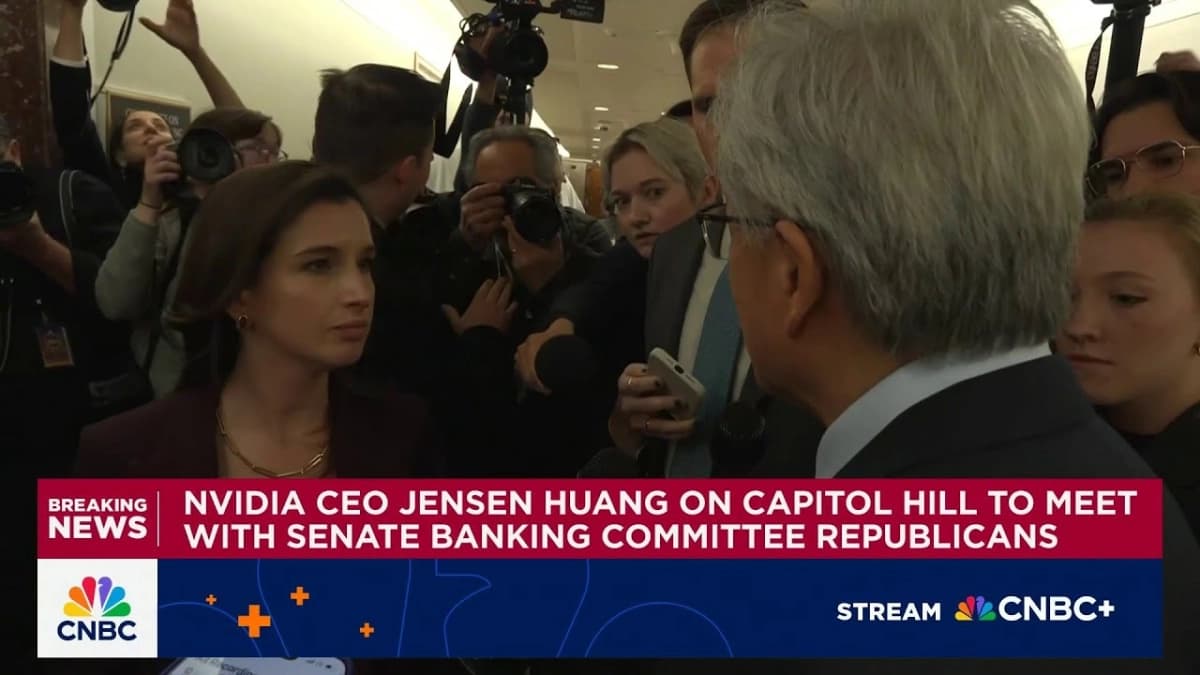
Nvidia CEO Jensen Huang, speaking on Capitol Hill, delivered a stark warning regarding the future of artificial intelligence in the United States: piecemeal state-by-state regulation would be catastrophic. He articulated a clear preference for a unified federal approach, arguing that anything less would severely impede American innovation and global competitiveness in a critical technological domain.
Huang spoke with CNBC's Emily Wilkins and other reporters outside his meeting with Senate Banking Committee Republicans, primarily addressing the complex interplay between AI innovation, national security, and the imperative of maintaining American technological leadership in the face of global competition, particularly from China. His remarks provided a candid glimpse into the tech industry's perspective on the burgeoning regulatory discussions surrounding artificial intelligence.
His primary concern centered on the fragmented regulatory landscape emerging across the United States. Huang stated unequivocally that "state-by-state AI regulation would drag this industry into a halt." This perspective is rooted in the inherent global nature of AI development and deployment. A patchwork of diverse regulations across individual states would create an administrative nightmare for companies operating nationwide, diverting resources from research and development towards compliance with potentially conflicting mandates. Such an environment would stifle the rapid iteration and scaling necessary for AI advancement, risking the nation's technological edge.
Furthermore, Huang suggested that inconsistent state-level regulations could inadvertently create national security vulnerabilities. He believes that by slowing down the domestic AI industry, the United States could fall behind other nations, thus compromising its ability to leverage AI for defense and intelligence purposes. A unified federal framework, conversely, would provide clarity and predictability, fostering an environment where innovation can thrive while simultaneously addressing legitimate concerns around safety, ethics, and national security. This approach would allow the industry to accelerate its advancements, securing the nation’s technological future.
The discussion inevitably turned to export controls on advanced chips, particularly those bound for China. Huang acknowledged the validity of concerns regarding advanced chips potentially aiding adversaries. "Of course there is," Huang affirmed when asked about chips going to China, reflecting the geopolitical tensions and the dual-use nature of cutting-edge technology. However, he quickly pivoted to emphasize that China already possesses significant chip manufacturing capabilities. He pointed out that "China makes plenty of chips and their military has plenty of ample chips... to build whatever they need." This suggests that simply withholding advanced chips from China might not achieve the desired strategic effect, as China could either produce its own or procure them from other sources.
Huang’s message to policymakers was clear: the goal should be to ensure America remains at the forefront of AI innovation, rather than solely focusing on restrictions that could backfire. He stressed the importance of the United States maintaining its technological lead and the industry's role in achieving this. Nvidia, alongside other American tech giants like Microsoft, AWS, Google, and Meta, is actively developing and launching the "latest generation, our most advanced technology with American companies first." This collaborative ecosystem, he argued, is the natural engine for US leadership.
Related Reading
- Nvidia CEO Jensen Huang Declares AI a Foundational Platform Shift Beyond Chatbots
- AI's Shifting Moat: From Models to Infrastructure and Commoditization
- Fed's Restrictive Hand on an AI-Driven Economy
A critical nuance in Huang's stance on export controls was his warning against "degrading chips that we sell to China." He emphatically stated, "They won't accept that. There's a reason why they won't accept that." This insight highlights a practical reality: if the US offers significantly less capable versions of its advanced chips, China would simply refuse them and intensify efforts to develop superior domestic alternatives or turn to other global suppliers. Such a strategy, in Huang's view, would undermine the US's market presence and influence without genuinely hindering China's long-term AI ambitions. Instead, he advocates for offering "the most competitive chips we can to the Chinese market" within appropriate national security parameters, allowing American companies to continue to serve a global customer base and fund further innovation.
Ultimately, Huang’s commentary underscores a delicate balance: the imperative to protect national security interests through export controls must be harmonized with policies that foster a vibrant, innovative domestic AI industry. He believes that US technological leadership is best secured not just by limiting access to advanced technology, but by continually advancing it at an unprecedented pace, ensuring that America always has "the best technology at all times." This requires a thoughtful, unified regulatory approach that avoids fragmentation and empowers the industry to compete and lead on a global scale.