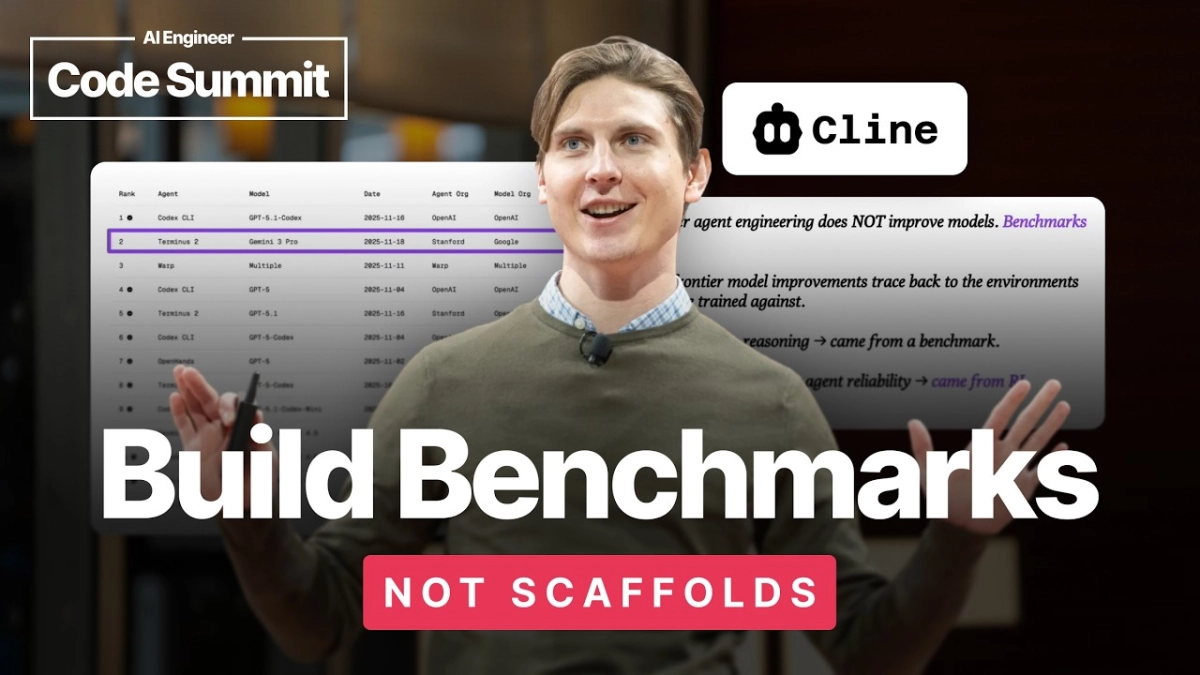
"Most of what’s written about AI agents sounds great in theory — until you try to make them work in production." This blunt assessment, delivered by Nik Pash, Head of AI at Cline, cuts through the prevailing optimism surrounding AI coding agents. Pash spoke with a representative from the AI industry, likely an interviewer or moderator at an unspecified event, to dissect the practical challenges and hard-won lessons learned from attempting to deploy these sophisticated tools at scale. The core of his message centers on a critical re-evaluation of what truly drives progress in this domain, moving beyond theoretical elegance to tangible, real-world effectiveness.
The seductive allure of complex architectural patterns like multi-agent orchestration, Retrieval Augmented Generation (RAG), and prompt stacking, Pash argues, often collapses under the weight of practical constraints. These sophisticated frameworks, while intellectually stimulating, frequently optimize for the wrong metrics. They can create an illusion of capability, but fail when confronted with the messy, unpredictable realities of production environments. Pash contends that the focus needs to shift from elaborate scaffolding to fundamental evaluation and environmental design.
Cline, a company deeply invested in building effective AI coding agents, has encountered these pitfalls firsthand. Pash shared insights into what failed and what ultimately survived within their development process. The key takeaway is that progress isn't driven by increasingly intricate theoretical constructs, but by rigorous, data-driven evaluation. As Pash stated, "They collapse under real-world constraints. Why? Because they optimize for the wrong thing." This highlights a fundamental misalignment between academic or theoretical pursuits and the demands of practical application.
A central insight Pash offered is the paramount importance of robust evaluation frameworks. Instead of focusing solely on building more complex agent architectures, the real leap forward will come from environments that accurately measure and demonstrably improve an agent's reasoning capabilities. This means moving beyond superficial benchmarks and developing metrics that truly reflect the agent's ability to solve complex, real-world coding problems. The emphasis is on empirical evidence of performance, not just theoretical potential.
This pragmatic approach necessitates a deep understanding of the operational environment in which these agents function. Pash alluded to the fact that successful agents are not built in a vacuum; they require carefully crafted environments that mimic production scenarios to allow for meaningful testing and iteration. This is where the true innovation lies – in creating sophisticated sandboxes that push agents to their limits and reveal their true strengths and weaknesses.
The current fascination with "clever scaffolds," as Pash terms them, is a distraction from the core challenge. These are the elaborate prompt chains, the intricate agent coordination mechanisms, that often mask underlying limitations. The real progress, he suggests, will be driven by a more fundamental understanding of how to measure and enhance AI reasoning. This shift in focus is crucial for anyone building or investing in AI agents.
The journey to effective AI coding agents is fraught with challenges, but also ripe with opportunity for those who can navigate the gap between theory and practice. Cline's experience underscores the necessity of a results-oriented approach, prioritizing measurable improvements in agent performance over theoretical sophistication. The path forward is paved with diligent evaluation and the creation of environments that foster genuine reasoning development.