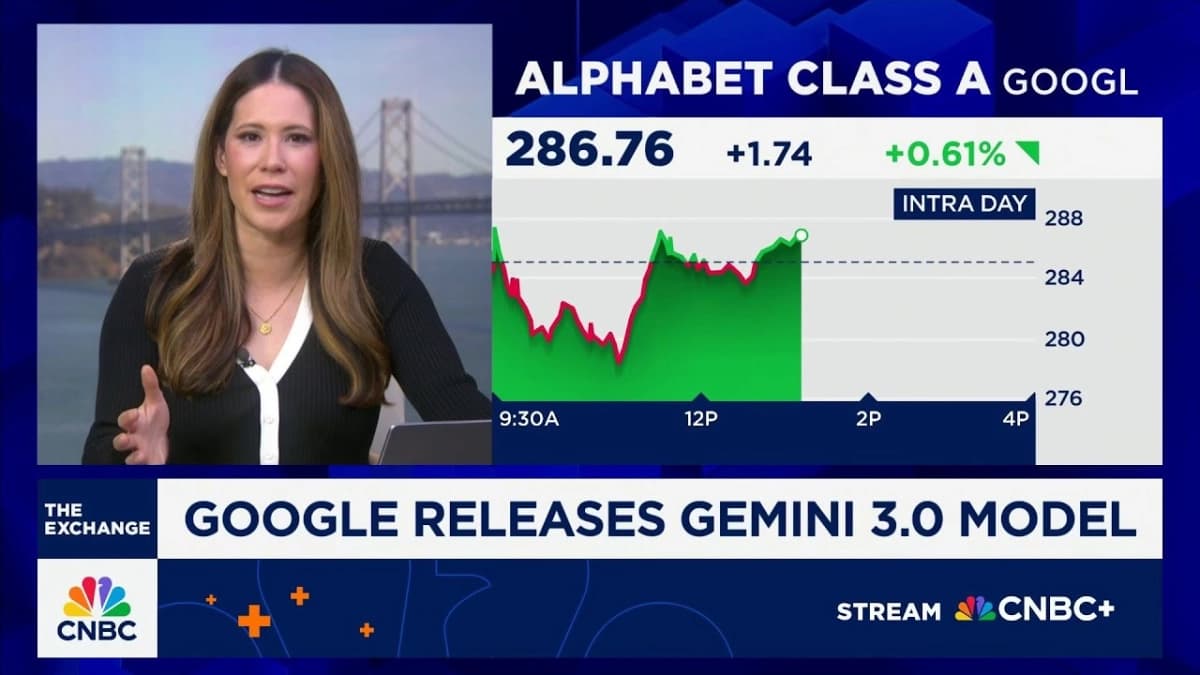
The "wall of worry" surrounding Google's position in the generative AI landscape appears to be rapidly eroding, replaced by a surge of "AI enthusiasm" that recently prompted Loop Capital to upgrade Alphabet's stock to a "buy." This renewed optimism, highlighted on CNBC's "The Exchange," centers squarely on the formidable capabilities and strategic integration of Google's latest large language model, Gemini 3.0. CNBC's Morgan Brennan and Deirdre Bosa discussed the implications of this release, alongside broader market dynamics and concerns.
The financial community's shift in perception signals a pivotal moment for Alphabet. Loop Capital's analysis explicitly stated that "search concerns are no longer valid" as Gemini's traffic share has reportedly doubled year-on-year. This burgeoning engagement underscores a critical insight: Google is effectively leveraging its immense user base and product ecosystem to drive AI adoption, embedding generative capabilities directly into the daily digital experience of millions.
Deirdre Bosa emphasized Gemini 3.0 as "another benchmark-topping model," but its true competitive edge stems from Google's deep, vertical integration. This encompasses everything from its custom Tensor Processing Units (TPUs) and foundational models to its robust cloud infrastructure. This full-stack approach allows for unparalleled efficiency in development and deployment, translating advanced AI capabilities into accessible features across Google's suite of products, making AI a default experience for a vast segment of its user base.
The rapid user acquisition for the Gemini app further illustrates this strategic success. Google CEO Sundar Pichai reported that the Gemini app now boasts 650 million monthly active users, a figure "slightly less than 700 million" that OpenAI's ChatGPT had reached in weekly active users as of August. This trajectory suggests Google is not just participating in the AI arms race but is rapidly closing the user gap, demonstrating its potent ability to scale AI applications across its existing platforms.
Despite the undeniable momentum and significant investment in AI, the market remains acutely aware of potential pitfalls. Bosa noted that the market is now tracking capital expenditure (CapEx) more closely than just raw model quality or user growth. Persistent concerns about rising debt and circular financing within the AI sector suggest a cautious undercurrent even amidst the excitement.
Sundar Pichai himself offered a sobering perspective, acknowledging that the "trillion-dollar AI boom has elements of irrationality." He delivered a pointed warning to the BBC, stating unequivocally that "no firm is immune if the bubble bursts." This candid assessment from a leading figure in AI development underscores the inherent risks and the need for sustainable, value-driven innovation rather than speculative hype.
Adding to Google's strategic advantages is the persistent chatter, though unconfirmed by the company, that Gemini 3.0 was developed using Google's custom TPUs. If true, this would be a "big moment," as Bosa described it, marking a significant leap in efficient AI inference and potentially positioning Google as a formidable competitor to established chip manufacturers like Nvidia. This internal hardware capability provides a critical layer of control and optimization, further enhancing Google's integrated AI ecosystem.
Ultimately, investors are "finally appreciating this deep integration that Google has from its chips, its TPUs to models, cloud ecosystem," a comprehensive strategy that underpins the Gemini launch. This holistic approach, from silicon to software, offers Google a distinct competitive advantage, enabling it to infuse advanced AI across its product portfolio and solidify its position in the evolving technological landscape. Alphabet's stock performance, significantly outpacing other major tech players like Microsoft, Meta, and Amazon, reflects this growing market recognition of its strategic depth and execution in the AI domain.