
• StartupHub.ai
    StartupHub.aiAI Intelligence
Discover
  • Home
  • Search
  • Trending
  • News
Intelligence
  • Market Analysis
  • Comparison
  • Market Map
Workspace
  • Email Validator
  • Pricing
Company
  • About
  • Editorial
  • Terms
  • Privacy
  • v1.0.0
  1. Home
  2. News
  3. Google Clouds Agent Development Kit Orchestrating Autonomous Ai
Back to News
Ai video

Google Cloud's Agent Development Kit: Orchestrating Autonomous AI

StartupHub.ai Staff
StartupHub.ai Staff
Dec 17, 2025 at 2:45 AM4 min read421
Google Cloud's Agent Development Kit: Orchestrating Autonomous AI

The promise of artificial intelligence has long extended beyond simple query-response systems to truly autonomous entities capable of complex reasoning and action. Annie Wang, an AI expert, articulated this vision succinctly when she stated, "An agent is essentially an LLM that can reason, act, and observe." This fundamental shift, from a static language model to a dynamic, goal-oriented system, was the core subject of a recent Google Cloud {Dev}cember livestream.

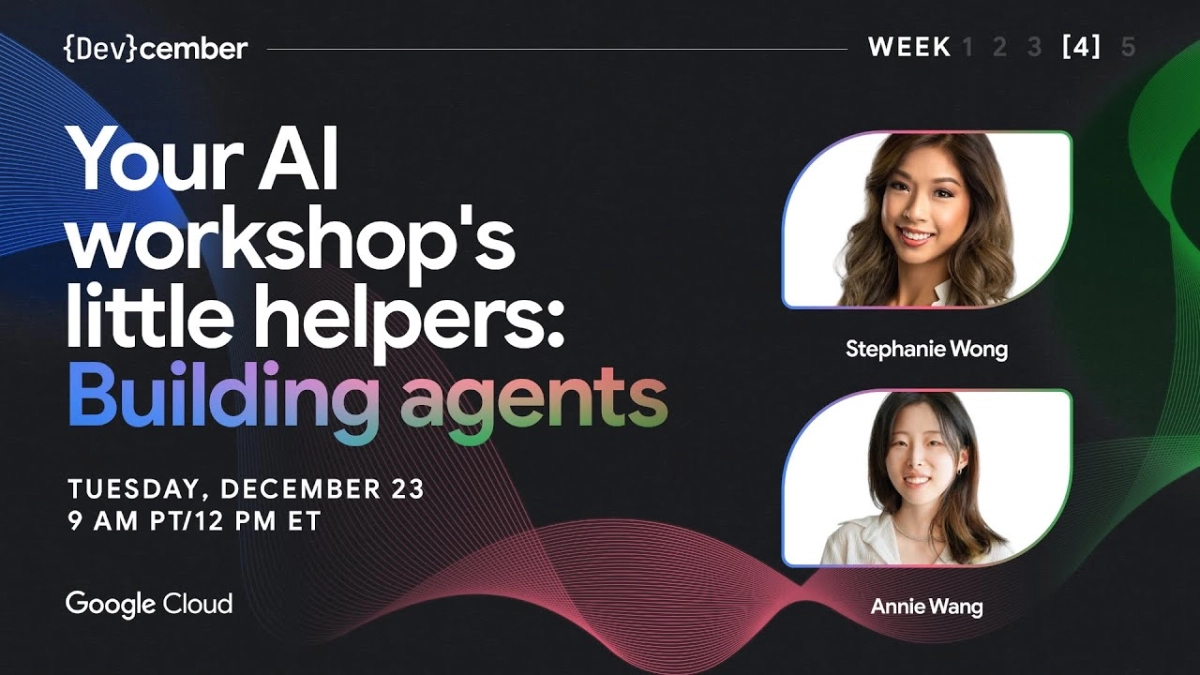
During the session, Annie Wang spoke with host Stephanie Wong at the #DEVcember event, detailing the intricacies of building AI agents, showcasing the Agent Development Kit (ADK), and demonstrating its integration with Vertex AI for deployment. Their discussion highlighted the critical evolution in AI development, moving beyond basic large language model (LLM) calls to sophisticated, multi-step workflows. This transition is paramount for enterprises seeking to embed AI into mission-critical operations, demanding reliability and explainability that single-turn interactions cannot provide.

The Agent Development Kit emerges as a pivotal tool in this new paradigm. It is not merely a collection of libraries but a structured framework designed to manage the inherent complexity of agentic systems. Historically, developers faced significant hurdles in orchestrating LLMs to perform sequences of actions, interact with external tools, and maintain state over time. The ADK addresses these challenges by providing a systematic approach to defining an agent's capabilities, its interaction patterns, and, crucially, its evaluation.


At its heart, an ADK-powered agent comprises several key components. It begins with a clear prompt, defining the agent's objective. This prompt guides the LLM to leverage a suite of "tools" – external functions or APIs that extend its capabilities beyond pure text generation. These tools could range from simple search queries to complex database interactions or even proprietary business logic. For instance, the demonstration illustrated an agent capable of analyzing a CSV file, writing SQL queries to extract insights, and then summarizing its findings – a multi-faceted task requiring both reasoning and tool utilization.

Memory is another vital aspect, allowing agents to retain context over longer interactions. The ADK facilitates both short-term memory, maintained within the LLM's context window, and long-term memory, often powered by vector databases, ensuring agents can recall past interactions or learned information. This capability is crucial for sustained engagement, enabling agents to handle ongoing customer service dialogues or lengthy data analysis projects without losing their train of thought.

Perhaps the most significant contribution of the ADK lies in its emphasis on robust evaluation. Building autonomous agents without a systematic way to measure their performance is akin to building software without testing. Annie Wang stressed this point, noting that the ADK provides "a systematic way to measure the performance of your agents." This includes defining test sets, running agents against these scenarios, and utilizing automated metrics alongside human-in-the-loop review to identify failures and drive iterative improvements. This structured evaluation process is indispensable for founders and VCs investing in AI solutions, as it underpins the reliability and trustworthiness of deployed agents, transforming experimental prototypes into production-ready applications.

The ADK also streamlines the deployment process through its tight integration with Google Cloud's Vertex AI. Vertex AI offers the necessary infrastructure for hosting agents, managing their lifecycle, scaling resources as demand fluctuates, and monitoring their performance in real-time. This end-to-end platform approach simplifies the journey from development to production, allowing businesses to rapidly iterate and deploy sophisticated AI agents without grappling with complex infrastructure management. The synergy between ADK and Vertex AI ensures that the agents built are not just intelligent but also scalable and maintainable in an enterprise environment.

The implications for various sectors are profound. In customer service, agents can handle more complex inquiries, reducing human workload. For data analysts, agents can automate tedious data extraction and preliminary analysis, freeing up time for deeper insights. For defense and intelligence analysts, agents could sift through vast amounts of unstructured data, identifying patterns and anomalies at speeds impossible for human teams. The ADK empowers developers to build these "little helpers," transforming abstract AI capabilities into tangible, high-impact business solutions.

The Agent Development Kit represents a significant step forward in making advanced AI accessible and manageable. It provides the necessary structure and tools to transition from conceptual AI power to practical, deployable intelligence, offering a clear pathway for organizations to leverage autonomous systems effectively.

#AI
#Artificial Intelligence
#Technology
#Your AI workshop's

AI Daily Digest

Get the most important AI news daily.

GoogleSequoiaOpenAIa16z
+40k readers