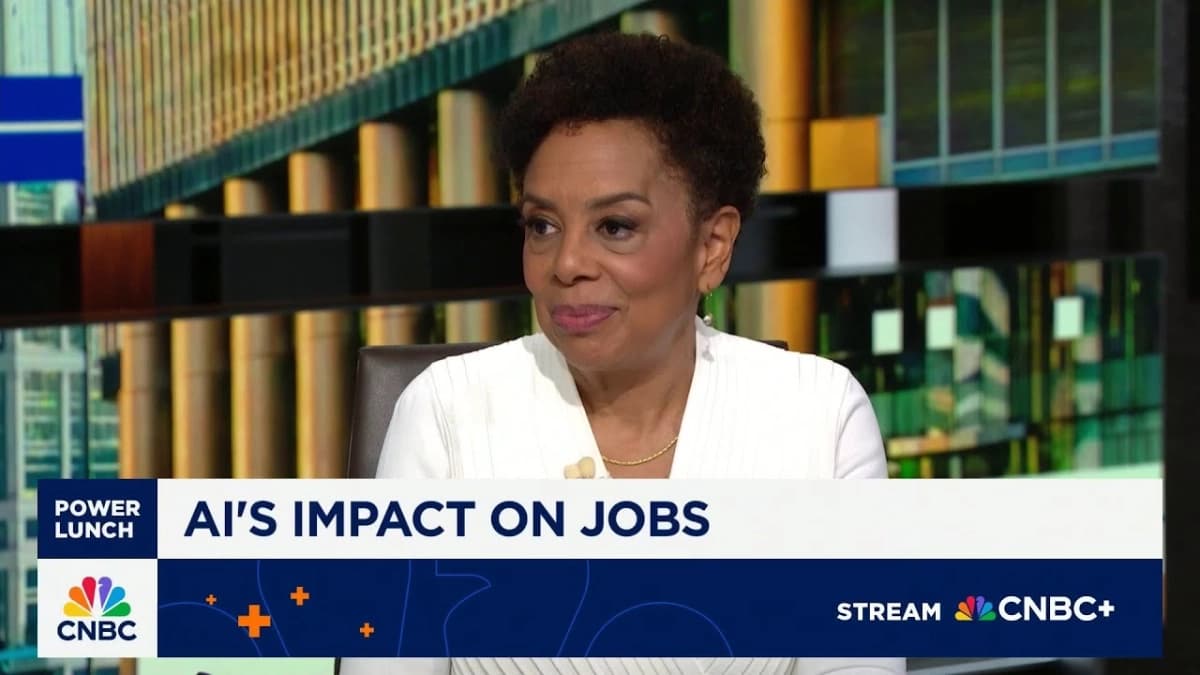
The prevailing sentiment among senior executives regarding artificial intelligence's immediate impact on jobs appears to be one of cautious observation, yet a seismic shift is anticipated just around the corner. While a significant portion currently reports minimal disruption, the overwhelming majority foresee substantial changes within the next year, signaling a critical window for strategic adaptation. This paradox, highlighted by recent CNBC research, underscores a potential underestimation of AI's current transformative power, even as its future influence becomes undeniable.
Sharon Epperson, CNBC's Senior Personal Finance Correspondent, reported on the findings of a survey conducted by the CNBC Workforce Executive Council, a group of senior executives from various organizations. Her discussion with the interviewer centered on the present and projected effects of AI on employment, efficiency, and innovation within the workplace. The survey data reveals a nuanced picture, challenging some common assumptions about AI's role in the modern economy.
Currently, a notable 22% of senior executives indicate that AI is having "no impact" on jobs. However, this figure dramatically shrinks when looking ahead. The survey projects that in the next 12 months, a staggering 89% of jobs will be impacted by AI, with nearly half (45%) expecting "half or more" of their jobs to be affected, and another 44% anticipating "less than half" to see changes. This rapid acceleration of perceived impact, from a quarter experiencing no change to only 11% expecting no change within a year, suggests that many organizations are bracing for an imminent and widespread transformation.
This impending shift is not primarily driven by a desire for immediate headcount reductions. When asked about AI's impact on headcount, the survey revealed that 38% of executives plan to "maintain headcount," while 28% expect to "increase headcount," and an equal 28% anticipate a "decrease headcount." This balanced distribution suggests that AI's initial wave is not universally perceived as a job-eliminating force.
Indeed, Sharon Epperson explicitly stated a crucial distinction: "When it comes to that reduction in headcount, it's not because of the efficiency of AI, they're saying it's because they need to control costs." This insight is vital for founders and VCs, indicating that while companies may be streamlining operations, AI is being viewed more as an enabler of efficiency and innovation rather than a direct tool for layoffs driven by its own capabilities. The focus, instead, is on broader economic pressures and strategic cost management.
The positive attributes of AI are clearly recognized by these leaders. A substantial 61% believe AI makes their companies "more efficient," and an even larger 78% credit AI with making their organizations "more innovative." These figures paint AI as a powerful catalyst for enhanced productivity and creative problem-solving, rather than solely a cost-cutting measure. The perceived benefits extend beyond simple automation, touching upon the very core of business growth and competitive advantage.
However, the path to realizing these benefits is not without its strategic challenges. A thoughtful approach to AI adoption is paramount, moving beyond the superficial allure of new technology. As Epperson articulated, "Don't just rush to buy the latest AI tool until understanding exactly how that's going to enhance your workforce because it has to be a human digital connection." This emphasizes the need for a deliberate integration strategy that prioritizes augmenting human capabilities and fostering a symbiotic relationship between employees and AI tools. The goal should be enhancement, not replacement, ensuring that AI complements human expertise and creativity.
The future workforce, according to these executives, will also see a shift in hiring priorities. There is a growing emphasis on "AI skills-based hiring" over traditional "degrees." This signals a move towards valuing practical competencies and adaptability in the AI era, requiring companies to re-evaluate their talent acquisition strategies and invest in reskilling and upskilling initiatives. The "human component" remains critical, not just for entry-level positions but for sustained employment, suggesting that uniquely human skills—such as critical thinking, creativity, and emotional intelligence—will become even more valuable alongside technical AI proficiency. Organizations must cultivate environments where human ingenuity can thrive alongside advanced algorithms, ensuring that the workforce is prepared to leverage AI for strategic advantage.