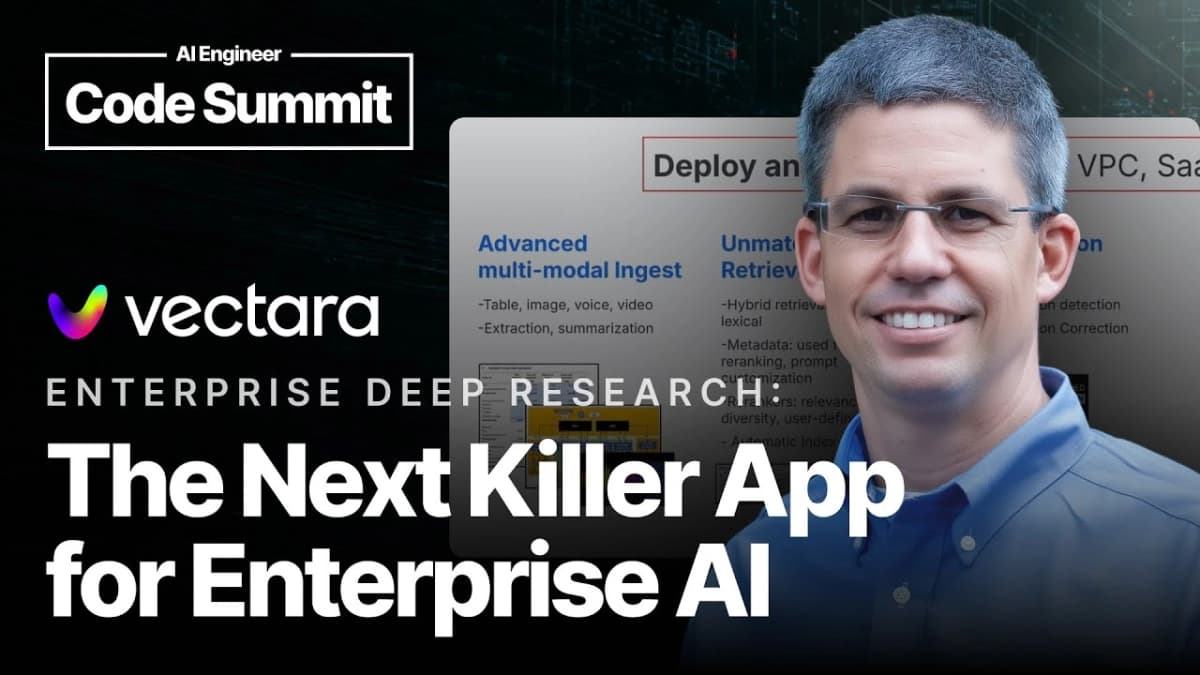
The true inflection point for enterprise artificial intelligence is shifting beyond the conversational interface to autonomous deep research, specifically within an organization’s private data. This was the central tenet articulated by Ofer Mendelevitch, Head of Developer Relations at Vectara, during his presentation on "Enterprise Deep Research: The Next Killer App for Enterprise AI." Mendelevitch underscored that while conversational AI has demonstrated high ROI, the next wave of transformative value lies in automating high-value, document-centric workflows that currently absorb extensive human hours.
Vectara positions its "Trustworthy Agent Operating System" as the foundational platform enabling this advanced capability. The system offers deployment flexibility across on-premise, VPC, and SaaS environments, catering to diverse enterprise needs. Key technical features include advanced multi-modal ingest, capable of processing tables, images, and voice data for comprehensive understanding, along with an "unmatched retrieval pipeline" that combines semantic and lexical search, metadata filtering, and sophisticated reranking to ensure highly relevant results.
Crucially, Vectara places a strong emphasis on "hallucination mitigation," acknowledging that factual accuracy remains a paramount concern for enterprise AI adoption. Mendelevitch highlighted this challenge with compelling statistics, noting that "hallucinations are systemic, not random." Indeed, McKinsey's 2023 report indicates that 50% of U.S. employees cite inaccuracy as a top GenAI risk, while Gartner suggests 3-10% of AI responses contain hallucinations. Further underscoring this point, 73% of LLM customers identify "factual accuracy" as their primary challenge. This commitment to mitigating AI-generated falsehoods is not merely a technical refinement; it is a critical differentiator that builds trust and enables the safe deployment of AI in sensitive enterprise contexts.
Deep Research, in its general form, is defined as an AI agent that undertakes in-depth, multi-step investigations into complex topics. It achieves this by autonomously browsing and analyzing numerous online sources, then synthesizing this information into comprehensive, citation-driven reports. This process significantly reduces manual research time. Examples of such web-based deep research capabilities are already present in platforms like Google Gemini and ChatGPT, demonstrating the power of autonomous information gathering.
Enterprise Deep Research, however, extends this paradigm to an organization's proprietary information. It is, as Mendelevitch succinctly put it, "an extension of Deep Research to use YOUR PRIVATE data." This critical distinction allows AI agents to navigate and synthesize internal knowledge bases—ranging from internal wikis and shared drives to legacy documents—with the same multi-step reasoning and analytical rigor applied to public web sources. The system incorporates a multi-agent architecture with reflection capabilities, enabling parallel agent execution and continuous process refinement. By querying enterprise data through Vectara’s Agentic RAG (Retrieval Augmented Generation) capabilities, it ensures high accuracy and effective hallucination mitigation, underpinned by a deep "corpus understanding" that facilitates intelligent planning based on the organization's unique data landscape.
Related Reading
- Architecture Copilots: The Overlooked Frontier for Enterprise ROI
- Muna’s Compiler: Unlocking AI Model Portability Beyond Python’s Cage
- Agents are Robots Too: The Infrastructure Imperative for Next-Gen AI
The practical applications of Enterprise Deep Research are vast and immediately impactful for businesses. Mendelevitch outlined several compelling use cases. Responding to Requests for Proposals (RFPs), for instance, often involves sifting through hundreds of questions and vast internal documentation. An AI agent capable of autonomously extracting and synthesizing relevant information from internal data sets to formulate accurate responses can drastically reduce the time and effort involved. "Being able to use Enterprise Deep Research to go through all of your enterprise data sets, picking up the right documents and answering those questions is a really cool use case," he explained.
Another significant application lies in employee onboarding. New hires frequently face an overwhelming deluge of information, often scattered across outdated documents and disparate platforms. Enterprise Deep Research can generate on-demand, personalized onboarding guides by dynamically accessing and summarizing the most current and relevant internal documentation, significantly accelerating a new employee's time to productivity. Similarly, in financial services, the autonomous generation of investment memos, requiring deep dives into company financials, market trends, and regulatory documents, represents a substantial opportunity for efficiency and accuracy gains. Similar transformative use cases can be envisioned across healthcare, insurance, and other document-heavy industries, where the ability to rapidly and accurately research private data can unlock unprecedented levels of operational efficiency and informed decision-making.