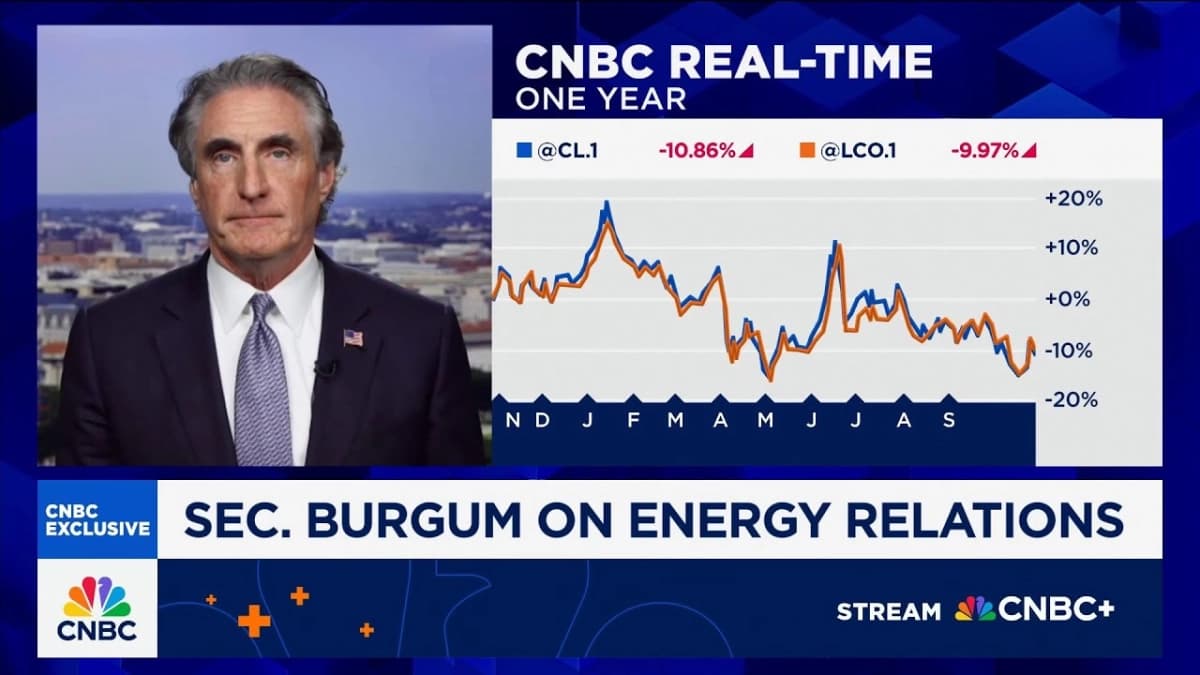
“Knowledge used to be power, now power is knowledge.” This stark redefinition, articulated by U.S. Secretary of the Interior Doug Burgum during a CNBC "Power Lunch" interview, cuts to the core of the contemporary global power struggle. Speaking with Brian Sullivan, Burgum outlined a comprehensive strategy for the United States to secure its position in the burgeoning artificial intelligence sector, emphasizing that robust energy policy is not merely an economic imperative but a critical component of national security and technological dominance. The conversation, held against the backdrop of Nvidia's GTC conference in Washington D.C., highlighted the profound energy demands of AI and the strategic implications of America's capacity to meet them.
The central insight driving Burgum's commentary is the inextricable link between abundant, reliable energy and leadership in artificial intelligence. He stressed that AI systems, advanced manufacturing, and indeed, the very fabric of modern American life, require "7x24x365 power." This constant, uninterrupted energy supply is the bedrock upon which the entire AI industry is built, making energy independence and affordability paramount. Burgum posited that the nation that can reliably supply this power at competitive prices will ultimately lead the AI revolution.
This realization, according to Burgum, prompted President Trump to establish the National Energy Dominance Council (NEDC), a multi-agency effort aimed at ensuring the US can "win the AI arms race against China." The council's mandate extends beyond domestic energy production, encompassing policies on public lands, trade, and international diplomacy. It represents a holistic governmental approach to leverage America's energy resources as a strategic asset.
Burgum criticized the prior administration's "anti-energy policy," which he claimed led to the shutdown of electricity production and an attempt to replace "reliable, affordable baseload" power with "intermittent, highly subsidized, weather-dependent sources of electricity." This, he argued, is a losing proposition for an economy increasingly reliant on stable, high-capacity power for AI infrastructure. The current administration's pivot, he asserted, has been a "180-degree turn," focusing on maximizing domestic energy output to meet burgeoning demand and lower prices at home.
The strategic implications of this energy policy extend far beyond American borders. Burgum detailed the US's pivotal role in global energy security, particularly concerning Europe. He noted a "25% increase in LNG exports" from the US to Europe within the first ten months of the current administration. This surge in American liquefied natural gas has been crucial in helping European nations replace their reliance on Russian gas, thereby undermining a key funding source for Russia's military actions in Ukraine.
This energy diplomacy is not without its infrastructural challenges. Burgum explained that while the US can ship abundant LNG, Europe still needs to enhance its receiving and distribution capabilities. He mentioned upcoming engagements in Europe to discuss building a "North-South corridor" of pipelines, running from the Baltics down to Greece and Croatia, to efficiently distribute US natural gas to landlocked nations. This infrastructure development is seen as a critical investment in European energy independence and stability.
Moreover, the strategic energy push is also directed towards Asia. Burgum revealed ongoing deals for Alaskan LNG as the President travels through the region, further solidifying America's position as a global energy supplier. This global energy outreach, he contended, serves a dual purpose: securing markets for American energy and strengthening geopolitical alliances by providing reliable alternatives to adversarial energy sources. This comprehensive approach to energy, from domestic production to international diplomacy, is viewed as essential for maintaining global peace and fostering prosperity.
The confluence of AI's insatiable demand for electricity and the geopolitical landscape underscores a profound shift in strategic thinking. Energy, once primarily an economic commodity, is now explicitly recognized as a fundamental enabler of advanced technology and a tool of international influence. The US, with its vast energy resources and renewed focus on production and export, aims to leverage this reality to ensure its leadership in the AI era and to support its allies. This is not merely about kilowatt-hours; it is about securing the future of American innovation and global stability.