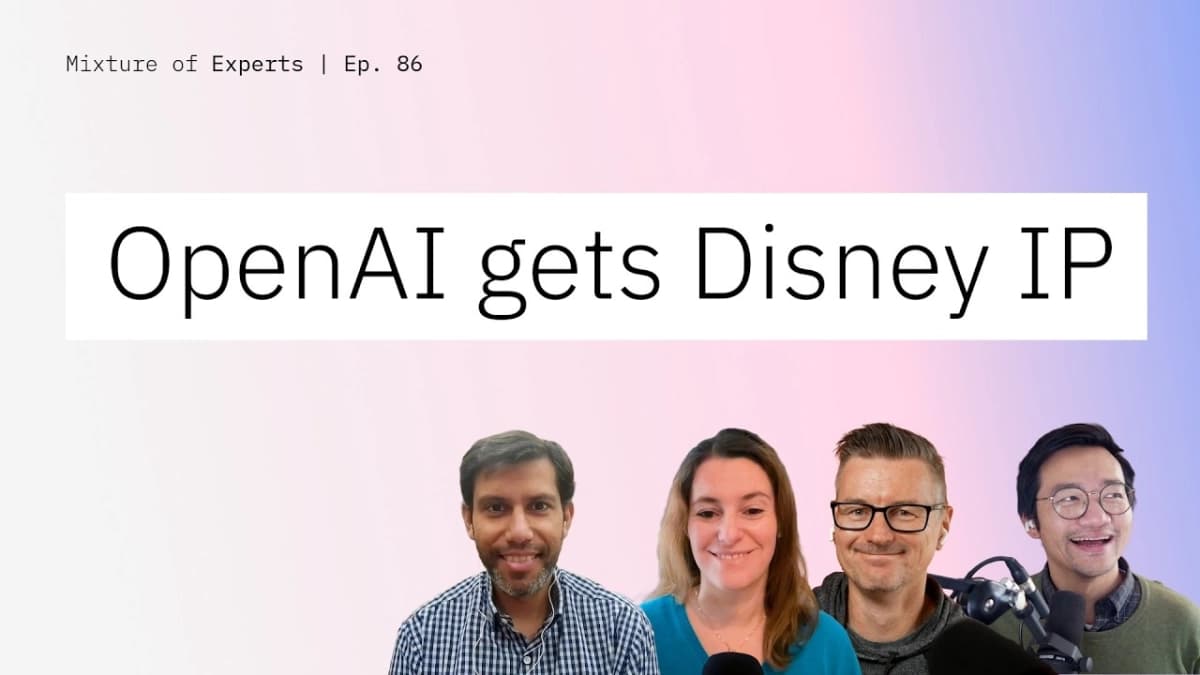
The recent billion-dollar licensing deal between Disney and OpenAI marks a pivotal moment in the rapidly evolving landscape of artificial intelligence. This strategic alliance, far beyond a mere content acquisition, signifies a profound shift in how intellectual property owners are navigating the generative AI frontier, moving from defensive posturing to proactive integration and monetization. On IBM's "Mixture of Experts" podcast, host Tim Hwang, alongside panelists Marina Danilevsky, Martin Keen, and Kush Varshney, dissected this landmark agreement, along with Time Magazine's "Architects of AI" designation, NVIDIA's Nemotron 3 release, and Anthropic's leaked "Soul Document," offering sharp insights into the intertwined future of technology, business, and creativity.
Martin Keen, a Master Inventor, highlighted the unprecedented nature of the Disney-OpenAI transaction. He distinguished it sharply from prior AI content deals, which typically involved licensing data for model training. "Traditionally the generative AI deals that we've seen up until now have been for training and grounding purposes," Keen explained, referencing OpenAI's agreement with the Financial Times or Google's deal with Reddit. Disney's investment, however, is on the "other end of it," focused on leveraging OpenAI's finished models to incorporate Disney characters and IP directly into generated output. This move suggests a strategic pivot towards actively shaping and controlling the creative outputs of AI, rather than merely feeding its learning algorithms.
Marina Danilevsky, a Senior Research Scientist, elaborated on Disney's underlying motivation. "Disney is going to stream these kind of videos. So they're going right back to Disney, and they're trying to basically have control in some way of that fan-generated content and have it come back to Disney instead of proliferating on X or Blue Sky." This demonstrates Disney's intent to centralize and monetize the vast potential of AI-generated fan content. The deal is less about preventing unauthorized use and more about co-opting the phenomenon, ensuring that the creative energy of its fanbase, amplified by AI, flows back into Disney's ecosystem. This is a platform play.
The conversation then broadened to Time Magazine's controversial choice of "Architects of AI" as its 2025 Person of the Year. The panelists debated the implications of recognizing a collective, particularly one heavily weighted towards business leaders. Kush Varshney, an IBM Fellow, observed that this choice underscores the prominence of financial and business aspects in the current AI narrative, rather than solely celebrating scientific breakthroughs. "Architects of AI, like what are they architecting, right? I think it's the financial aspects, the hype, the business, I mean, that's what's being architected." Danilevsky concurred, stating, "This is a signal that it hasn't been as much the year of AI as it has been the year of AI hype, AI communication, AI as business, AI as the financial deals." This perspective suggests that the public perception and indeed the driving force of AI development are increasingly shaped by economic incentives and market dynamics, with vast sums of capital flowing into infrastructure and deployment.
NVIDIA's recent release of its Nemotron 3 open-source models further illustrates the industry's "full-stack play." While a technical development, the panelists noted that NVIDIA's strategy extends beyond hardware, encompassing software and models to create a vertically integrated AI ecosystem. This approach, as Varshney pointed out, aims to consolidate control, with companies like NVIDIA striving to make "the AI stack the computer." This strategic consolidation is a response to the massive investments in AI data centers and activities, which Martin Keen noted could exceed $400 billion in 2025 alone.
The discussion concluded with a deep dive into Anthropic's leaked "Claude Soul Document," a philosophical manifesto guiding the model's alignment and safety. Danilevsky found this approach intriguing, noting it's distinct from traditional, rule-based safety guidelines. The "Soul Document" is embedded during the fine-tuning process, aiming to instill a core set of values and principles directly into Claude's operational parameters. Varshney connected this to complex philosophical concepts of "value uncertainty" and "dualism," questioning the universality of such an imposed "soul" across diverse contexts. This deliberate, philosophical embedding of values represents a more nuanced, albeit challenging, approach to AI alignment, moving beyond simple input-output prompting to shape the model's inherent "personality" and ethical framework.
The overarching commentary from the "Mixture of Experts" panel reveals an AI landscape defined by rapid commercialization and strategic consolidation. Intellectual property, once a battleground for copyright infringement, is now a valuable asset to be licensed and integrated, as exemplified by Disney. The narrative of AI is increasingly driven by financial titans and market hype, rather than solely by the quiet work of researchers. As AI models become more commoditized and powerful, the emphasis shifts to full-stack control, ease of integration, and the profound, sometimes philosophical, challenge of aligning these technologies with human values at their core.