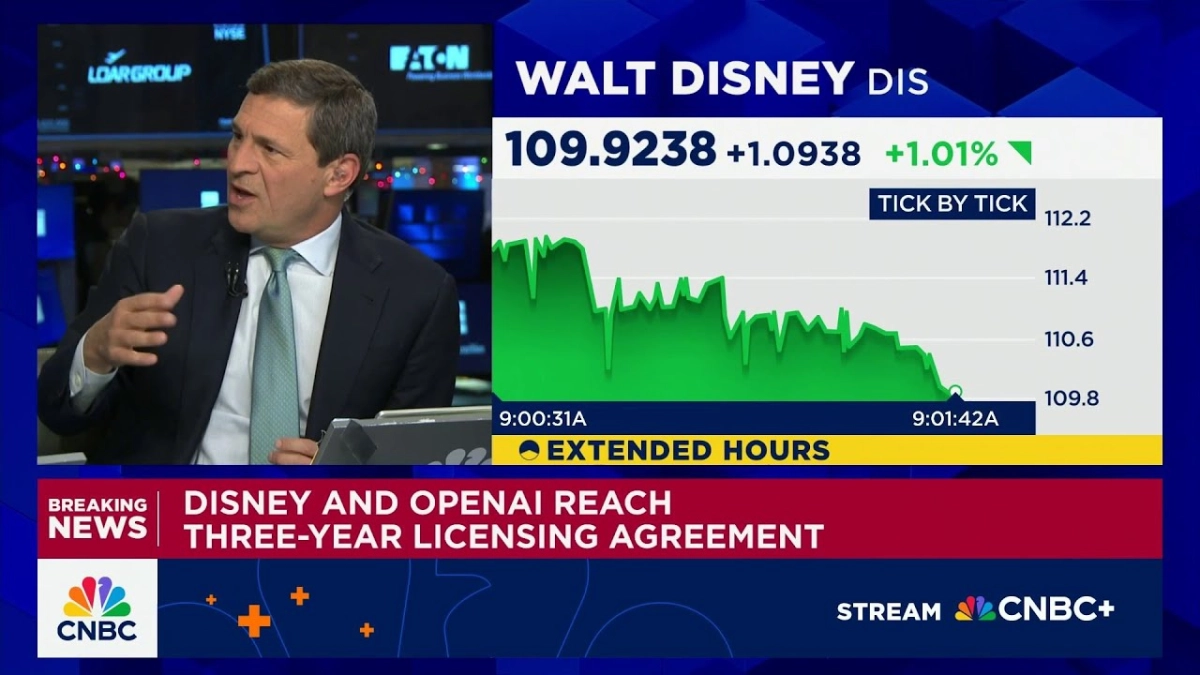
The financial world is abuzz with the news of a significant three-year licensing agreement between The Walt Disney Company and OpenAI, the artificial intelligence research and deployment company. This strategic alliance, announced on CNBC's "Squawk on the Street," signifies a substantial commitment from Disney, including a $1 billion equity investment in OpenAI and warrants for additional equity. The commentators highlighted the groundbreaking nature of this collaboration, emphasizing its potential to reshape the landscape of AI integration in media and entertainment.
This partnership positions Disney as a key player in leveraging advanced AI technologies. The agreement specifically allows Disney to utilize OpenAI's Sora platform, a powerful tool capable of generating short, user-prompted videos featuring more than 200 characters. Furthermore, a curated selection of fan-inspired Sora videos will be made available on Disney+, broadening the platform's content offerings and engaging audiences in novel ways. This strategic move signals Disney's proactive approach to embracing generative AI for creative and commercial purposes.
The implications of this deal extend beyond content creation. Disney's substantial investment underscores a recognition of AI's transformative power and its potential to drive innovation across the entertainment industry. As one commentator noted, "This is where the technology is going." This sentiment reflects a broader industry trend where established giants are actively seeking to integrate cutting-edge AI capabilities into their core operations and product development. The move also suggests a strategic pivot for Disney, aiming to harness AI to enhance its storytelling and user engagement strategies.
A crucial insight from the discussion is Disney's intent to become a "major customer of OpenAI." This implies a deep integration of OpenAI's technology into Disney's workflows, potentially spanning content generation, character animation, and personalized user experiences. The agreement to receive warrants for additional equity further solidifies Disney's long-term interest and potential for growth alongside OpenAI, signaling a partnership built on shared vision and mutual benefit. This financial commitment also suggests a belief in OpenAI's future trajectory and its capacity to deliver significant value.
The partnership also brings to light the ongoing competition and intellectual property considerations within the AI space. In a related development, it was reported that Disney has sent a cease-and-desist letter to Google. This letter alleges that Google has been using Disney's copyrighted works without authorization to train and develop its generative AI models. This legal action highlights the critical importance of intellectual property rights in the rapidly evolving field of AI, particularly concerning the data used to train these sophisticated systems. The juxtaposition of these two events – the strategic partnership with OpenAI and the legal action against Google – paints a complex picture of Disney's approach to AI, balancing collaboration with the protection of its valuable intellectual assets.
The agreement between Disney and OpenAI is a significant development, indicating a substantial shift in how major media companies are approaching artificial intelligence. By investing heavily and securing licensing rights, Disney is not merely experimenting with AI but is integrating it as a core component of its future strategy. This move will likely set a precedent for other media and entertainment companies, encouraging further exploration and adoption of generative AI technologies. The dual actions of forging a partnership and asserting intellectual property rights demonstrate a calculated strategy to navigate the opportunities and challenges presented by the AI revolution.