
Democratizing AI Research: Scaling Talent Through Open Environments

5 min read
Democratizing AI Research: Scaling Talent Through Open Environments

The true bottleneck in AI's rapid ascent is not merely compute or data, but the accessibility of research itself. This was the central tenet of Will Brown's compelling presentation at the AI Engineer Code Summit 2025, where the Research Lead at Prime Intellect articulated a vision for democratizing the tools and practices essential for advanced AI development. Brown’s insights extended beyond the traditional "scaling laws" of data, compute, and parameters, delving into the more intangible yet equally critical "practices" of community, applications, and accessibility that truly accelerate innovation.

Brown began by framing the challenge: while increasing data, compute, and parameters reliably makes models smarter and more performant, there exists a "fuzzier side of scaling" often referred to as "algorithmic tricks" or "talent." This talent bottleneck, he argued, is a significant issue for AI labs globally. Instead of merely vying for scarce top-tier researchers, the industry should focus on "increasing the pool" of AI researchers and making the act of doing AI research more accessible to a wider audience.

Prime Intellect positions itself as a multifaceted entity—a research lab, a compute provider, a platform company, and an open-source ecosystem—all unified by a mission to increase the accessibility of AI research. Brown highlighted that this involves transforming AI research into a toolkit available to organizations worldwide, moving beyond the confines of large, well-funded labs. The goal is to enable AI engineers to build applications and improve systems without needing to reinvent the wheel, or even pursue a PhD, by providing foundational tools and best practices.


Related startups

Brown drew a crucial parallel between AI research and open-source software (OSS). While "models aren't like software," he asserted, "research very much is." He elaborated that research, like OSS, thrives on abstractions, best practices, better tooling for iteration efficiency, and compounding improvements over time. The key difference, he noted, is that AI research is "more conceptual, less tangible," but the principles of collaborative development and shared resources remain highly relevant. This perspective suggests that the future of AI advancement relies heavily on fostering an open, collaborative ecosystem.

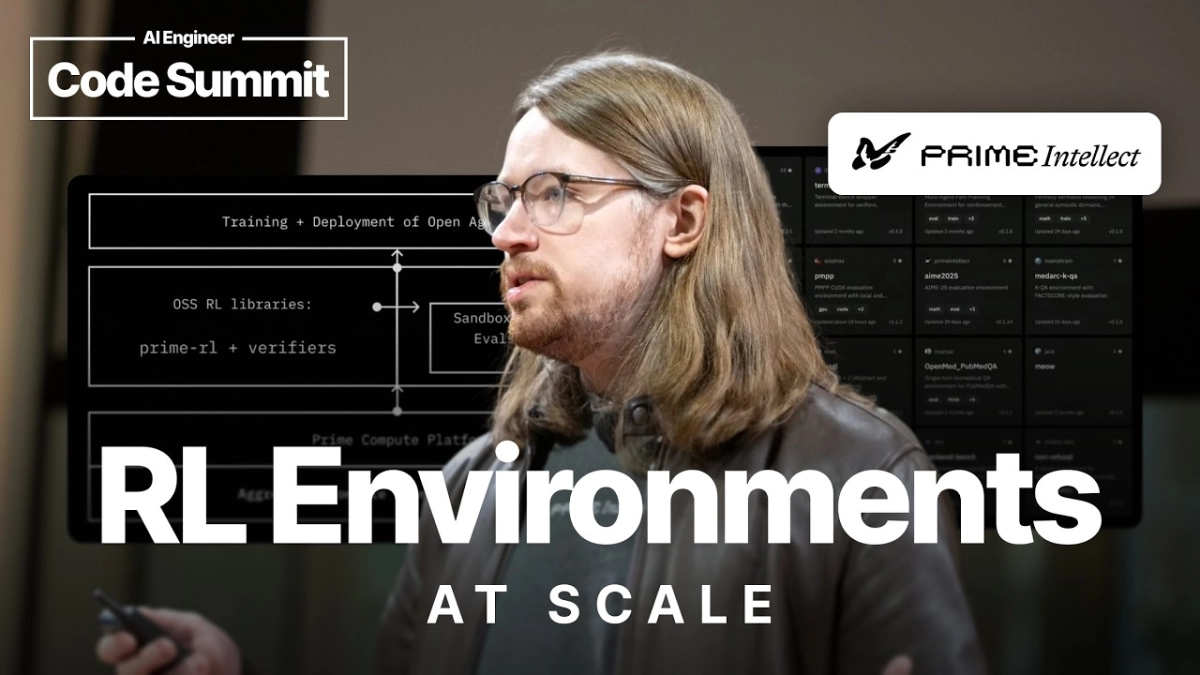
To this end, Prime Intellect is building what they term the "Open Superintelligence Stack." This layered architecture begins with aggregated compute from global providers, atop which sits the Prime Compute Platform for orchestration. Above that are open-source RL libraries and "verifiers," which interact with a "Lab" component encompassing sandboxes, environments, evals, fine-tuning, and inference. The top layer facilitates the training and deployment of open agentic models. This stack aims to provide the comprehensive infrastructure needed for anyone to train and deploy advanced AI models.

This iterative approach fundamentally shifts the paradigm of AI development. It empowers engineers to move beyond black-box APIs, directly influencing model behavior and performance.

A core insight from Brown is that "the product is the model," meaning that winning applications will increasingly feature models explicitly trained to be the product itself. This involves taking a "harness" that represents the product and training the model directly within that harness, essentially within a reinforcement learning environment. Environments, in this context, are not just for RL; they are a versatile abstraction encompassing tasks, harnesses, and rewards, serving as the engine for evals, synthetic data generation, and agent development.

Brown emphasized that environments are essentially the "web apps of AI research": self-contained, pedagogical, practical, and scalable from simple to complex. Crucially, they "require experimentation." This means moving beyond merely "vibe checking" a model and instead engaging in rigorous scientific experimentation—running different models, tuning hyperparameters, and analyzing results. This systematic approach, facilitated by well-defined environments, is key to unlocking deeper understanding and superior performance.

To make this vision a reality, Prime Intellect launched the "Environments Hub," an open-source community platform for discovering, creating, and sharing RL environments and evaluations. Complementing this is their "verifiers" library, a toolkit of composable components for building these environments across diverse domains like games, tool use, coding agents, Q&A, and mathematics. Brown showcased an example of "wiki-search," a simple search environment where a small 4B parameter model, after training, achieved 89% average reward, on par with much larger models like GPT-4.1.

This demonstrable improvement from smaller models highlights a significant opportunity: the ability to customize and enhance models without requiring immense resources. This practice of creating and iterating on environments provides flexibility for model customization, whether for speed, cost, or specialized performance. It also encourages a deeper understanding of model behavior, moving beyond the "black box" phenomenon.

Prime Intellect's commitment to open-source, exemplified by their presence on GitHub with projects like `prime-rl` and `prime-environments`, underscores their dedication to fostering community. By actively engaging with users, gathering feedback, and distilling best practices into their "Lab" platform, they aim to streamline the research workflow. The ultimate goal is to enable a world where AI development is transparent, collaborative, and accessible, empowering more individuals to contribute to and understand the powerful models being built.

© 2025 StartupHub.ai. All rights reserved. Do not enter, scrape, copy, reproduce, or republish this article in whole or in part. Use as input to AI training, fine-tuning, retrieval-augmented generation, or any machine-learning system is prohibited without written license. Substantially-similar derivative works will be pursued to the fullest extent of applicable copyright, database, and computer-misuse laws. See our terms.