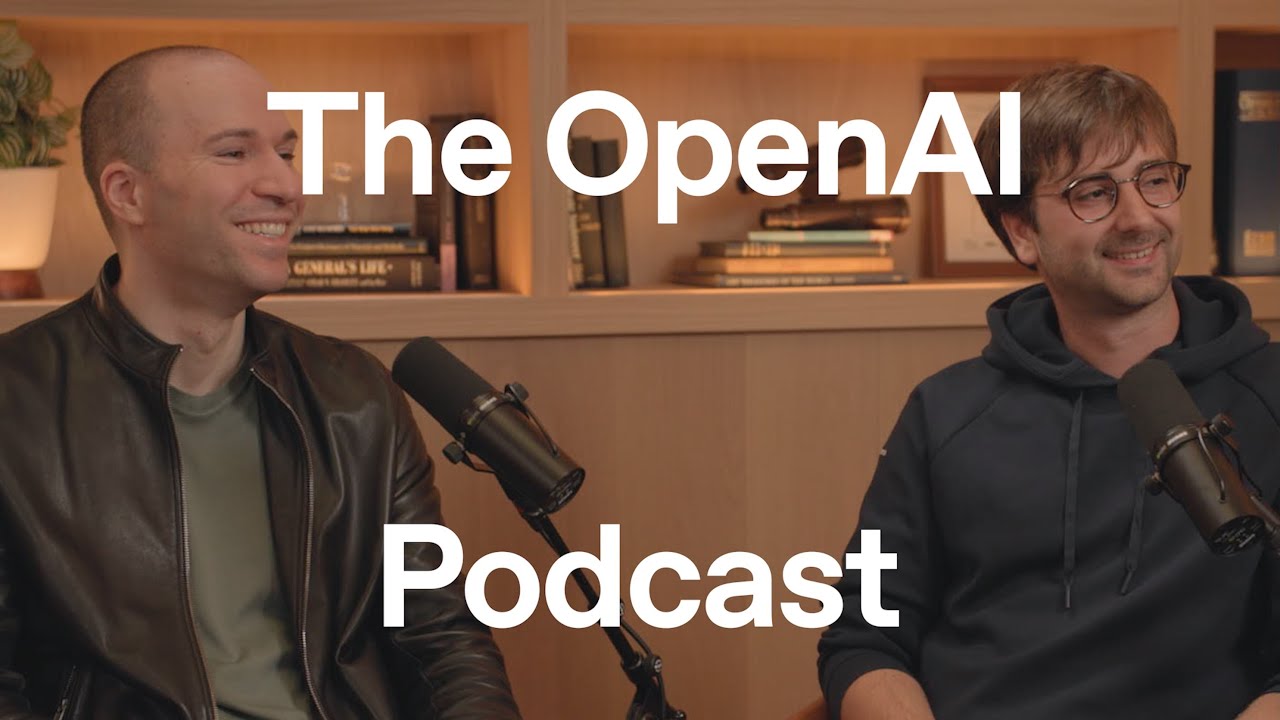
"As soon as you saw that, you knew this is gonna work. This is going to be big." This declarative statement by OpenAI co-founder and President Greg Brockman, recalling the nascent days of GPT-3’s ability to generate code, encapsulates the profound shift discussed in a recent OpenAI Podcast episode. Joined by Thibault Sottiaux, Codex engineering lead, Brockman unpacked the journey from rudimentary code generation to the sophisticated agentic systems now redefining software development. The conversation, expertly guided by Andrew Main, delved into the evolution of AI coding, the critical role of "harnesses," and the transformative potential of GPT-5 Codex.
The early inklings of AI’s coding prowess emerged during the GPT-3 era, when the model demonstrated a surprising capacity to complete Python functions from simple doc strings. This initial spark quickly ignited OpenAI's deep focus on coding, driven by the belief that general intelligence (AGI) inherently requires the ability to interact with and manipulate the world through code. This foundational understanding positioned coding as an exceptional domain, meriting dedicated programs for data collection, metric analysis, and model performance evaluation.
One of the central insights of the discussion revolved around the concept of a "harness." Sottiaux clarified this as the infrastructure that integrates an AI model, enabling it to act on its environment. He eloquently described the model as the "brain" and the harness as the "body," emphasizing that the usability of an AI is equally dependent on its intelligent core and the tools it can wield. This realization, born from early Codex demos, highlighted that for coding, the AI's output must "come to life" through execution and integration with existing development tools.
The development of GitHub Copilot served as a crucial learning ground, particularly in understanding the paramount importance of latency. Brockman stressed that for developer tools, speed isn't merely a performance metric; it's a core product feature. A brilliantly intelligent auto-completion model becomes useless if it takes too long to respond. This led to a strategic imperative: optimize for the smartest model achievable *within* strict latency constraints. However, the advent of more powerful models like GPT-4, while smarter, often exceeded these real-time interaction limits. This presented a new challenge: how to leverage immense intelligence when direct, instantaneous interaction isn't feasible? The answer lay in evolving the "harness."
The shift towards agentic coding emerged as a solution, allowing models to operate asynchronously and autonomously. Instead of the user constantly driving the interaction, the model itself begins to drive, exploring codebases, debugging complex problems, and performing multi-hour refactorings. Sottiaux noted that this "reversing that interaction" was a pivotal moment, giving the model the ability to act and create on behalf of the developer. This is exemplified by GPT-5 Codex, which can tackle extensive refactoring tasks, a capability previously unseen. Such advancements are not just theoretical; internal tools like "10x" at OpenAI, which offered a 10x productivity boost, and Codex code review, which identified bugs even experienced engineers missed, showcased the practical value.
The future, as envisioned by Brockman and Sottiaux, involves a landscape populated by "large populations of agents" operating in cloud data centers, supervised and steered by humans. The challenge now is not just building smarter models, but designing interfaces and interaction patterns that allow humans to effectively collaborate with and oversee these increasingly capable agents. This includes investing in safety, security, and alignment research to ensure these powerful systems operate reliably and in accordance with human intent. The goal is to make AI not just a tool, but a true co-worker, enhancing human creativity and productivity across all domains.