The promise of artificial intelligence has long hinged on its ability to transcend general utility and adapt to the intricate, bespoke demands of specific enterprises. Anthropic recently showcased a compelling demonstration of Claude's new "Skills" feature, illustrating its enhanced capabilities for specialized task execution and brand adherence, a significant leap towards truly customizable and integrated AI solutions for the modern business landscape. This product release signals a shift from broad-stroke AI assistance to granular, context-aware operational support, a development keenly observed by founders, venture capitalists, and AI professionals alike.
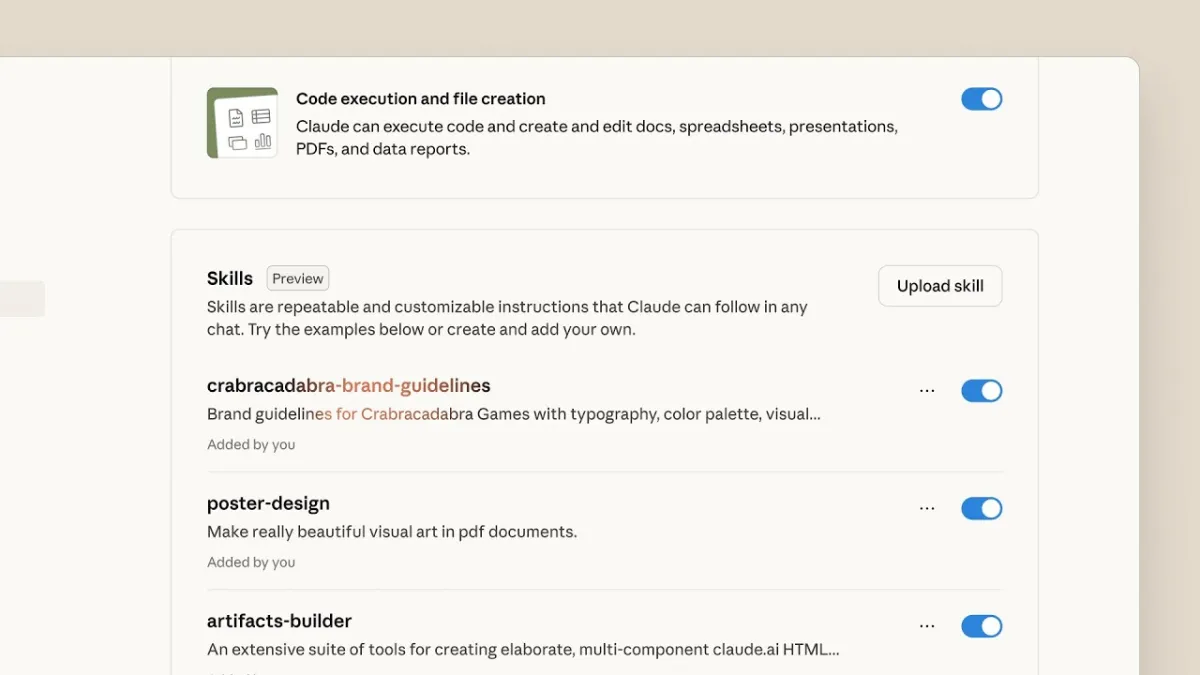
The demonstration began with the seamless integration of a custom "Skill" – a zipped folder containing specific instructions and resources, in this instance, a company’s brand guidelines. This ability to upload and activate proprietary knowledge directly within Claude’s operational framework is a powerful differentiator. Once uploaded, these Skills become active capabilities, ready to be invoked by the user, transforming Claude from a generalist chatbot into a specialized, brand-compliant team member.
In the initial scenario, a user, Mahesh, representing "Crabracadabra Games," tasked Claude with creating a creative pitch deck for their new game, "Shelldon and the Hermit’s Grimoire." The prompt itself, "My company Crabracadabra Games is working on an exciting new game – Sheldon and the Hermit’s Grimoire! Help us with the creative pitch deck!" immediately highlights the practical, project-oriented nature of the interaction. Claude's response underscored its newfound intelligence: "I’ll help you create a pitch deck for 'Shelldon and the Hermit’s Grimoire!' You mentioned Crabracadabra Games, let me start by reading the brand guidelines skill to ensure I apply the correct styling." This immediate, proactive application of a custom brand guideline skill, alongside a generic PowerPoint skill, showcases Claude's ability to combine disparate knowledge bases for a unified, professional output.
This integration of specialized knowledge is not merely about data retrieval; it's about contextual application. Claude actively processes the brand guidelines, understanding typography, color palettes, and visual cues, then synthesizes this information with the structural requirements of a pitch deck. The result, a multi-slide presentation covering everything from game title and story setup to character introductions and gameplay mechanics, was delivered in a downloadable .PPTX format. Crucially, Claude affirmed, "The presentation follows your company branding style and is ready for your pitch!" This level of adherence to specific corporate identity, often a bottleneck in creative workflows, positions Claude as an invaluable asset for maintaining brand consistency at scale.
The demonstration extended further, illustrating Claude’s multimodal capabilities. Following the successful pitch deck creation, Mahesh requested concept posters for the game, aiming for designs that felt "magical and oceanic… and epic!" Claude’s response was equally impressive: "I’ll create three distinct poster concepts for 'Shelldon and the Hermit’s Grimoire' – each with a completely different visual approach." This showcased not only Claude's creative flexibility but also its capacity to interpret nuanced artistic direction.
The process involved Claude leveraging a "poster-design" skill, which included understanding creative processes, and then executing code to generate visual concepts. The video briefly displayed Python-like code snippets, indicating that Claude isn't just generating text descriptions but actively scripting the visual elements based on its learned parameters and the user's creative brief. This ability to translate abstract design philosophies into tangible, code-generated artifacts represents a profound evolution in AI’s creative output, moving beyond mere image generation to programmatic design.
The three poster concepts presented—"Underwater Realm," "Nautilus Portal," and "Cartographer’s Journey"—each offered a distinct visual philosophy, yet all aligned with the game’s core premise. This bespoke creativity, tailored to specific thematic requirements, underscores a core insight: Claude Skills enables AI to move beyond generic solutions to provide deeply customized, high-quality creative and operational outputs. The extensibility of this framework, allowing users to "build your own Skills," implies a future where virtually any repetitive or knowledge-intensive task can be codified and automated within Claude, from QA bug reports and sprint planning to localization workflows and financial reporting.
The underlying architecture supporting Claude Skills represents a significant stride in AI development. By allowing users to define and upload specialized instruction sets and resources, Anthropic has created a powerful framework for enterprise AI. This approach addresses a critical need for businesses: to infuse AI with institutional knowledge and specific operational protocols, thereby reducing the "hallucination" factor and increasing reliability. The concept of "Skills" transforms Claude into a customizable, adaptable agent capable of operating with a high degree of precision and context-awareness across diverse business functions. For decision-makers in the startup ecosystem, this signals a new era of efficiency and bespoke automation, where AI can be precisely molded to fit unique organizational demands.