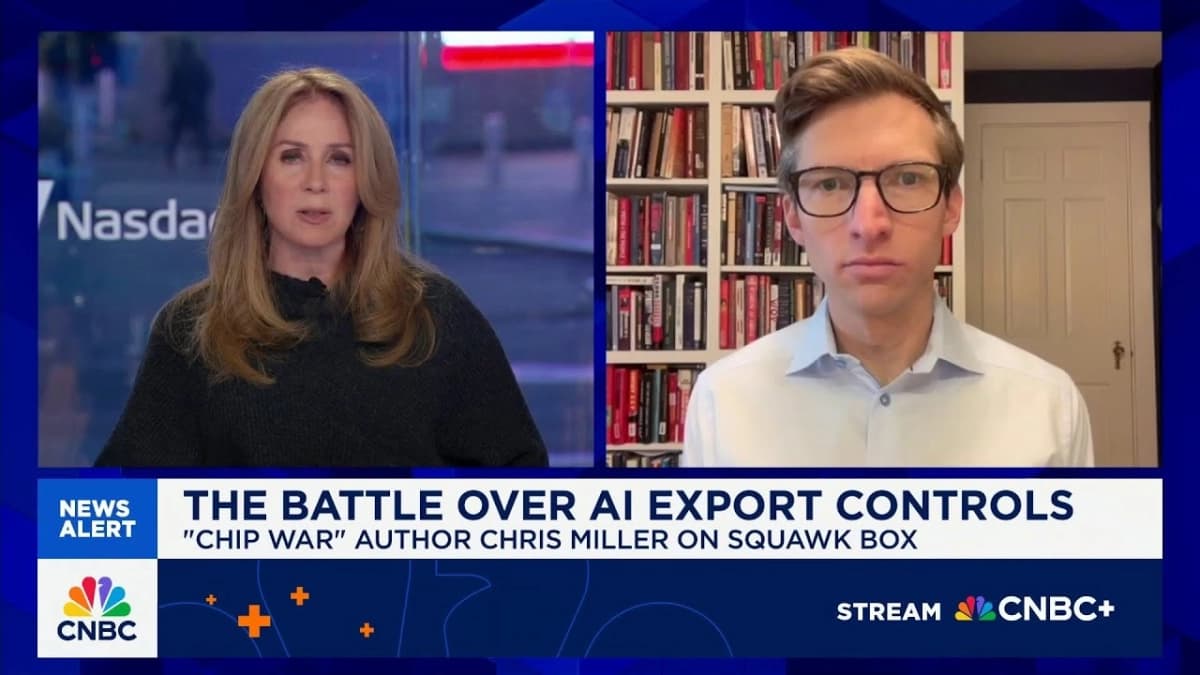
"We have to be very careful when deciding which countries and which companies we sell these to." This statement by Chris Miller, author of "Chip War," encapsulates the high-stakes debate surrounding the export of advanced artificial intelligence chips. Miller spoke with CNBC's Squawk Box about the intricate relationship between national security, industry profitability, and the global race for AI dominance. His insights highlight the critical role of semiconductor technology in shaping geopolitical power and the strategic implications of controlling access to these vital components.
The core of the discussion revolves around the United States' efforts to restrict China's access to cutting-edge AI chips. Miller argues that allowing China unfettered access to these advanced semiconductors poses a significant risk to both U.S. national security and its own burgeoning AI industry. The United States currently holds a commanding lead in the production of these specialized chips, which are fundamental to the development and deployment of sophisticated AI systems. This technological advantage is seen as a crucial element in maintaining a strategic edge.
Miller emphasizes the strategic importance of this leadership, stating, "The US has a really commanding lead in the production of AI chip... that's been one of the key drivers of the US leadership position in AI." He further elaborates on the inherent risk of sharing this advantage, noting, "And by allowing more AI chips to flow to China... it risks giving a shot in the arm to China's AI ecosystem." This sentiment underscores the concern that empowering a geopolitical rival with the tools of advanced AI could have far-reaching consequences.
A key insight from Miller's analysis is that China's current strategy is to become self-sufficient in this critical sector. He observes, "China has had an interesting response to the chips that they've been allowed to purchase... they basically said we don't want, even in the instance of some of these chips, we don't want to rely on the US for rare earth metals or anything else that we've come to rely on over the years." This drive for autonomy is a direct response to perceived vulnerabilities and a strategic imperative to control their technological destiny.
The challenge for the U.S. and its allies lies in striking a balance between economic engagement and security concerns. While restricting access to advanced technology can slow a competitor's progress, it also presents an opportunity for that competitor to accelerate its domestic capabilities. Miller points out this dynamic: "If China can build something domestically, then they're not going to buy ours." This creates a complex feedback loop where export controls, while intended to curb advancement, can inadvertently spur innovation elsewhere.
The manufacturing of advanced semiconductors is an extraordinarily complex and capital-intensive process. Miller highlights this difficulty, stating, "What we know is that right now even in China the most advanced chip making facilities rely on chip making tools that are imported from the US, from Japan, from the Netherlands before our controls were in place." This reliance on foreign equipment is a significant bottleneck for China's ambitions. However, the narrative also suggests that China is actively working to overcome these limitations.
Miller's assessment of China's long-term strategy is clear: "The Chinese government is dead set on trying to build out its own fully self-sufficient domestic semiconductor ecosystem." This ambition is not merely about economic growth; it is intrinsically linked to national security and technological parity. The struggle is not just about selling chips today, but about shaping the technological landscape for decades to come.
The underlying principle for export controls, as articulated by Miller, is to prevent the transfer of technology that could be used to advance a rival's military or strategic capabilities. However, the current situation with AI chips presents a unique challenge. "It's not that China can't build them domestically, it's that they can't build them domestically as quickly or as efficiently as they can buy them," Miller explains. This highlights the competitive advantage the U.S. and its allies currently possess.
The long-term implications of this technological competition are profound. As Miller suggests, "If we seed them with some of those chips, we're giving them a leg up in their AI ecosystem." This strategic calculus drives the debate over how restrictive export controls should be. The goal is to impede a rival's progress without entirely cutting off economic ties or inadvertently accelerating their domestic innovation.
The current landscape suggests a protracted struggle. China's commitment to achieving self-sufficiency in semiconductor manufacturing is unwavering. This means that the United States and its allies must carefully consider the efficacy and potential repercussions of their export control policies. The long-term objective is to maintain a technological advantage while navigating the complex geopolitical realities of a rapidly evolving global economy.