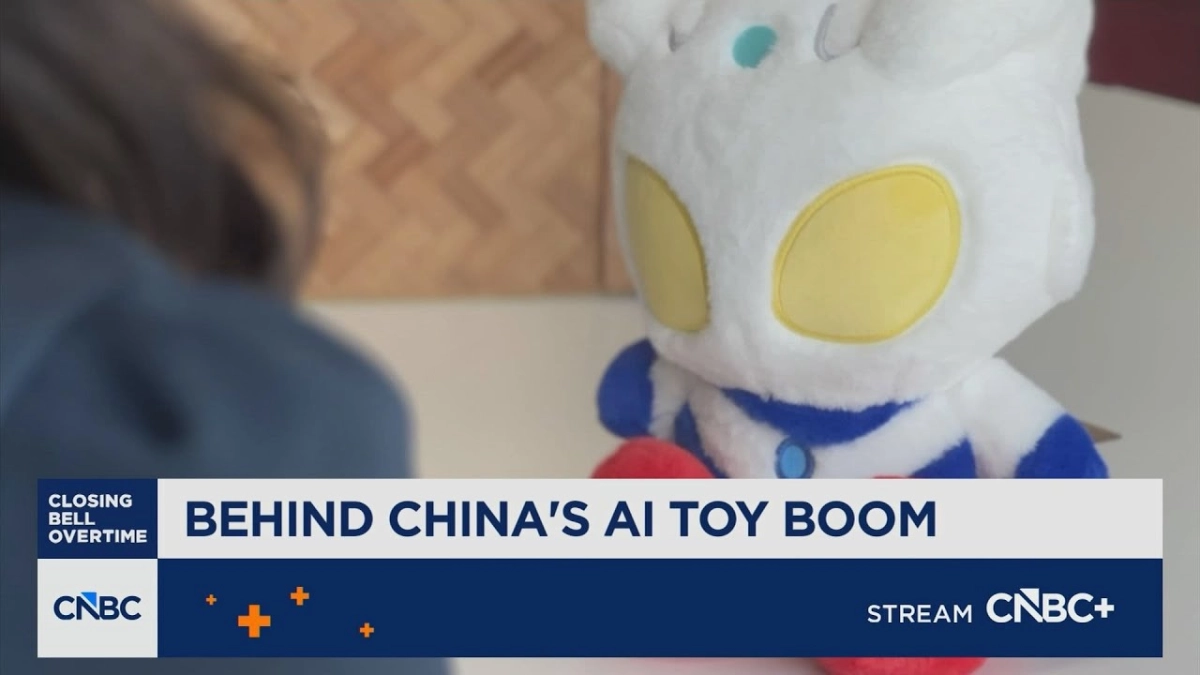
The burgeoning integration of artificial intelligence into children’s toys, particularly in China, signals a profound shift in consumer technology and the evolving relationship between humans and machines. CNBC’s Eunice Yoon, in her segment "The China Lens," delves into this rapidly expanding $4 billion industry, spotlighting the remarkable innovation and the inherent risks that accompany AI-powered companions. Yoon, speaking with industry experts and showcasing various products, unveils a landscape where cuddly cats and interactive puppies are not merely playthings but sophisticated interfaces designed to learn, adapt, and even subtly shape user experience, all while navigating the unique socio-political currents of the Chinese market.
This segment, featuring commentary from Sean Xu, Director of AI Products at Chongker, and Tom Van Dillen, Managing Partner at Greenkern, meticulously unpacks the dynamics behind China’s AI toy boom. It highlights a market teeming with approximately 1,500 companies vying to capture the attention of a demographic increasingly comfortable with advanced technology. The discussion underscores the dual promise of AI – personalized companionship and educational enrichment – alongside the critical concerns of data privacy, algorithmic bias, and state control that permeate the broader AI discourse.
One of the most striking aspects of this new generation of toys is their capacity for personalized interaction, moving far beyond pre-programmed responses. The Chongker AI cat, for instance, exemplifies this by utilizing voice recognition and cloud-banked memories to tailor its behavior to its owner's needs. Sean Xu elaborates on this adaptive quality, stating, "Some people like the cat to be more, maybe noisy or naughty, right? And some people just need the quiet one. So, it will learn what kind of thing you like." This adaptability extends to sensory feedback, as the cat emits a "heartbeat" when petted, designed to evoke a calming response in its user. This level of personalized emotional engagement suggests a future where AI companions are not just tools but integral parts of daily emotional landscapes, particularly for children.
The Luna AI puppy by Kuyeetech further illustrates this advanced integration, relying on lasers and cameras to map its environment and recognize up to five family members, responding uniquely to each. Such capabilities point to a future where AI toys could play a significant role in early childhood development, offering interactive learning experiences and fostering a sense of connection. However, this intimacy also raises substantial questions regarding data collection and privacy. The constant monitoring and analysis required for these toys to "learn" and adapt inherently involve gathering sensitive personal data, often from young, vulnerable users. The implications for how this data is stored, secured, and potentially utilized by companies or governmental entities remain a pressing concern for parents and regulators alike.
Beyond individual privacy, a more systemic risk emerges from the nature of AI models themselves. Tom Van Dillen, a Beijing-based tech consultant, cautions that "sometimes the models can hallucinate." This inherent unpredictability in large language models, the core of many AI systems, poses a genuine safety challenge, especially when deployed in products designed for children. While toy manufacturers are "doing a lot to create guardrails," the potential for unintended or inappropriate responses cannot be entirely eliminated. The responsibility for mitigating these risks falls heavily on developers and regulatory bodies to ensure robust testing and transparent operational guidelines.
Perhaps the most salient insight into China's unique AI landscape comes from the discussion around censorship. When asked about the limits of these AI toys, specifically regarding politically sensitive topics like Tiananmen Square, Eunice Yoon explicitly states, "You can't ask them political questions because they'll say that they cannot answer that, or they'll divert the answer." This reveals a stark reality: AI development within China operates under a different ethical and ideological framework than in many Western nations. The "guardrails" extend beyond preventing harmful or nonsensical responses to actively censoring information deemed sensitive by the state. This divergence means that Chinese AI, even in its most innocuous forms like children's toys, is often designed with embedded governmental controls, presenting a distinct challenge for global adoption and trust.
The global aspirations of these Chinese AI toy manufacturers are clear. These companies are not merely targeting the domestic market but are actively aiming for worldwide penetration, as Yoon confirms. This ambition brings the dual nature of Chinese AI—its innovative prowess and its inherent state control—to the international stage. Founders, VCs, and AI professionals must critically assess not only the technological capabilities and market potential of these products but also the underlying ethical and political implications of their widespread deployment. The $4 billion AI toy boom in China is a testament to rapid technological advancement, but it also serves as a potent reminder of the complex interplay between innovation, commerce, and societal values in the age of artificial intelligence.