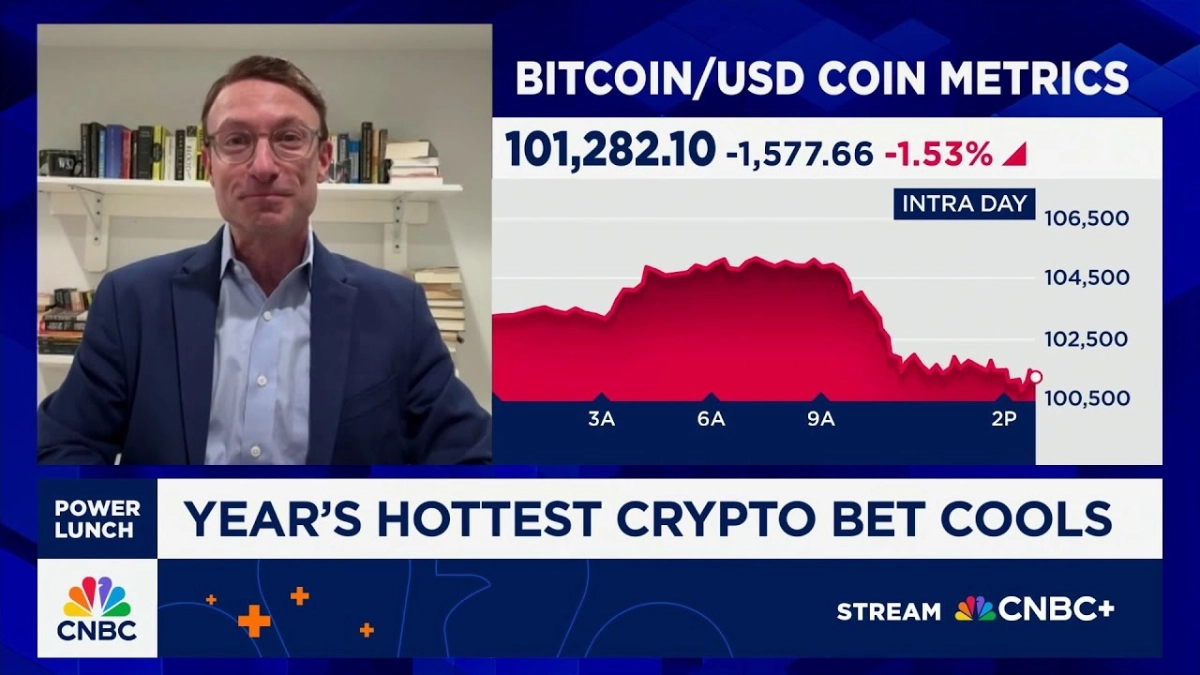
The Year's Hottest Crypto Trade Is Crumbling
"Bitcoin is the most interesting market trade apart from AI out there." This assertion by Gregory Zuckerman, a special writer for The Wall Street Journal, sets a provocative tone for his discussion on the current state of the cryptocurrency market. Zuckerman spoke with CNBC's 'Power Lunch' to delve into the recent performance of Bitcoin, the emergence of crypto treasury strategies, and the broader implications for investors.
Zuckerman's statement immediately positions Bitcoin not just as a speculative asset, but as a market phenomenon that warrants close attention, comparable in its intrigue to the burgeoning field of artificial intelligence. This framing is significant, as it elevates Bitcoin beyond the typical discourse of volatile digital currencies and into the realm of major economic and technological trends. The implication is that understanding Bitcoin's trajectory offers insights into market dynamics and investor behavior that are as crucial as grasping the advancements in AI.
The conversation then pivots to the recent performance of specific companies heavily invested in cryptocurrency, such as Bitmine and Strategy. Zuckerman highlights that these companies, which often act as proxies for Bitcoin's performance, have experienced significant declines. "Bitmine, Strategy fall 20% 1-month," the on-screen chyron declared, underscoring the immediate impact of Bitcoin's volatility on related equities. This suggests a correlation that is becoming increasingly difficult to ignore for traditional market participants.
A key insight emerging from the discussion is the concept of "crypto treasury strategies." Zuckerman explains that companies are increasingly holding Bitcoin as a treasury asset, a departure from traditional reserves. He elaborates on how some companies, like Michael Saylor's MicroStrategy, have pivoted their business models to leverage this strategy. "He took a software company, basically became a crypto repository with the price of crypto going up," Zuckerman states, illustrating the aggressive bet these firms are making. This approach, while potentially lucrative during bull markets, exposes these companies to substantial risk when the underlying asset depreciates.
The volatility of Bitcoin is further contextualized by Zuckerman's observations on investor behavior. He notes that many of these companies, and by extension their investors, are embracing a "hodl" mentality, a term originating from the crypto community for holding on to assets despite price fluctuations. "They're used to this, they embrace it, they buy more," he explains, suggesting a psychological resilience or perhaps a conviction that the long-term value of Bitcoin will ultimately prevail. This "buy the dip" strategy, while familiar to crypto enthusiasts, presents a stark contrast to traditional investment principles.
However, the article also touches upon the potential systemic risks associated with this trend. Zuckerman raises the critical question of whether the broader economy is susceptible to a significant downturn in Bitcoin's value. He draws a parallel to the dot-com bubble of the late 1990s, where many companies that adopted new technologies saw their stock prices soar, only to crash spectacularly. This historical parallel serves as a cautionary tale, reminding the audience that rapid adoption and speculative fervor can lead to significant market corrections.
The discussion also highlights how companies that have transformed into crypto repositories, such as Bitmine and Strategy, have seen their stock prices plummet significantly. Zuckerman points out that these companies have experienced drops of "80% at least 10 times" in their stock values, indicating the extreme volatility inherent in this investment strategy. This trend is not entirely new, as he references a similar situation with a company in 1999 that became a dot-com repository and subsequently failed.
The conversation then delves into the specific case of Bitcoin itself, noting its own significant price swings. "Bitcoin decline hits crypto stocks," the chyron warns, underscoring the direct impact on the market. Zuckerman articulates that the wild swings in Bitcoin are not new, and that many investors are accustomed to this level of volatility. He implies that for some, the strategy is to "hodl," or hold on for dear life, through these turbulent periods, believing in the long-term potential of the asset.
Zuckerman's analysis suggests that the current market environment for Bitcoin and related assets is characterized by a high degree of risk and speculative enthusiasm. The trend of companies converting their balance sheets into cryptocurrency, while offering the potential for substantial gains, also carries the risk of significant losses. This dynamic is particularly pronounced for companies that are essentially leveraged bets on the price of Bitcoin, as their stock performance is directly tied to the cryptocurrency's movements.
The article underscores the intricate relationship between Bitcoin's price and the performance of companies that have embraced it as a treasury asset. As Zuckerman points out, these companies are essentially "levered bets on crypto." This means that when Bitcoin's value declines, these companies experience amplified losses. The implications for the broader market remain a subject of keen observation, especially considering the historical parallels to other speculative bubbles.
The conversation highlights a core insight: the increasing integration of Bitcoin into corporate treasury strategies presents both opportunities and significant risks. Companies are making substantial bets on the future value of this digital asset, a strategy that has proven volatile. This trend warrants careful monitoring by investors and analysts alike.
The interview emphasizes the speculative nature of the current crypto market. Zuckerman notes that many investors who bought Bitcoin at very low prices have likely sold along the way, realizing significant gains. However, for those who continue to hold, the question of whether their conviction will pay off remains to be seen.
Finally, the discussion touches upon the broader economic implications. The question of whether a significant downturn in Bitcoin would impact the wider economy is a pertinent one. Zuckerman's historical references suggest that such a scenario could have far-reaching consequences, particularly for companies that have heavily invested in this volatile asset class.