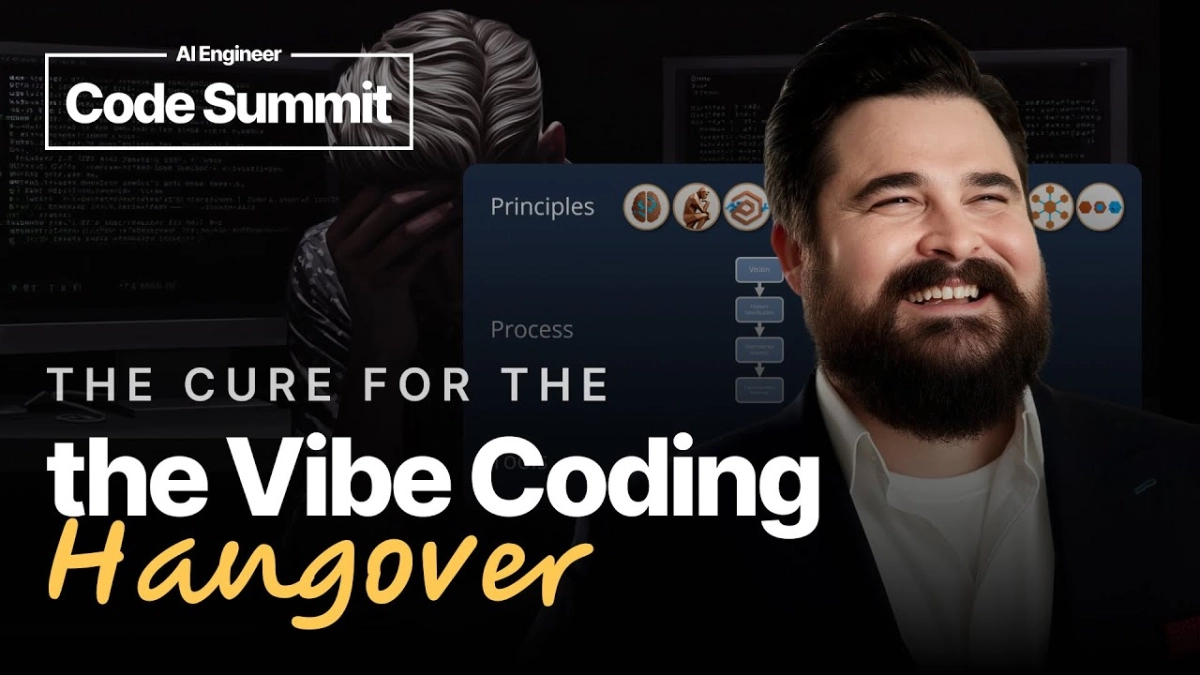
"Vibe Coding is the low-spec, zero-planning approach to AI accelerated development that feels productive but results in brittle, unmaintainable demoware." This stark definition, delivered by Corey J. Gallon, head of an AI-native holding company, cuts through the hype surrounding AI's role in software development. Gallon, a seasoned AI engineer and early contributor to GPT-Engineer, presented a practical framework designed to cure the "Vibe Coding Hangover"—the despair encountered when trying to evolve AI-generated demoware into robust, maintainable production software. His insights, shared during a recent presentation, offer a crucial roadmap for founders, VCs, and AI professionals aiming to harness AI agents effectively.
Gallon's core argument is that while AI can rapidly generate code that "works," this initial burst of productivity often masks fundamental flaws. Developers, caught in the excitement of immediate results, might find themselves unable to understand, modify, or maintain the code just weeks later. This leads to wasted time, burned tokens, and ultimately, the need to discard the entire effort. The solution, he contends, lies not in abandoning AI, but in adopting a structured framework that integrates AI agents into a disciplined engineering process, grounded in clear principles, a methodical workflow, and appropriate tools. This approach aims to empower engineers to be the "boss of the coding agents, not their confused intern," enabling them to build, own, and maintain complex, real-world applications.

One of the framework's foundational principles is that "AI Engineering is Accelerated Learning." Gallon emphasizes that treating AI solely as a productivity tool misses its profound potential for human growth. If developers merely crank out code without understanding the underlying mechanisms or architectural decisions, they risk plateauing as engineers and becoming overly dependent on AI. The true value, he argues, lies not just in the software produced, but in the exponential learning experience gained by the engineer throughout the process. Every step of his proposed framework is designed to create specific learning opportunities, ensuring that engineers build themselves as much as they build the software.
A critical tenet for navigating this new paradigm is clarifying roles: "You are the Architect. The Agent is the Implementer." Gallon stresses the importance of delegating "the doing, not the thinking." The human engineer retains ownership of the strategic, architectural decisions—defining interfaces, system intent, overall structure, and design tradeoffs. AI agents, conversely, are entrusted with the tactical execution: writing boilerplate code, following established patterns, and implementing tests. This clear delineation prevents the dangerous pitfall of relying on AI for core architectural thinking, which can lead to unmanageable systems.
To combat the "starting over cycle" inherent in unstructured AI development, Gallon introduces another counterintuitive principle: "Slow Down and Iterate to Go Fast." Without deliberate, validated iteration, projects tend to loop back to square one. His framework promotes compounding progress by emphasizing meticulous, sequential steps. While the initial stages might feel slower than the immediate gratification of "vibe coding," this disciplined approach builds momentum. Each validated iteration contributes to a stable foundation, allowing subsequent phases to accelerate dramatically and prevent the need for costly rewrites.
Related Reading
- Code Architecture: The Hidden Lever for AI Productivity Gains
- Coding Agents with Taste: The Next Frontier in AI Development
- Architecture Copilots: The Overlooked Frontier for Enterprise ROI
This meticulous approach extends to the very first step of code generation. Gallon asserts, "Write the blueprint, not the prompt." He views traditional prompt engineering, with its search for "magic words," as an optimization problem rather than a communication challenge. Instead, the framework advocates for detailed, structured specifications that precisely define requirements, behavior, interfaces, and acceptance criteria. These blueprints force architectural thinking upfront, ensuring that AI agents implement exactly what is specified, rather than interpreting vague conversational prompts. This clarity is essential for building predictable and maintainable systems.
The framework culminates in a comprehensive implementation plan that organizes features into dependency layers, identifies parallel development opportunities, defines phase completion criteria, and establishes validation strategies. This disciplined workflow, supported by the foundational principles, allows for the continuous "build, learn, and improve" cycle. It's a pragmatic response to the current state of AI-accelerated development, shifting the focus from ephemeral demoware to resilient, production-grade applications.