

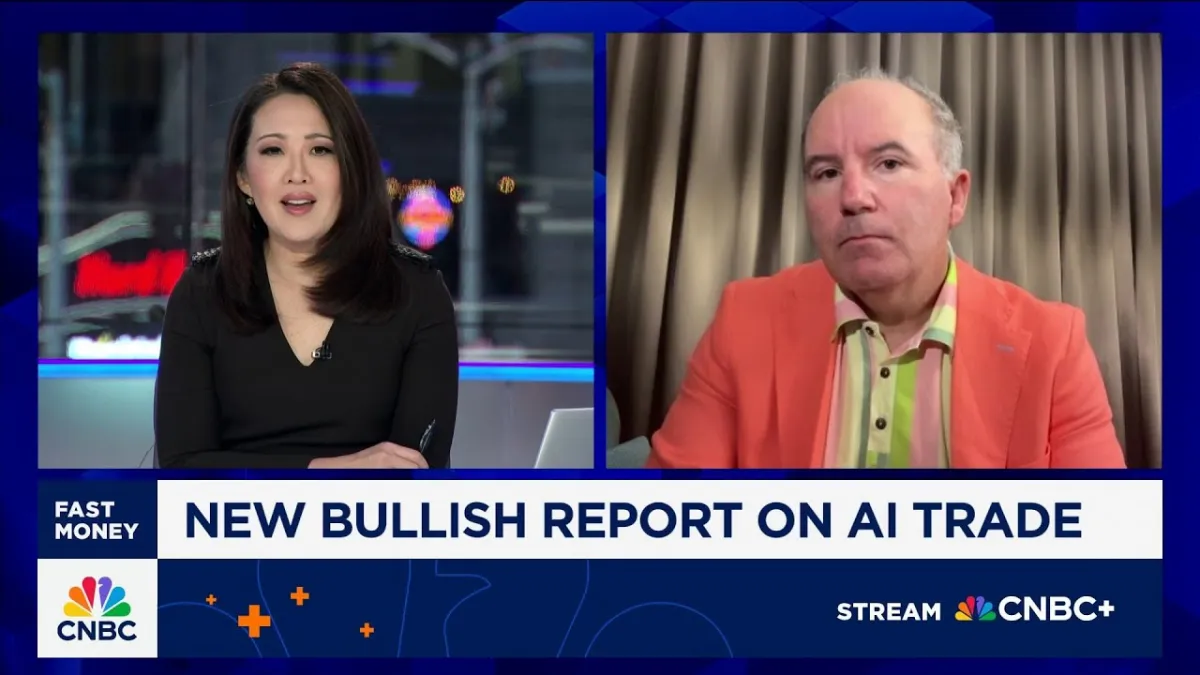
"Demand to supply for Nvidia chips, it's about 10 to 1, potentially 12 to 1," stated Dan Ives, Global Head of Technology Research at Wedbush Securities, speaking on CNBC's Fast Money from Hong Kong. This stark imbalance underscores a pervasive and accelerating demand for artificial intelligence infrastructure across Asia, a trend Ives views as significantly underestimated by current market projections. His recent channel checks throughout the region paint a vivid picture of a burgeoning AI revolution, far from its peak.
Ives spoke with Melissa Lee and Guy Adami, hosts of Fast Money, about his latest bullish report on the AI trade, having just concluded extensive channel checks in Asia. His findings point to a sustained, robust demand for the foundational hardware and cloud infrastructure necessary to power the AI surge, indicating that the market is still in its nascent stages of this transformative cycle. The core insight emerging from his analysis is that the current market valuations and growth expectations for key AI players, particularly on the hardware side, are conservative.
The sheer volume of demand for Nvidia's cutting-edge chips is a primary indicator of this accelerating trend. Ives’s observation of a 10-to-1 or even 12-to-1 demand-to-supply ratio for these critical components highlights a bottleneck in the supply chain that, while challenging, also signals immense underlying hunger for AI capabilities. This extends beyond Nvidia, offering a "very bullish" outlook for other semiconductor giants like TSMC, AMD, and ultimately Intel, as the entire ecosystem strains to meet the burgeoning requirements for AI processing power.
This accelerating chip demand is not merely a transient phenomenon; it is driven by a proliferation of AI use cases across industries and geographies. Ives emphasizes that "it's the use cases that are driving it," translating into substantial capital expenditure (CapEx) from hyper-scalers and other major tech players. Companies such as Microsoft, Google, Amazon, and Oracle are aggressively investing in AI infrastructure, with Ives believing that these CapEx figures are "significantly underestimated" by analysts for the coming year. The implication for founders and VCs is clear: the foundational layers of the AI stack are undergoing massive expansion, creating fertile ground for innovation and deployment.
Furthermore, the geopolitical landscape, specifically the U.S.-China trade tensions and associated tariffs, appears to be doing little to dampen this regional AI enthusiasm. Despite export controls and restrictions, the "underlying thirst for Nvidia chips" in Asia remains undiminished. This suggests that the strategic imperative to adopt and advance AI is overriding political friction, driving both indigenous development and continued demand for top-tier components where accessible.
Related Reading
- AI Infrastructure: The Next Frontier Beyond Hyper-Scalers
- Poolside and Coreweave Bet Big on West Texas for AI Infrastructure
- ING's Treon: AI Spending is Real CapEx, Not a Bubble
This dynamic also presents a "huge opportunity for Huawei," as Chinese tech giants like Alibaba and Baidu intensify their efforts to narrow the technological gap with Western counterparts. Ives characterizes this as an "AI arms race playing out," creating a dual-front growth narrative that benefits players on both sides. The competitive drive to achieve AI supremacy ensures continued investment and innovation, regardless of national origin.
From an investment perspective, this sustained and escalating demand, coupled with underestimated growth projections, presents a compelling picture. Ives asserts that "we're only in the second inning of this all playing out," suggesting that the current growth trajectory is sustainable and has significant room to run. His channel checks reveal that demand in the region has surged "up 20%" in just the last three months, underscoring the rapid pace of adoption and deployment. This long-term view is crucial for strategic planning among VCs and founders, indicating that the AI market is not just a fleeting trend but a foundational shift with years of expansion ahead.



