• StartupHub.ai
    StartupHub.aiAI Intelligence
Discover
  • Home
  • Search
  • Trending
  • News
Intelligence
  • Market Analysis
  • Comparison
  • Market Map Maker
    New
Workspace
  • Email Validator
  • Pricing
Company
  • About
  • Editorial
  • Terms
  • Privacy
  1. Home
  2. AI News
  3. Amazon In Talks To Invest 10 Billion Or More In Openai
  1. Home
  2. AI News
  3. AI Video
  4. Amazon in talks to invest $10 billion or more in OpenAI
Ai video

Amazon in talks to invest $10 billion or more in OpenAI

Startuphub.ai Staff
Startuphub.ai Staff
Dec 17, 2025 at 9:45 PM4 min read
Amazon in talks to invest $10 billion or more in OpenAI

The escalating arms race in artificial intelligence demands not just groundbreaking algorithms but the foundational infrastructure to train and deploy them. In a recent CNBC segment, reporter MacKenzie Sigalos, in conversation with anchor Kelly Evans, unpacked the strategic implications of Amazon’s potential $10 billion-plus investment in OpenAI, a deal poised to reshape the competitive landscape of AI compute. This isn't merely a financial transaction; it represents a calculated maneuver by Amazon to reassert its standing in the high-stakes AI arena and a critical opportunity for OpenAI to diversify its infrastructure and manage burgeoning costs.

For Amazon, the proposed investment carries significant weight, signaling a bid for "redemption" in the intensely competitive AI market. The company had previously positioned Anthropic as its marquee AI partner, with its Claude models running on Amazon's proprietary AI chips. However, Anthropic's recent engagements with rival cloud providers like Microsoft and Google delivered a "reputational hit for Amazon," particularly for its in-house Trainium chips. These chips, as Sigalos noted, are "still not viewed as best in class on performance" in the industry. Securing OpenAI as a customer would provide a much-needed validation and a "flagship customer" to bolster Amazon Web Services' (AWS) AI offerings and chip credibility.

The deal, characterized as "chips for equity," offers a compelling value proposition for both parties. OpenAI is currently grappling with a staggering "1.4 trillion dollar compute bill over the next several years," a cost largely predicated on Nvidia's premium GPU pricing. This immense expenditure highlights a core insight into the AI industry: the cost of advanced AI development is astronomical, forcing even leading innovators to seek more economical alternatives. Amazon’s Trainium chips, according to Sigalos, possess the capacity to "undercut Blackwell's on cost by up to 40%." This significant cost advantage presents a powerful incentive for OpenAI to integrate Amazon's hardware, offering a substantial reduction in its operational run rate.


Beyond the immediate financial and infrastructural benefits, the potential partnership underscores a broader strategic imperative for OpenAI: diversification. Relying solely on a single chip provider, particularly one with a near-monopoly like Nvidia, introduces supply chain vulnerabilities and limits negotiating leverage. By engaging with Amazon, OpenAI can broaden its compute options, fostering a more resilient and cost-effective development pipeline. This move could also serve as a crucial "pressure test" for Amazon’s Trainium chips, demonstrating their capability to handle the demanding workloads of one of the world's foremost AI research labs.

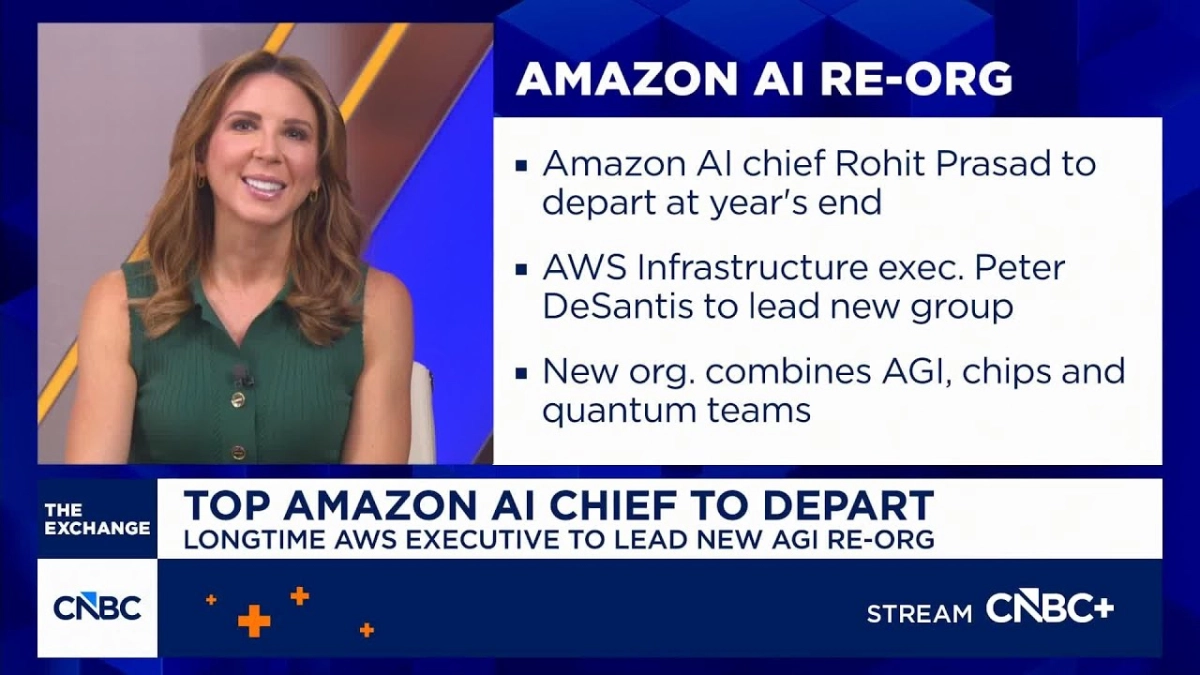
The announcement coincides with a significant internal reorganization within Amazon's AI division. Rohit Prasad, the outgoing Amazon AI chief, will be succeeded by Peter DeSantis, an AWS Infrastructure executive. DeSantis will head a newly consolidated group, merging Amazon's AGI, chips, and quantum teams under a unified leadership. This restructuring reinforces Amazon's commitment to its in-house AI hardware and foundational models, aiming to streamline development and accelerate innovation. It signifies a more aggressive, integrated approach to competing in the AI infrastructure space, directly challenging the established dominance of Nvidia and the growing capabilities of Google's Tensor Processing Units (TPUs).

The market's immediate reaction, with Amazon shares rising while other "Mag 7" stocks lagged, reflects investor confidence in the strategic value of this potential deal. It suggests a recognition that Amazon is actively addressing its perceived shortcomings in the AI race, leveraging its cloud infrastructure prowess and commitment to cost-effective, custom hardware. The move is not just about catching up but about carving out a distinct competitive advantage by offering a compelling alternative to the prevailing Nvidia-centric compute paradigm. This strategic pivot, driven by the dual needs of market positioning for Amazon and cost efficiency for OpenAI, signals a maturation of the AI infrastructure landscape where diverse, high-performance, and cost-optimized hardware solutions are becoming paramount.

#AI
#Amazon in talks
#Artificial Intelligence
#Technology

AI Daily Digest

Get the most important AI news daily.

GoogleSequoiaOpenAIa16z
+40k readers