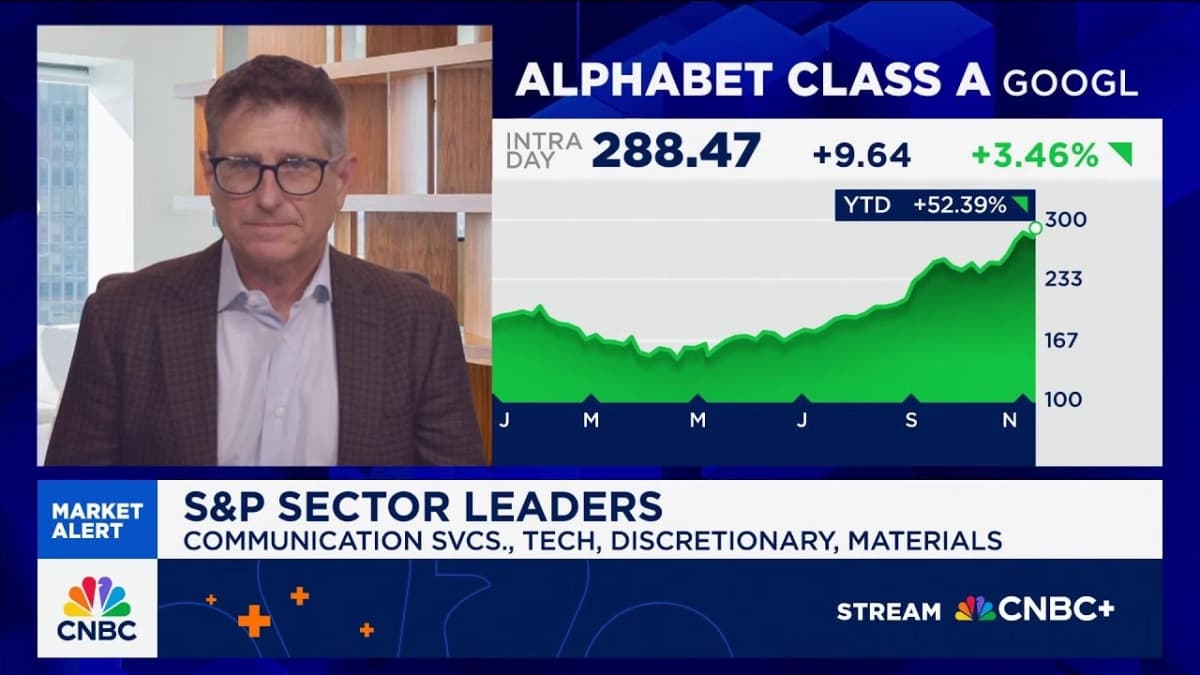
The true measure of success for today's market-leading technology stocks hinges less on fleeting political headlines and more on the long-term trajectory of artificial intelligence, a perspective articulated by Tom Hancock, Portfolio Manager at GMO. He posits that while daily market fluctuations may distract, the underlying potential of AI applications over the next five to six years is the paramount factor driving value.
Hancock spoke with a CNBC host on 'The Exchange' about the recent rally in megacap stocks, GMO's investment philosophy regarding AI, and specific sector preferences beyond technology. His commentary provided a pragmatic lens through which to view the current market, emphasizing quality and resilience in the face of anticipated volatility.
For Hancock, the current market dynamics, including movements related to government shutdowns, are largely superficial. He asserts, "What really matters is how successful AI is, what the end uses are five to six years from now." This long-term outlook underscores a fundamental belief that the transformative power of AI will ultimately overshadow short-term economic or political noise, making dips in these high-quality tech names a potential buying opportunity. Conversely, excessive market exuberance could signal a time to take profits.
Despite a bullish long-term view on AI, Hancock cautions against a smooth upward climb. He explicitly expects a "volatile trajectory" for AI investments. The more immediate concern for the AI sector, according to Hancock, is not a failure of the technology itself, but rather the potential for funding to dry up if risk aversion among investors intensifies. This highlights a crucial distinction: the technology is robust, but its growth is dependent on sustained capital expenditure. The ultimate long-term risk, he suggests, is the eventual size of the market, implying a need for careful selection rather than broad-brush enthusiasm.
GMO’s investment strategy in this environment is characterized by a focus on "safer businesses." This includes hyperscalers and supply chain companies, entities that possess the financial fortitude and diversified business models to withstand market storms. Such companies, often with strong balance sheets and established revenue streams, are seen as better positioned to continue investing in AI infrastructure and applications, even if broader market sentiment wavers. Hancock underlines that while approximately one-third of their portfolios are in AI-related stocks—a proportion similar to the S&P 500—their emphasis remains on quality within this segment.
Alphabet emerges as a prime example of a company well-positioned within the AI ecosystem. Hancock highlights its unique advantage: "Alphabet... they go all the way from end applications... down to kind of infrastructure. They have their own TPU chips that give them a cost of goods advantage over other people who are using Nvidia chips." This full-stack capability, from consumer-facing applications like Search and YouTube to proprietary hardware and technical expertise, provides a significant competitive moat. Furthermore, Alphabet’s strong balance sheet and long investment horizons mean they are less likely to "panic over short-term issues." The recent shift where Apple reportedly pays Alphabet for access to its Gemini AI, reversing the traditional dynamic of Google paying Apple for search default, signals a notable turn in competitive advantage and regulatory headwinds becoming less of a concern.
Beyond the tech sector, Hancock identifies healthcare as another attractive area for investment. He notes its non-cyclical nature and suggests that many companies in this sector are currently undervalued, having under-earned coming out of the COVID cycle. He specifically points to managed care and big pharma names, arguing that market reactions to regulatory concerns, such as those surrounding ACA subsidies, are often overblown. "ACA's not a big profit pool for these companies. So any overreaction to that, I think is a buying opportunity in a damaged sector," he states. This perspective suggests that perceived policy threats may have more "bark than bite," creating opportunities for discerning investors.
In essence, Tom Hancock’s commentary advocates for a disciplined, quality-focused investment approach. It emphasizes identifying companies with robust fundamentals, diversified business models, and a full-stack command over the AI value chain, while also seeking undervalued opportunities in less volatile sectors like healthcare. The prevailing message is to look beyond short-term market noise and focus on the enduring competitive advantages and long-term growth drivers.