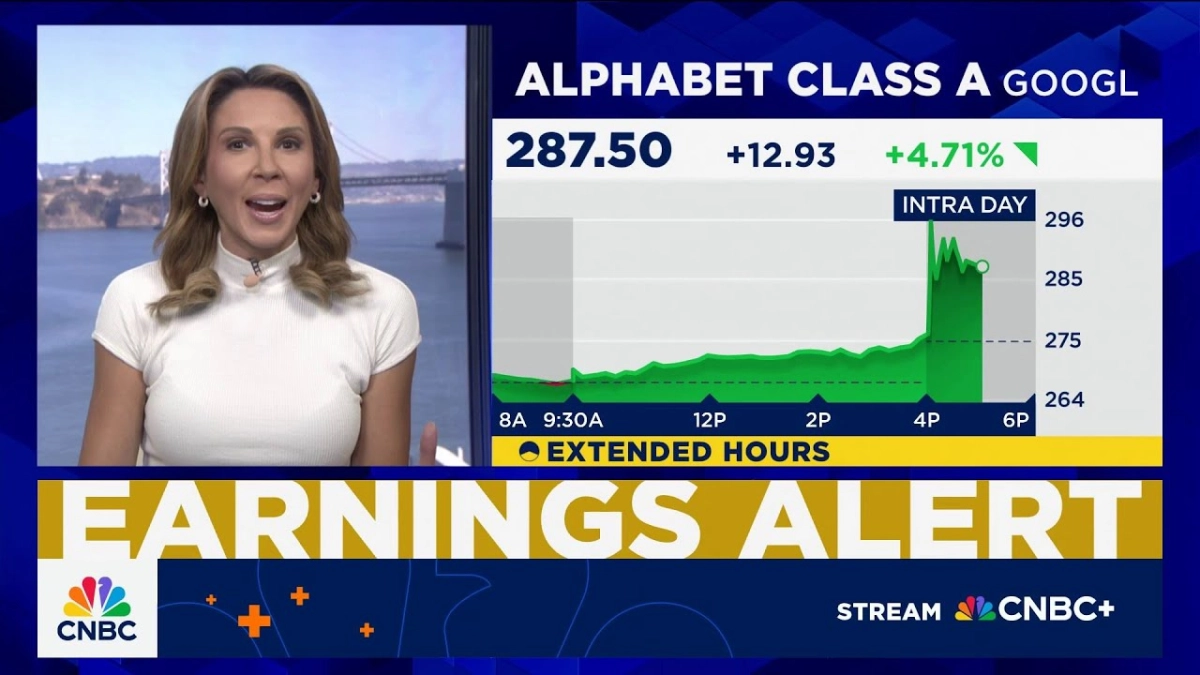
The notion that generative AI might cannibalize Alphabet’s foundational search advertising business was a prevalent concern amongst investors and industry observers alike. However, the company's Q3 results, as reported by CNBC’s MacKenzie Sigalos, unequivocally demonstrate a different narrative: AI is not merely a defensive play but a potent accelerant for Alphabet’s core segments and burgeoning cloud infrastructure. This financial period marks a pivotal shift, assuaging fears and illuminating the substantial returns on Alphabet’s aggressive AI investments.
MacKenzie Sigalos, reporting for CNBC, provided a succinct yet insightful overview of Alphabet's Q3 earnings, focusing on the unexpected strength of its search division and the continued momentum of Google Cloud. Her commentary underscored the broad impact of AI integration across the company’s offerings, dispelling the bearish sentiment that had shadowed its generative AI initiatives. The core topics revolved around Alphabet's strategic investments in AI, the performance of its search and cloud businesses, and the implications of its significantly increased capital expenditure.

One of the most striking revelations from the earnings report was the performance of Google's search advertising revenue. Analysts had braced for a potential erosion of this critical segment as users potentially shifted to AI chatbots for information retrieval, bypassing traditional ad-laden search results. Yet, the search segment "beat by one and a half billion dollars," a robust performance that not only defied expectations but also indicated a successful integration of AI into the search experience, enhancing rather than diminishing its value proposition. This suggests that Alphabet has adeptly navigated the initial disruption, turning a potential threat into an opportunity for improved engagement and monetization. For founders and VCs, this outcome validates the thesis that incumbents, with their vast data moats and distribution channels, can often integrate new technological paradigms in ways that strengthen their core business rather than merely reacting to competitive pressures.
Alphabet’s burgeoning AI ecosystem extends beyond search, with its chatbot, Gemini, demonstrating significant user adoption. With 650 million monthly active users, Gemini is rapidly scaling, indicating a strong appetite for Google’s generative AI capabilities.
This rapid adoption positions Google as a formidable player in the AI chatbot arena, challenging the perception of OpenAI’s ChatGPT as the sole dominant force. The sheer scale of Google’s user base and its ability to rapidly deploy AI features across its product suite represent a significant advantage, fostering a flywheel effect where more users lead to better data, leading to better models.
Beyond consumer-facing AI, Google Cloud emerged as another strong performer, with Sigalos noting it was "showing strength, topping estimates on the back of new AI deals with Meta and OpenAI." This is a crucial insight for the AI professional and startup ecosystem. Google Cloud is not just competing in the general cloud market but is actively positioning itself as the infrastructure provider of choice for leading AI developers, including those who might be considered direct competitors in other domains. This strategic move highlights the foundational role of cloud infrastructure in the AI era, where specialized hardware, robust computing power, and advanced AI services are paramount. The ability to secure deals with major players like Meta and OpenAI speaks volumes about the technical prowess and competitive pricing of Google Cloud’s AI offerings.
The intensified competition in AI infrastructure is further evidenced by Alphabet’s capital expenditure guidance. The company’s capex is "expected to hit $93 billion at the high end as Alphabet races to build infrastructure to meet demand and stay competitive with other hyperscalers." This substantial investment underscores the capital-intensive nature of the AI race, where scaling computational resources, particularly GPUs and custom AI accelerators, is non-negotiable for maintaining a competitive edge. This figure should serve as a stark reminder to startups and VCs of the immense financial commitment required to operate at the cutting edge of AI, differentiating the hyperscalers from smaller players. The demand for AI-specific infrastructure is driving unprecedented investment, creating a booming market for specialized hardware and data center capabilities.
Related Reading
- Alphabet’s AI Reckoning: Cloud Momentum vs. Search Durability
- Amazon's AI Power Play: Inside the $11 Billion Indiana Data Center
- The AI Infrastructure Gold Rush: Opportunities, Risks, and Strategic Moats
While Google Cloud’s backlog still trails that of Microsoft, Amazon, and Oracle, the recent deal with Anthropic, a prominent AI safety and research company, has yet to be fully reflected in these figures. This indicates a pipeline of significant AI-driven revenue growth that could further narrow the gap with its rivals. For tech insiders, this suggests that the battle for AI infrastructure dominance is far from over, with strategic partnerships and investments continuing to reshape the competitive landscape. The ability to attract and support leading AI research firms like Anthropic is a strong validation of Google Cloud’s platform and its long-term potential.
Ultimately, Alphabet's Q3 results, particularly an adjusted earnings per share of $3.10 against an expected $2.33, paint a picture of a company successfully leveraging its deep AI expertise to drive growth across its diverse portfolio. The report demonstrates that Alphabet has effectively navigated the initial uncertainties surrounding generative AI, transforming perceived threats into tangible opportunities. The financial performance reflects a robust strategic pivot, where AI is integrated not just as a feature but as a fundamental driver of revenue and market positioning.