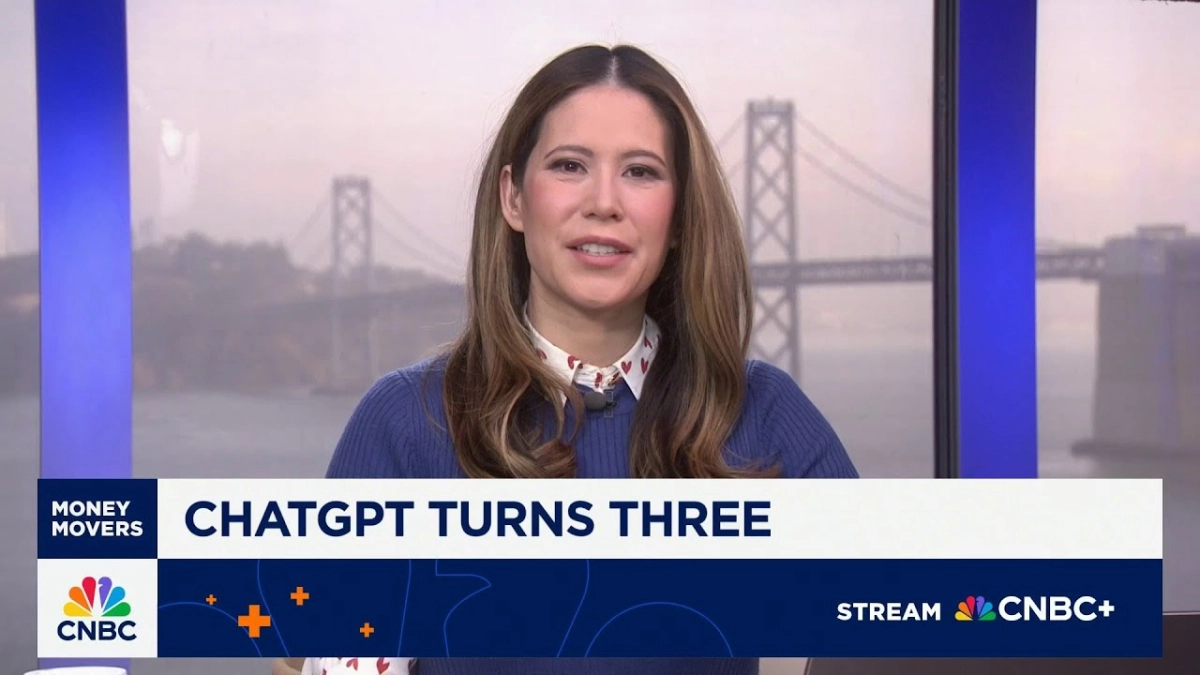
The narrative surrounding artificial intelligence has dramatically evolved in the three years since ChatGPT's public debut, transforming from a story of disruptive startups to a battle for infrastructural supremacy waged by deep-pocketed incumbents. CNBC’s Deirdre Bosa, speaking with anchors Carl Quintanilla and Sara Eisen on "Money Movers," meticulously dissected this evolution, highlighting how the competitive landscape for AI dominance has fundamentally altered, moving beyond mere model intelligence to encompass the vast resources of chips, cloud infrastructure, and user distribution.
In its nascent stage, often dubbed "the model era," the AI market’s prevailing sentiment was that of a "Google killer," where the primary moat was simply possessing the "smartest model." The winners of this initial phase were the nimble, fast-moving startups that could rapidly innovate and break existing paradigms. This period was characterized by a fervent optimism, with venture capital pouring into promising new AI ventures.

However, as Bosa keenly observed, "Year three is about math and scale. It's a game that the incumbents like Google, that were built to win." This signifies a profound shift, where the initial magic of groundbreaking models has given way to the hard realities of industrial-scale AI development and deployment. Google, far from being killed, is now "approaching a $4 trillion market cap," leveraging its immense financial strength and technological ecosystem. The moat has fundamentally changed.
The new battleground is infrastructure. "The moat is now the hardware, the cloud, the distribution to billions of users," Bosa articulated, underscoring that raw model intelligence, while still crucial, is no longer the sole differentiator. Companies like Google and Microsoft, with their established cloud platforms (Google Cloud, Azure) and vast user networks, possess an inherent advantage. They can integrate AI capabilities directly into widely used products and services, reaching billions without the need for independent platform adoption. This integration capability allows them to scale AI solutions efficiently and cost-effectively, a significant hurdle for smaller startups.
The financial landscape for AI innovation also reflects this shift. What was once funded by "VC checks and optimism" is now increasingly reliant on "debt and CapEx." OpenAI's partners are reportedly piling up "a hundred billion dollars in debt" to fuel their ambitions, while Google can draw from its already "cash-rich balance sheet." This capital-intensive environment favors those with existing financial leverage and robust revenue streams, making it harder for new entrants to compete on the sheer scale of investment required for cutting-edge AI development.
User behavior provides a critical validation point for these investments. Bosa presented compelling Similarweb data indicating a "stickiness flip" between ChatGPT and Google's Gemini. While ChatGPT still commands higher raw usage volume, the average user is now spending "more minutes per session on Gemini." This suggests users are engaging with Gemini for "deeper work," moving beyond simple queries to more complex, sustained interactions. Furthermore, Gemini's mobile active user growth year-over-year soared by 273.6%, dwarfing ChatGPT's 54.2% increase, highlighting a significant momentum shift in user engagement.
Related Reading
- Apple's AI Blind Spot, Google's Strategic AI Rally
- How OpenAI Builds for 800 Million Weekly Users: Model Specialization and Fine-Tuning
- The Nuanced Reality of the AI Chip Race: Google's Specialization vs. Nvidia's Ubiquity
The emergence of open-source models, particularly from Chinese labs, introduces another layer of complexity. These alternatives are "providing cheap, high-performance alternatives," effectively driving down "the cost of intelligence." This development challenges the "winner-take-all" mentality that often pervades tech investment. Instead, AI is beginning to behave like a commodity, leading to specialization and fragmentation rather than market consolidation.
This commoditization means that while proprietary models from OpenAI and Google will continue to push the boundaries of AI capabilities, a growing ecosystem of specialized, efficient, and cost-effective open-source solutions will proliferate. For enterprises and developers, this provides more choice and potentially lower barriers to entry for integrating AI, but it also means the value may shift from the foundational models themselves to the applications and services built on top of them. The strategic partnership between OpenAI and Accenture, a consulting giant, exemplifies this shift towards integration and distribution, rather than solely focusing on model development. It’s a return to an earlier era, where the "halo effect" of partnering with a leading AI provider still holds sway, but the depth of integration, rather than superficial association, will define success.