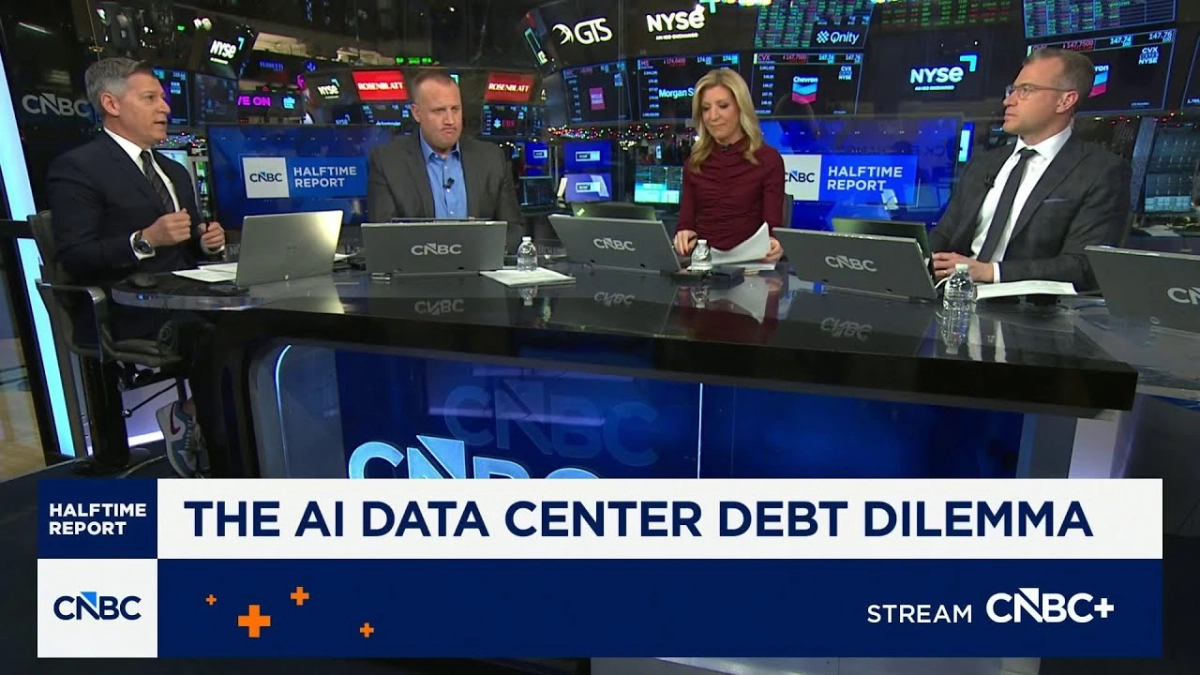
The collective investment narrative around artificial intelligence, while undeniably powerful, is undergoing a critical re-evaluation, as explored by the CNBC Halftime Report panel. Scott Wapner, alongside Chief Investment Strategist Stephanie Link, Blue Line Capital's Bill Baruch, and Ritholtz Wealth Management's Josh Brown, dissected the "AI data center debt dilemma," questioning whether the overarching AI story remains intact or if a more discerning approach to investment is now paramount. The consensus emerging from the discussion points to a bifurcated market, where the robust fundamentals of some players contrast sharply with the precarious debt-laden positions of others.
Apollo's Marc Rowan, in a recent interview referenced by the panel, succinctly captured this evolving landscape: "Hyperscalers are pretty safe; intermediaries that are taking up the debt and balance sheet risk not so much." This distinction underscores a fundamental divergence in the AI investment thesis. Companies with the capital strength to absorb massive infrastructure costs, like the tech giants building out their own AI capabilities, are perceived as more secure. Conversely, the "intermediaries" – those providing the underlying infrastructure and services, often reliant on significant debt to finance their expansion – face a more challenging environment as capital costs rise and market expectations shift.
Stephanie Link highlighted Meta Platforms as an example of a hyperscaler in the "sweet spot" of AI, noting its recent month-to-date gain. Despite a prior 26% drop from its high due to increased capital expenditure announcements, Meta's underlying financial health remained strong. "They were still able to grow 26% revenues, 20% earnings, margin expansion, free cash flow generation," Link explained, emphasizing the company’s ability to fund its AI ambitions from a position of strength. This contrasts sharply with other players in the data center ecosystem who may be struggling to generate sufficient free cash flow to service their burgeoning debt, a critical indicator of long-term viability.
The market’s increasingly critical eye is evident in the performance disparities among companies contributing to the AI infrastructure build-out. While Meta and Broadcom, with its impressive 70% AI growth last quarter and 100% expected this quarter, are viewed favorably, others are not. Oracle, for instance, has seen significant pullback, its stock down nearly 40% over three months, raising concerns among the panel. "They are not generating free cash flow. That's the biggest problem and the debt markets, that's the CDS spreads are telling you that they're worried, they're losing confidence," Link stated, pointing to a lack of fundamental financial discipline that is now being punished.
This scrutiny extends beyond the direct AI chipmakers to the broader industrial companies that enable data center construction and operation. Link pointed to companies like GE Vernova, Vertiv Holdings, Quanta Services, and Eaton Corp, all boasting strong backlogs and clear revenue visibility. These firms, providing essential power, cooling, and infrastructure services, represent a more tangible and less speculative play in the AI build-out, offering revenue streams that are less susceptible to the immediate whims of market sentiment.
The recent surge in Micron Technology’s stock after its stellar earnings report further illustrates the market's evolving discernment. Micron reported impressive cloud memory sales, doubling year-on-year, and received upgrades from several sell-side firms. BofA's trading desk noted that "Micron's stellar earnings last night have provided bit of support for the recently rudderless AI trade and for today at least, this catalyst looks set to halt the bleeding in AI and adjacent themes, following yesterday's bloodbath across the semis, software, power and datacenter ecosystem." This performance suggests a market willing to reward companies with clear, profitable exposure to the foundational components of AI infrastructure, particularly high-bandwidth memory.
Josh Brown articulated a critical tenet of a healthy bull market: "One of the hallmarks of a healthy bull market is that it takes out its own trash." He contrasted Micron’s sustained strength and quick recovery from dips with the prolonged decline of Super Micro Computer (SMCI), despite both being suppliers to the AI data center theme. While Micron has seen its stock soar, SMCI has languished, trading significantly lower than its previous highs. This divergence highlights the market's increasing ability to differentiate between companies with genuinely robust fundamentals and those merely riding the speculative wave. The AI narrative is far from over, but the era of indiscriminate investment is certainly waning, replaced by a demand for demonstrable financial health and strategic positioning.