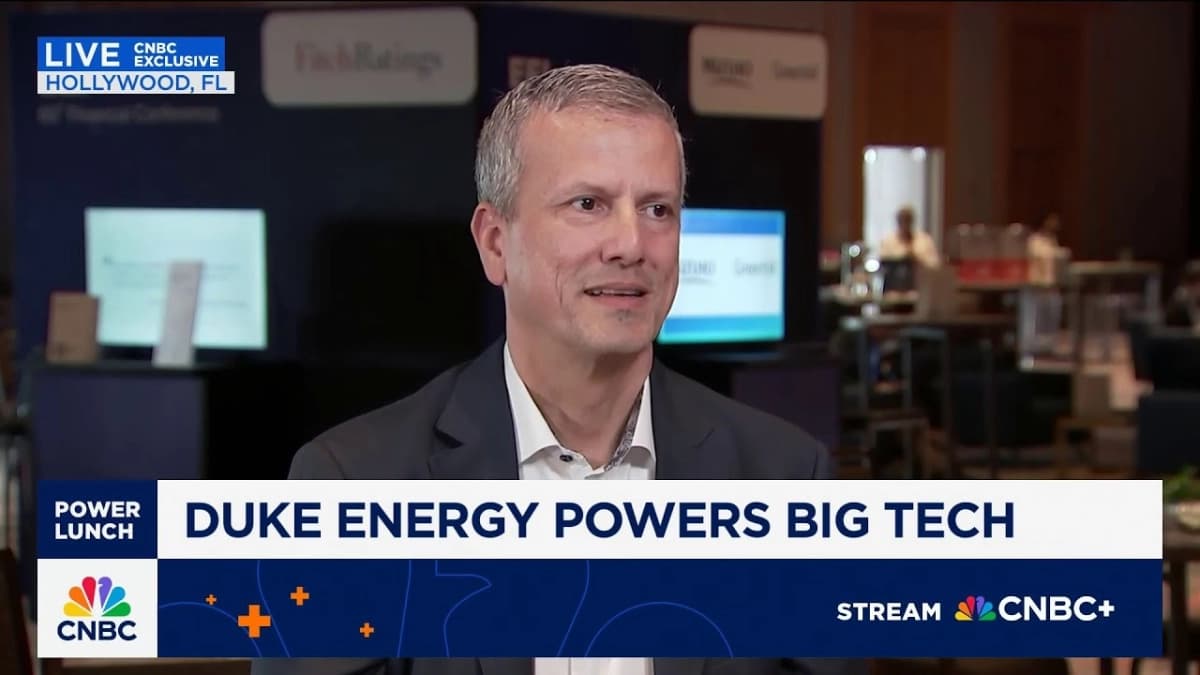
"How quickly we can bring speed to power." This fundamental question, posed by AI companies, encapsulates the urgent demands now facing utility providers, as highlighted by Duke Energy CEO Harry Sideris in a recent interview with CNBC's Brian Sullivan. The conversation illuminated the critical role of energy infrastructure in facilitating the burgeoning artificial intelligence sector, particularly in states like North Carolina, and the strategic considerations utilities must navigate.
Harry Sideris, President and CEO of Duke Energy, spoke with Brian Sullivan on CNBC’s "The Exchange" at the EEI Financial Conference in Hollywood, Florida. Their discussion centered on Duke Energy's pivotal role in supporting the burgeoning artificial intelligence sector, the specific demands of AI companies, and the strategic importance of energy infrastructure in facilitating this technological boom.
Sideris emphasized that the paramount concern for AI companies like Amazon, Google, and Microsoft is the swift provision of power. These firms are not merely seeking energy; they require it with unprecedented velocity, demanding faster transmission line construction and quicker energy delivery. "We're focused on how we can bring speed to power," Sideris stated, articulating the core challenge. He elaborated that AI companies specifically inquire, "How fast can you build transmission lines? How fast can you get energy to them?" This rapid deployment capability is a significant competitive differentiator for utilities and regions. Duke Energy has proactively addressed this by assembling dedicated teams focused on accelerated infrastructure development, a strategy that proved instrumental in securing a significant Amazon deal in Richmond County, North Carolina. The Amazon investment, a staggering $10 billion, represents the largest single economic development project in North Carolina's history. This influx is poised to generate 500 new jobs in a rural community, profoundly transforming its economic landscape. Beyond direct employment, this investment drives ancillary economic activity, from construction and local services to increased tax bases, ultimately strengthening the regional economy.
A critical concern, as Sullivan rightly probed, is how the immense power demands of AI data centers will affect the electricity bills of residential and other commercial customers. Sideris affirmed that protecting the broader customer base from these large loads is a top priority for Duke Energy. He clarified that the utility works with companies like Amazon on "special contract terms" to ensure these major consumers "are paying their way. None of our customers are going to pay or subsidize the Amazon deal that we just signed." This commitment to equitable cost allocation is crucial for maintaining public trust and regulatory approval as utilities attract more power-intensive industries.
Moreover, Sideris noted that the increased presence of data centers could, over time, lead to reductions in fixed costs for all customers. As these new entities contribute to the overall tax base and absorb a portion of the grid's fixed operational expenses, the burden on individual households and smaller businesses may decrease. "I think over time you will see reductions because they will be taking on a portion of the fixed cost that are in everybody's bill," he explained. This symbiotic relationship, where new industrial loads contribute to shared infrastructure costs, offers a compelling economic argument for utilities engaging with the AI sector, provided the contractual frameworks are robust.
The rapid expansion of AI infrastructure necessitates not just speed, but also immense, reliable, and consistent power generation. Sideris highlighted North Carolina's strategic advantage, situated near the Transco natural gas pipeline, which is vital for meeting this escalating demand. He revealed that Duke Energy is currently building "seven and a half gigawatts of new gas-fired power plants in North Carolina, powered by that pipeline that you're talking about." This substantial investment in gas-fired generation underscores the immediate need for dispatchable power, which can be ramped up or down quickly to meet fluctuating demand, a characteristic not yet fully matched by intermittent renewable sources without significant battery storage.
The proximity to a major gas pipeline ensures a reliable and affordable fuel supply, critical for hyperscale operations where even momentary power interruptions can lead to significant data loss and operational disruption. While the long-term energy transition towards renewables remains a goal, the immediate and continuous power requirements of AI computing underscore the continuing importance of robust fossil fuel infrastructure in the near to medium term. For founders, VCs, and AI professionals, understanding this intricate interplay between energy supply, infrastructure, and cost structures is paramount when evaluating potential locations for their power-hungry operations. The strategic placement of data centers near existing, reliable power sources like these pipelines offers a distinct advantage, ensuring both operational stability and a pathway for future growth.
Duke Energy’s proactive approach, combining rapid infrastructure deployment with careful ratepayer protection and strategic energy source utilization, positions it as a key enabler of the AI revolution. The company's ability to deliver power at the speed and scale required by the world's largest tech firms, while navigating complex economic and environmental considerations, provides a blueprint for other utilities facing similar burgeoning demands.