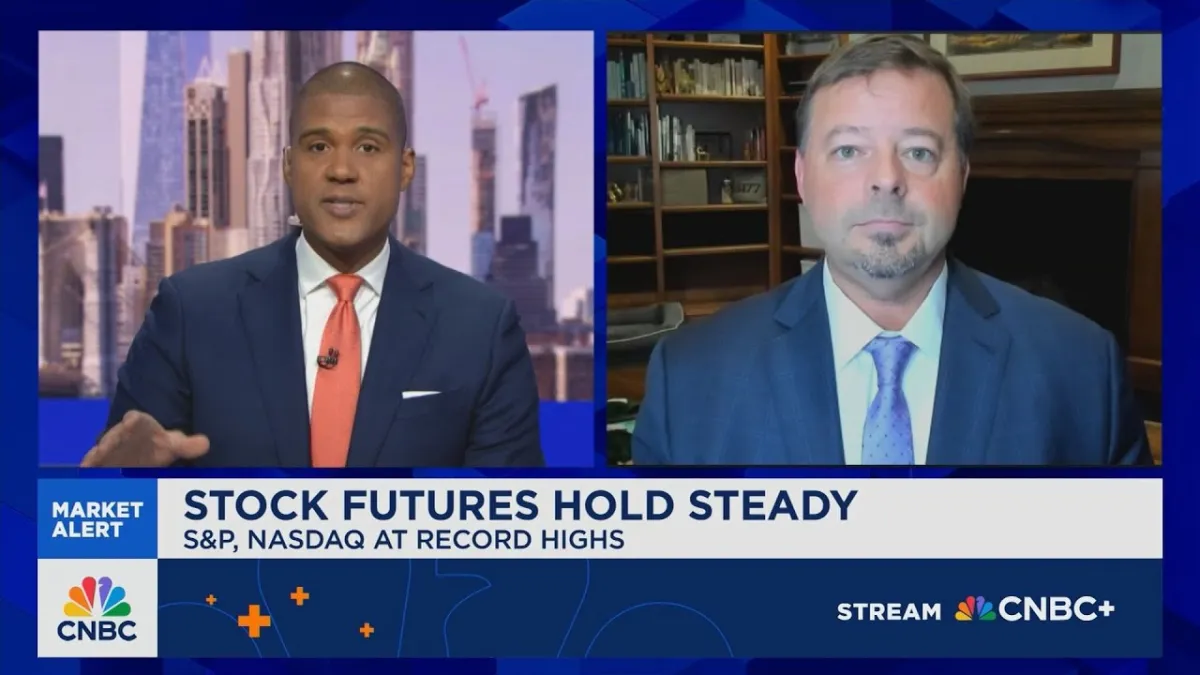
The market continues its relentless march, powered predominantly by the transformative force of artificial intelligence. Scott Ladner, Chief Investment Officer at Horizon Investments, recently engaged with CNBC's Frank Holland in an insightful discussion, dissecting the current investment landscape and the sectors poised for future growth. Their conversation, set against a backdrop of rising S&P and Nasdaq futures, underscored AI's multifaceted influence, extending far beyond the immediate beneficiaries of chip manufacturers and hyperscalers.
Ladner firmly asserts, "This is still a tech-driven, AI-driven market," emphasizing that the momentum isn't solely derived from the direct applications of AI, but critically, from the foundational infrastructure required to scale its capabilities. He highlights the profound, often underestimated, extent of this necessary build-out. The sheer scale of what needs to be constructed to fully integrate AI productivity across global economic systems is monumental.
A significant point of analysis revolved around the financial health underpinning this AI expansion, especially in contrast to past tech bubbles. Unlike the late 1990s, where speculative ventures were frequently fueled by debt, the current wave of investment is largely self-sustaining. Ladner clarifies, "These things are being funded by through cash flows. They're being funded through operating profits. They're not being funded through debt like in the late 90s and early 2000s." This distinction suggests a more robust and sustainable growth trajectory, mitigating concerns about overvaluation for core infrastructure players.
The "AI Arms Race," as visually depicted by CNBC, illustrates a circular spending model among tech giants like Nvidia, OpenAI, Oracle, and AMD. Nvidia invests in OpenAI, which leverages Oracle's cloud compute, which in turn might deploy AMD chips, while AMD itself holds a stake in OpenAI. This interconnected ecosystem demonstrates how capital flows are reinforcing the build-out, creating a virtuous cycle of investment and deployment within the AI supply chain. Hyperscalers such as Amazon, Microsoft, Google, and Meta are projecting staggering capital expenditures, with Amazon alone expected to exceed $100 billion by 2025.
Beyond the immediate tech giants and chipmakers, Ladner points to "adjacent to the tech trade" areas where AI's influence is set to create substantial value. He believes "that infrastructure play is going to be one of the most important ones that we're going to see," particularly as the market fully grasps the sheer scale of the necessary build-out. This extends beyond data centers and networking hardware to the foundational elements that enable AI to function at a global level.
The discussion also touched upon the unexpected outperformance of healthcare, traditionally considered a defensive sector. Ladner views this as a natural rebalancing, noting that healthcare has "underperformed drastically" over the past several years. Investors are now actively seeking avenues for growth and efficiency, with AI emerging as a key enabler. Artificial intelligence has the potential to revolutionize drug development, streamline manufacturing processes, and enhance overall productivity within the healthcare sector. This infusion of AI could provide a much-needed boost, offering a "margin for safety" for those looking to diversify beyond pure tech.
Financials, too, are positioned to benefit, not only from the broader economic ripple effects of AI-driven productivity but potentially from regulatory shifts. Ladner anticipates that "financials probably will start to benefit from some deregulation pushes that start coming from the administration next year." This could unlock new opportunities and efficiencies within a sector that stands to gain significantly from AI-powered automation and data analysis.
Holland briefly pivoted to the resurgence of "meme stocks," noting a meme stock ETF (MEME) that saw a nearly 13% jump in pre-market trading. Ladner, with a wry smile, quipped, "What else would you expect a meme stock ETF to do, frankly?" He acknowledged that this behavior, characterized by retail investors engaging in aggressive call buying, mirrors the speculative frenzy of 2021. While not endorsing such speculative plays, his commentary implied that the broader market's underlying strength, driven by robust AI fundamentals and cash flows, might be indirectly contributing to a general appetite for risk.
Ultimately, the core message from Ladner is clear: AI is not a fleeting trend but a fundamental shift driving significant, sustained investment. The market's current valuations, particularly in the tech and adjacent infrastructure sectors, are supported by robust cash flows and the immense, ongoing need to build out the foundational capabilities for AI. This industrial-scale build-out, coupled with AI's potential to revitalize undervalued sectors like healthcare and financials, paints a picture of a market evolving with profound structural changes.