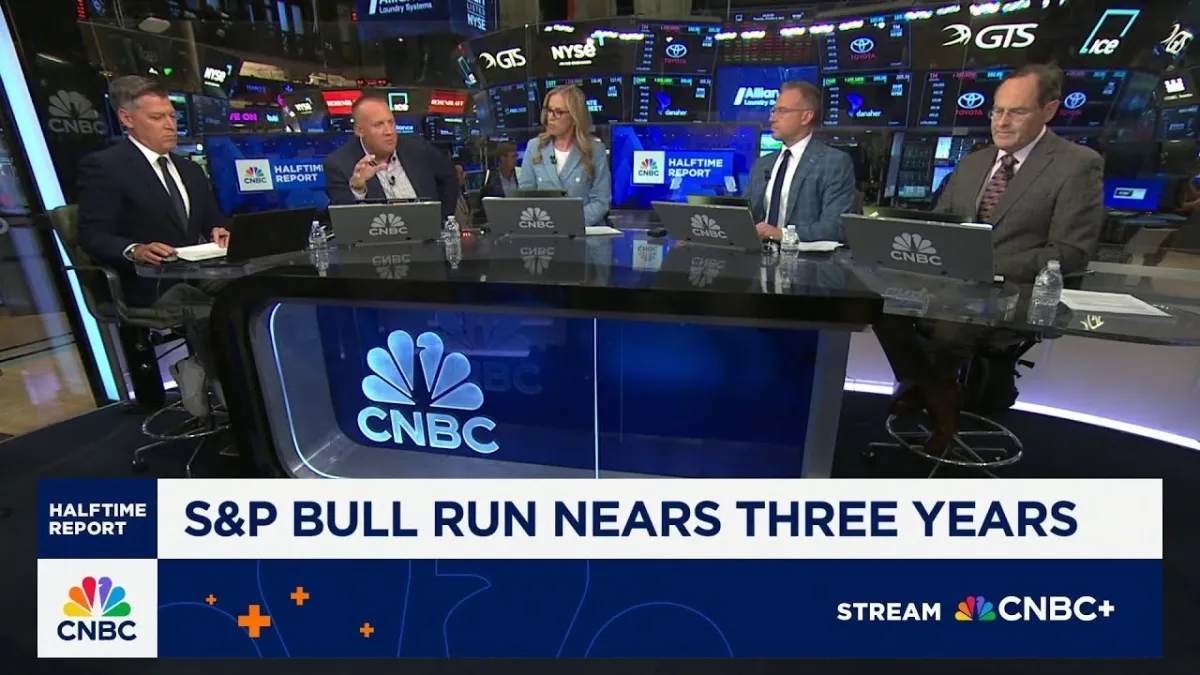
The burgeoning landscape of artificial intelligence presents a stark dichotomy for investors and industry leaders: undeniable transformative potential on one hand, and the looming specter of speculative excess on the other. This tension formed the core of a recent CNBC Halftime Report discussion, where a panel of financial experts delved into the remarks of JPMorgan Chase CEO Jamie Dimon, who offered a historical perspective on the current AI frenzy. The debate wasn't merely academic; it sought to discern whether the present enthusiasm for AI echoes the irrational exuberance of past bubbles or if it represents a foundational shift justifying today's soaring valuations.
The CNBC Halftime Report panel, hosted by Scott Wapner, engaged in a lively exchange following Jamie Dimon's interview where he addressed concerns about an AI-driven market bubble. Dimon, known for his pragmatic insights, drew parallels between the current AI buildout and historical technological revolutions, cautioning against the perils of speculative investment. His commentary provided a crucial backdrop for the panel's subsequent analysis, inviting a deeper look into market valuations, earnings sustainability, and the sheer velocity of capital flows into AI-centric ventures.
Jamie Dimon articulated a nuanced view, acknowledging the profound impact of AI while tempering expectations for short-term investor gains. He stated, "It's really impossible to tell the burst... AI is real, AI will pay off... but most people involved in it didn't do well." This sentiment underscores a critical distinction: the long-term, fundamental value of a technology does not guarantee success for every participant in its early, often speculative, phases. History, from the railway mania to the dot-com boom, is replete with examples of groundbreaking innovations that ultimately transformed society, yet left many early investors and companies in their wake.
The panel quickly picked up on the theme of market exuberance. Josh Brown, a panelist, highlighted aggressive activity in the financial sector, noting that "none of these things would have been happening even as recently as a year or two years ago," suggesting a broader market dynamism that extends beyond direct AI integration. This observation points to a contagion effect, where the AI narrative fuels speculative behavior across diverse sectors, potentially decoupling valuations from immediate operational realities.
Goldman Sachs, echoing Dimon's cautious stance, provided a quantitative perspective on market health. Their analysis, presented during the report, indicated that while valuations are "looking increasingly stretched," the market is "not a bubble yet at the levels that were typically in other bubble periods before they burst." However, they warned, "The biggest risk is that earnings disappoint and investors start to question the sustainability of their current rates of return. This, at least, could trigger a significant correction." This highlights the precarious balance between growth expectations and the tangible delivery of financial results.
The discussion intensified as panelists cited recent, almost unbelievable, stock performance in the AI ecosystem. Advanced Micro Devices (AMD), for instance, saw its stock price surge by over 40% in just three days, a phenomenon Josh Brown described as "ludicrous activity." Micron, Oracle, and Nvidia also experienced substantial, rapid gains, with Lam Research also seeing a significant uptick.
Such rapid appreciation in market capitalization, particularly for established multi-hundred-billion-dollar companies, raises legitimate questions about the underlying drivers. While genuine innovation and strategic partnerships are undoubtedly occurring, the velocity of these gains suggests a significant component of speculative capital chasing the AI narrative. The market is not merely valuing future earnings potential but appears to be aggressively front-running it, creating an environment susceptible to sharp corrections if growth projections falter or competitive landscapes shift.
Shannon Saccocia added a crucial dimension to the debate, emphasizing the time lag inherent in monetizing AI investments. She noted that the "transmission of the AI CapEx that's been done is going to take some time to actually be monetized by these companies." This underscores that while companies are pouring capital into AI infrastructure and development, the realization of tangible returns and "clear use cases" within their businesses is not instantaneous. This temporal disconnect between investment and monetization creates a window during which market expectations can outpace real-world performance, setting the stage for volatility.
The panel's overarching sentiment, while acknowledging the profound potential of AI, gravitated towards a cautious appraisal of current market dynamics. The rapid ascent of AI-related stocks, coupled with stretched valuations and the inherent lag in realizing returns from capital expenditures, paints a picture of a market perhaps not in a full-blown bubble, but certainly exhibiting characteristics of heightened speculation. The true test will lie in the ability of these companies to translate their AI investments into sustainable earnings growth, validating the hype with tangible results rather than relying solely on the promise of future innovation.