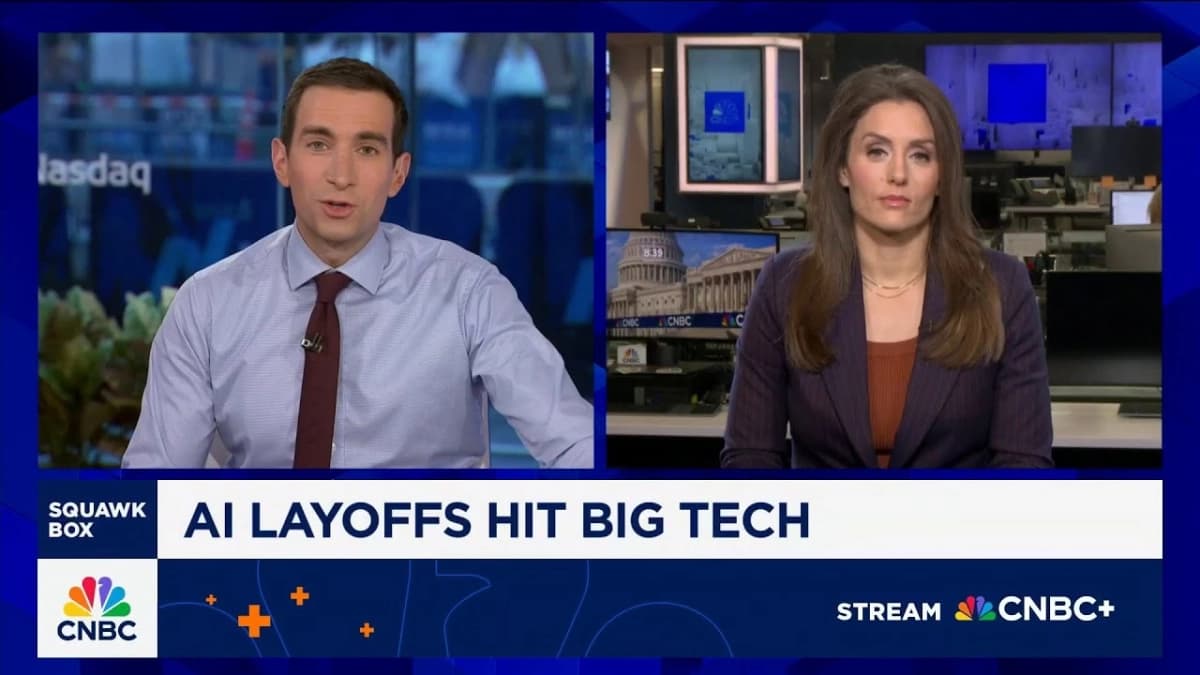
Partsinevelos, speaking with Andrew Ross Sorkin, framed the discussion around a central query: are the reported AI layoffs in Big Tech genuine, or are they serving as a convenient "scapegoat" for other underlying issues in the employment landscape? She highlighted recent job cuts across major tech companies—Amazon, Applied Materials, Meta, and Google Cloud—some explicitly attributing these reductions to AI-driven efficiencies. Yet, insights gleaned from top CEOs at NVIDIA’s GTC event offered a more intricate perspective.
Aravind Srinivas, CEO and Co-Founder of Perplexity, was unequivocal in his assessment, stating, "Overhiring they did in the COVID era when they didn't actually need to. That's the results of that are being seen now. So correlation doesn't imply causation, like it's not because of AI that people are losing jobs." This direct challenge suggests that the pandemic-induced surge in demand, coupled with readily available capital, led to an unsustainable expansion of headcount across the tech sector. The current layoffs, then, represent a market correction, a re-alignment of resources, rather than a direct consequence of AI’s capabilities.
This perspective reveals a core insight: many current tech layoffs are a correction of past overhiring, with AI serving as a convenient scapegoat or an accelerant for pre-existing efficiency goals. It allows companies to streamline operations while simultaneously investing in the very technology they cite for restructuring. The narrative of AI-driven optimization provides a palatable explanation for shareholders, masking potentially less strategic decisions made during a period of rapid, perhaps unchecked, growth.
Michael Intrator, CEO of Coreweave, expanded on this, describing the phenomenon not as a destructive force but as a "rotation" inherent to technological evolution. "During each technical revolution, there is a rotation that occurs," Intrator explained, emphasizing the necessity to "retrain, to repurpose" the workforce. He further posited that government has a role in facilitating this transition, assisting individuals in building new careers amidst the shift. This frames AI as a transformative agent, demanding adaptability and continuous learning, rather than simply eliminating roles.
CrowdStrike CEO George Kurtz reinforced this idea, suggesting that AI will ultimately elevate human workers to supervisory roles, acting as "controllers" while AI handles the more mundane, repetitive "grunt work." This vision implies a symbiotic relationship where humans and AI collaborate, with the latter augmenting human capabilities rather than rendering them obsolete. The shift is less about job eradication and more about job evolution, demanding higher-level cognitive engagement from the human workforce.
Partsinevelos’s summation crystallizes a second core insight: companies are using the AI narrative "as cover to finally correct years of bloated headcount and hiring mistakes." This candid observation highlights a strategic maneuver where AI becomes a justifiable reason for cost-cutting, even as these same companies pour billions into AI development. Microsoft, for example, is noted to have invested $80 billion in AI this year, even while eliminating over 15,000 jobs. This simultaneous investment and reduction point to a deliberate re-allocation of resources towards future growth areas, underpinned by increased efficiency.
Related Reading
- Amazon's AI-Driven Efficiency Reshapes Big Tech Workforce
- AI's True Impact: Productivity, Not Layoffs, Driving CEO Agendas
- AI Reshapes M&A Landscape, Trillions in Value Up for Grabs
The male anchor then introduced a profound consideration for the future of work: if AI indeed fosters "remarkable amounts of productivity," what are the broader implications for the economy when fewer individuals are required to produce more? Partsinevelos affirmed that this productivity inherently implies job cuts to lower costs and maintain margins, confirming a direct link between AI-fueled efficiency and workforce reduction.
This leads to a third core insight: while AI promises immense productivity gains and profitability, the economic implications for the workforce—specifically, fewer jobs for a given output—are a significant, underlying concern that current corporate explanations often sidestep. For founders, VCs, and AI professionals, this implies a critical need to consider not just the technological advancements but also the societal impact. The ability of companies to post record profits while reducing their workforce, enabled by AI, presents a complex challenge that demands innovative solutions for managing economic transitions and fostering new forms of employment. The current landscape is a testament to both the transformative power of AI and the enduring human element of economic cycles.