

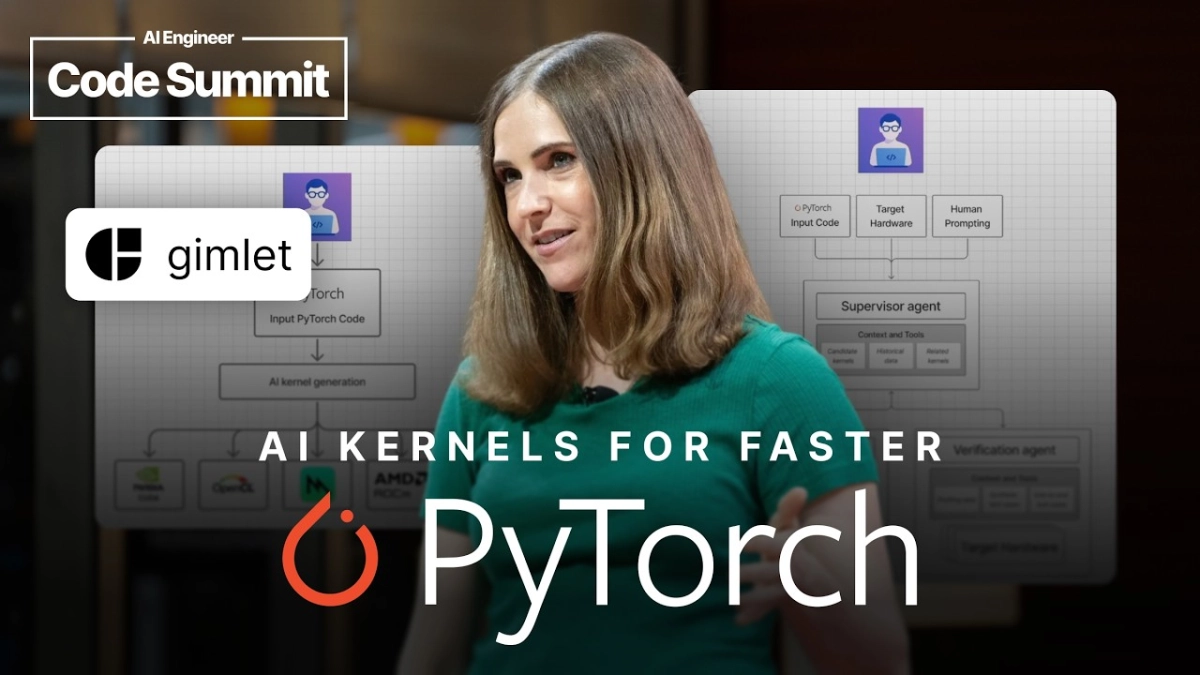
In the relentless pursuit of computational efficiency, the fine art of low-level kernel optimization has long remained the exclusive domain of a select few, a bottleneck in the age of rapidly evolving AI models. Natalie Serrino, Co-founder of Gimlet Labs, recently illuminated this critical challenge and her company's novel approach at the AIE Code Summit. Her presentation centered on how AI-generated kernels can dramatically accelerate custom PyTorch code, tackling the inherent complexities of hardware-specific optimizations without requiring extensive human intervention.
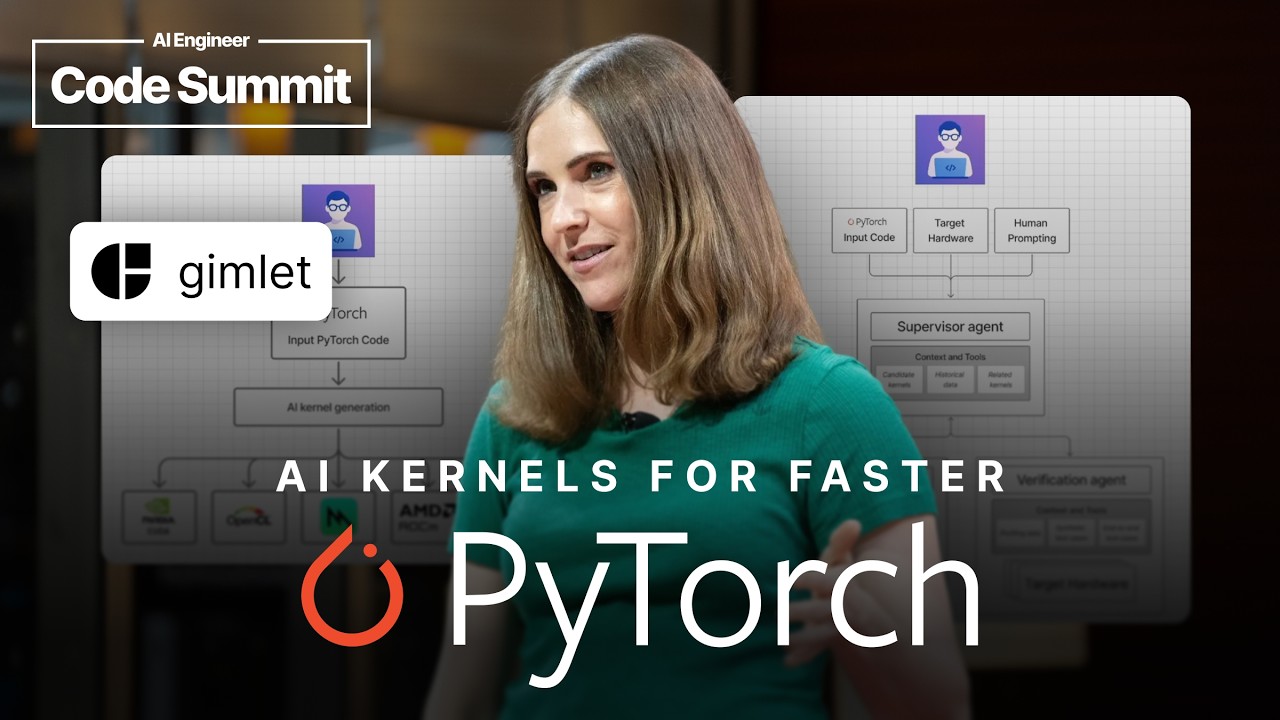
Gimlet Labs is at the forefront of building an agentic inference cloud, purpose-built for performance and efficiency. Serrino explained their core mission: to leverage AI to automatically synthesize kernels, bridging the gap between high-level PyTorch code and the nuanced demands of diverse hardware. This initiative is particularly pertinent given the explosion of AI models and the heterogeneous nature of modern computing environments, from NVIDIA GPUs to Apple Silicon and various other platforms.
The crux of the problem lies in the specialized knowledge required. While frameworks like Triton and MLX offer programmatic optimizations, the most substantial performance gains often stem from "hand-written, low-level kernels that are targeted to the exact device and workload." These are notoriously tedious and time-consuming to craft, especially when developers must support multiple platforms, each with its unique architectural characteristics, cache sizes, and optimal instruction sets. As Serrino highlighted, "There's just not enough experts to be able to solve every problem in this space right now." This scarcity of deep kernel expertise creates a significant impediment to widespread, high-performance AI deployment.
Gimlet Labs proposes an agentic optimization path, mirroring and enhancing the human workflow. An AI agent receives PyTorch code and embarks on an iterative loop: it generates kernel candidates, checks if they compile, execute correctly, and then evaluates their performance. Errors or suboptimal results feed back into the agent, guiding further refinement. This continuous feedback loop, powered by AI, allows for rapid exploration of optimization possibilities that would be impractical for human engineers.
However, the journey is not without its intricate challenges, particularly in measuring the effectiveness of these AI agents. "What is the definition of 'correct'?" Serrino pondered, emphasizing the complexities introduced by floating-point arithmetic and the need for carefully selected input sizes. Naive performance timing can be misleading, often measuring launch overhead rather than true execution time, necessitating sophisticated benchmarking considerations like warm-ups and cache clearing. These are critical details that underscore a profound insight: the very metrics used to evaluate AI performance in this domain are themselves complex and prone to misinterpretation, demanding a human-in-the-loop approach for true validation.
