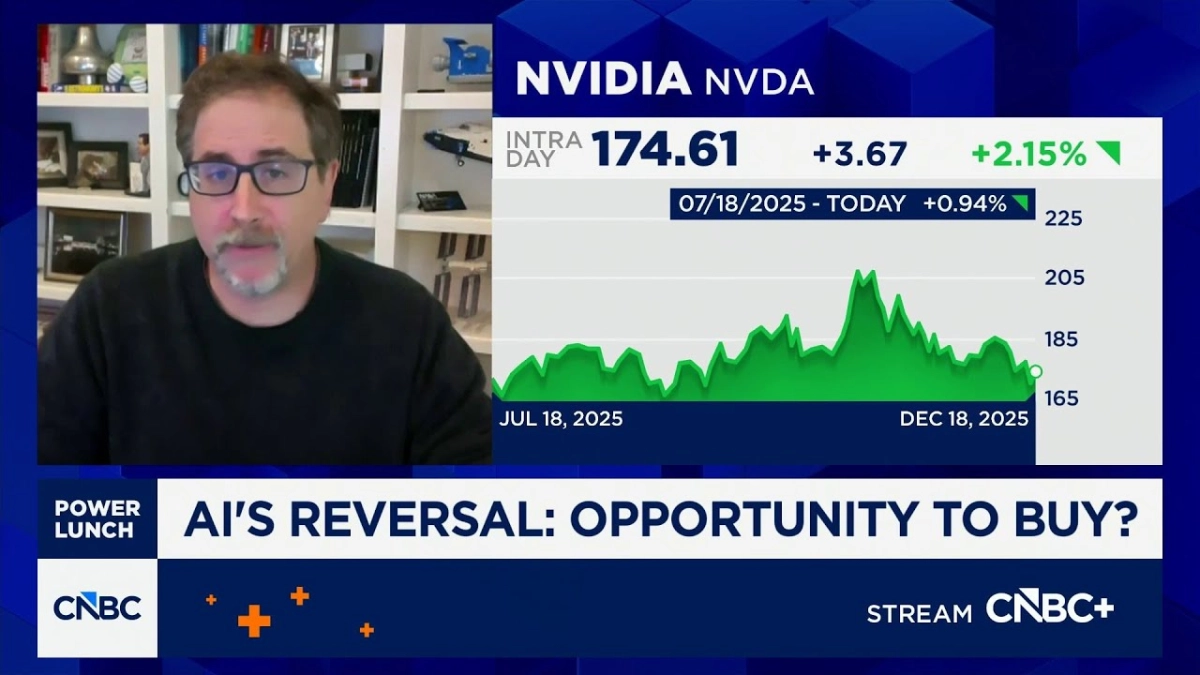
"AI demand is off the charts," declared Bernstein's Stacy Rasgon, a U.S. semiconductor analyst, on CNBC's "Power Lunch." This blunt assessment cuts through the market's recent anxieties, offering a grounded perspective on the relentless appetite for compute power fueling the artificial intelligence revolution. The sheer scale of this demand, he contends, is not merely a transient trend but a fundamental shift, deeply impacting the semiconductor industry.
Rasgon spoke with CNBC's "Power Lunch" team, including anchors Scott Wapner and Kelly Evans, about the latest market dynamics surrounding AI. The discussion critically addressed concerns about a potential "AI reversal" and whether the current dip in chip stocks presents a buying opportunity, emphasizing the sustainability of AI demand and the underlying financial health of the companies driving this unprecedented technological shift. His commentary provided a crucial counter-narrative to prevailing market anxieties.
Rasgon repeatedly emphasized that the demand for high-bandwidth memory (HBM), crucial for AI accelerators and GPUs, remains exceptionally strong. He noted that "we've seen memory prices going up... a gazillion percent every single day because supply is very tight." This intense demand has led to significant backlogs across the industry, with companies like Micron reportedly booked out through 2026 for their HBM products. The analyst's insight underscores that the current market environment is characterized by a fundamental supply-demand imbalance, where the bottleneck is not a lack of interest or use cases, but rather the sheer capacity to produce the necessary, highly specialized components. This persistent scarcity, driven by the foundational needs of AI, indicates a robust, long-term growth trajectory for the segment.
This relentless demand for specialized memory and accelerators is a direct consequence of the escalating need for AI training and inference capabilities across industries. From large language models requiring colossal datasets to advanced scientific simulations and autonomous systems, every facet of AI development and deployment necessitates immense computational resources. Hyperscalers, enterprise clients, and research institutions are all vying for limited resources, driving up prices and extending lead times. It's unequivocally a seller's market for those supplying the foundational infrastructure of AI, and this dynamic is expected to persist as AI applications continue to proliferate.
A striking point Rasgon made was the palpable disconnect between external market perception and internal corporate activity. He observed, "a lot of investors have been getting concerned about the AI trade and how sustainable is AI demand... The only ones that really seem to be worried about it right now actually are the investors." This sentiment, often driven by short-term market fluctuations or speculative fears, stands in stark contrast to the operational reality on the ground. The companies actively deploying and investing in AI infrastructure are not expressing similar concerns about demand. Their primary lament, according to Rasgon, is simply that "nobody has enough compute." This highlights a crucial divergence: while some investors fear a bubble or slowdown, the actual builders and consumers of AI capacity are struggling to meet their insatiable requirements, indicating a deep, structural demand.
Addressing concerns about how this massive AI infrastructure buildout is being financed, Rasgon provided reassuring clarity, particularly regarding the industry's major players. He distinguished Oracle, which is "the most leveraged" among large hyperscalers and is "raising debt to do this," from others like Google, Meta, and Amazon. These tech giants, he explained, are "some of the largest, most profitable companies in the history of humanity," and they are largely funding their AI investments "out of free cash flow." This financial robustness among the leading hyperscalers suggests a sustainable foundation for continued AI spending, mitigating fears of a debt-fueled bubble in the core AI infrastructure market. The ability of these behemoths to self-fund such significant capital expenditures implies a long runway for AI investment, independent of external market volatility.
The conversation also touched upon the influence of OpenAI and its relationship with key chip manufacturers, an area of particular interest given the public profile of generative AI. While acknowledging that NVIDIA, Broadcom, and AMD all have "pretty sizable deals with OpenAI," Rasgon quickly contextualized this by noting these companies also have "plenty of sizable deals with others." This diversification of clientele is critical, illustrating that no single AI entity, however prominent, entirely dictates the fortunes of these chipmakers. He specifically mentioned that AMD's near-to-medium-term trajectory is "probably more dependent on the OpenAI ramp even than than say Nvidia or Broadcom," suggesting varying degrees of concentration risk among different players. However, he cautioned against over-focusing on any single entity, stating that if "something really went wrong with OpenAI, that wouldn't matter how exposed you are or not, I mean the whole AI trade would come crumbling down probably." This perspective underscores that while OpenAI is a significant catalyst, the broader AI ecosystem's health is a collective endeavor, and a major setback for any prominent player could have widespread repercussions across the entire AI value chain.
The enduring strength of AI demand, coupled with the robust financial positions of the leading hyperscalers, paints a picture of sustained growth for the semiconductor industry. While investor sentiment may fluctuate, the underlying corporate commitment to building and deploying AI capabilities remains steadfast, driven by an urgent, fundamental need for more computational power. The current landscape is less about speculative bubbles and more about the fundamental challenge of scaling infrastructure to meet an unprecedented technological transformation that promises to reshape global industries.