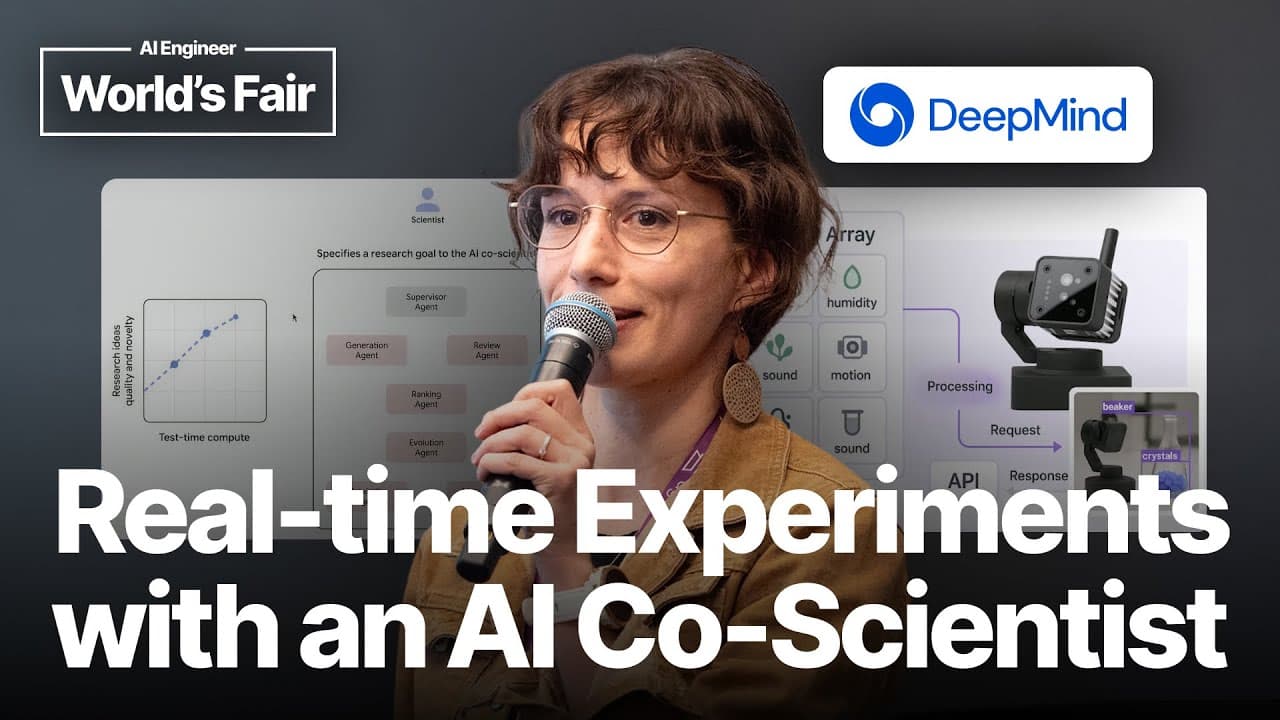
AI is not merely a tool for analysis; it is rapidly evolving into a true collaborative partner capable of accelerating scientific discovery at an unprecedented pace. This shift, from passive data interpretation to active, real-time experimentation, formed the crux of Stefania Druga's presentation at the AI Engineer World's Fair in San Francisco. Druga, formerly a Research Scientist at Google DeepMind, unveiled her "AI Co-Scientist" vision, embodied in her open-source platform, LabMind, which aims to democratize advanced scientific capabilities.
LabMind functions as a professional research assistant, bridging the gap between powerful AI reasoning and the dynamic reality of physical experiments. Druga demonstrated how the platform integrates diverse, real-time empirical data streams—visual data from cameras, quantitative readings from sensors, and positional feedback from actuators—directly into the AI's reasoning loop. "Think about pair programmers. How many of you use any form of copilot for coding? Right, so it's just like that, but for doing things in the real world, like science experiments," she explained, highlighting the intuitive collaborative nature of the system.
This real-time integration is paramount. It allows for continuous adaptation to experimental changes without batch processing delays, enables learning from actual world feedback rather than mere simulations, and fosters 24/7 discovery across multiple experiments. AI explores parameter spaces humans might not even consider. Such a paradigm accelerates scientific breakthroughs significantly. For instance, a gene transfer mechanism that took human scientists 12 years to uncover was re-discovered by an AI co-scientist in just two days.
The underlying engineering leverages scalable architectures, such as multi-agent systems built on foundation models like Gemini. These agents perform roles akin to human scientists: literature exploration, simulated scientific debate, hypothesis ranking, and iterative refinement. Druga emphasized that "AI can synthesize interdisciplinary knowledge and uncover novel insights humans might miss." The platform's open-source nature, with hardware components costing under $300, further underscores its potential to democratize access to advanced scientific research globally, extending capabilities beyond well-funded institutions.
LabMind’s unified context assembly is a key innovation. It embeds sensor data, images, and chat history into a single API call, maintaining conversational continuity and providing the AI with a rich, dynamic understanding of the experimental environment. This technical elegance underpins the system’s ability to interpret, correlate, and act upon live experimental feedback. The potential for such real-time, AI-assisted experimentation to transform fields from drug discovery to materials science is profound.