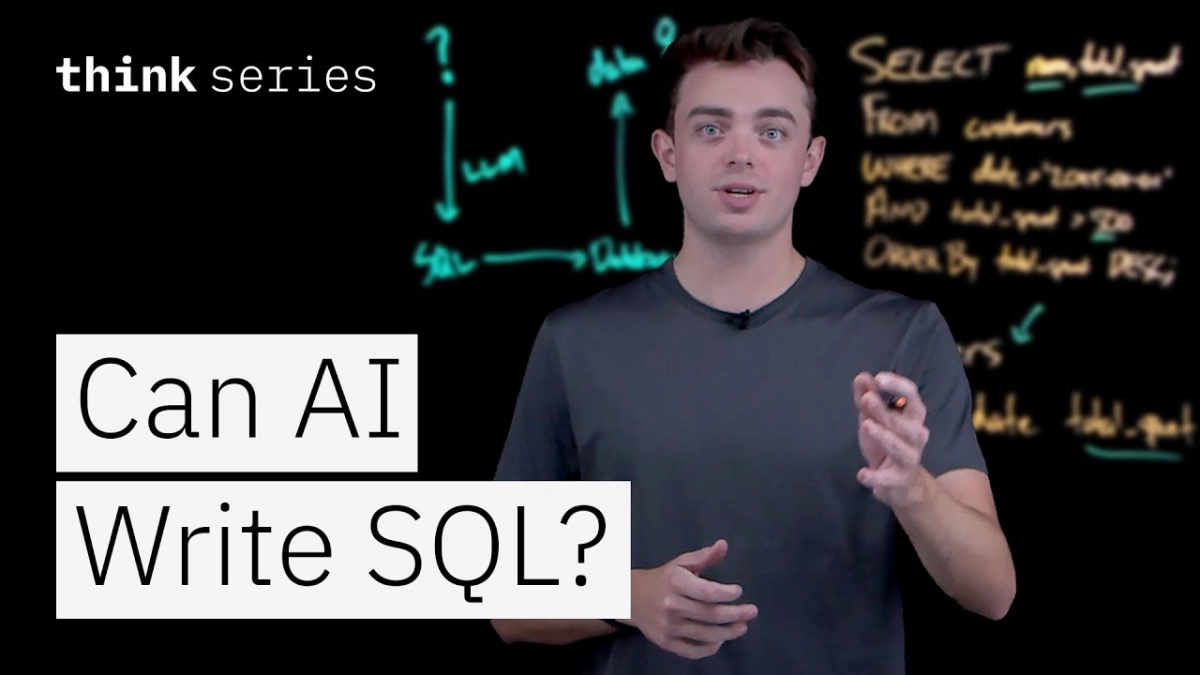
The long-standing chasm between business acumen and technical data querying is finally narrowing, thanks to advancements in artificial intelligence. Michael Dobson, Product Manager at IBM, recently presented on how Large Language Models (LLMs) are powering Text-to-SQL capabilities, fundamentally changing the paradigm of data analytics. His insights revealed how this technology empowers non-technical users to extract valuable information from complex databases using natural language, a critical shift for agile decision-making in today’s data-driven enterprises.
For decades, organizations have grappled with a significant bottleneck: "The people who best understand the business questions are not necessarily the people who can write the complex database queries. And the people who can write the SQL aren't always available when you need that urgent analysis." This inherent disconnect forces business analysts to either acquire specialized SQL knowledge, depend on overstretched data teams, or settle for pre-defined, often insufficient, dashboard reports. The limitations of traditional Business Intelligence (BI) tools become apparent the moment a unique or nuanced query is required, demanding a precise understanding of database structure and SQL syntax.
This is where LLM-based Text-to-SQL intervenes. Dobson clearly outlined the process: "LLM-based Text-to-SQL is the process of taking a user's natural language question, running it through an LLM, generating a SQL query, and then executing that query on a database, ultimately resulting in data coming back to the user." This seemingly straightforward concept has been a formidable challenge for AI systems until the recent breakthroughs in large language models. The ability of LLMs to comprehend human language and translate it into structured queries unlocks unprecedented access to data for a broader range of stakeholders.
The efficacy of Text-to-SQL hinges on two core capabilities: schema understanding and content linking. These pillars enable the AI to translate human questions into precise database queries.
Schema understanding involves the AI learning the inherent structure of a database, its tables, columns, and their relationships. For instance, if a user asks for movies directed by Christopher Nolan, the AI must first recognize "movies" as a table and "director_name" as a relevant column within that table. However, simply knowing the technical schema is insufficient for real-world application. "Modern AI systems need to go further than just understanding the director name or ratings or box office. They also need to understand your business context." This means the LLM must learn the specific nuances and implicit meanings within an organization's data. For a movie database, "recent movies" might mean films released in the last two years, or "top-rated" could imply an IMDb rating above eight. Such business-specific interpretations are crucial for generating accurate and relevant SQL queries, moving beyond literal keyword matching to contextual comprehension. This contextual learning is often reinforced by analyzing successful past queries, allowing the system to adapt and improve its understanding of user intent over time.