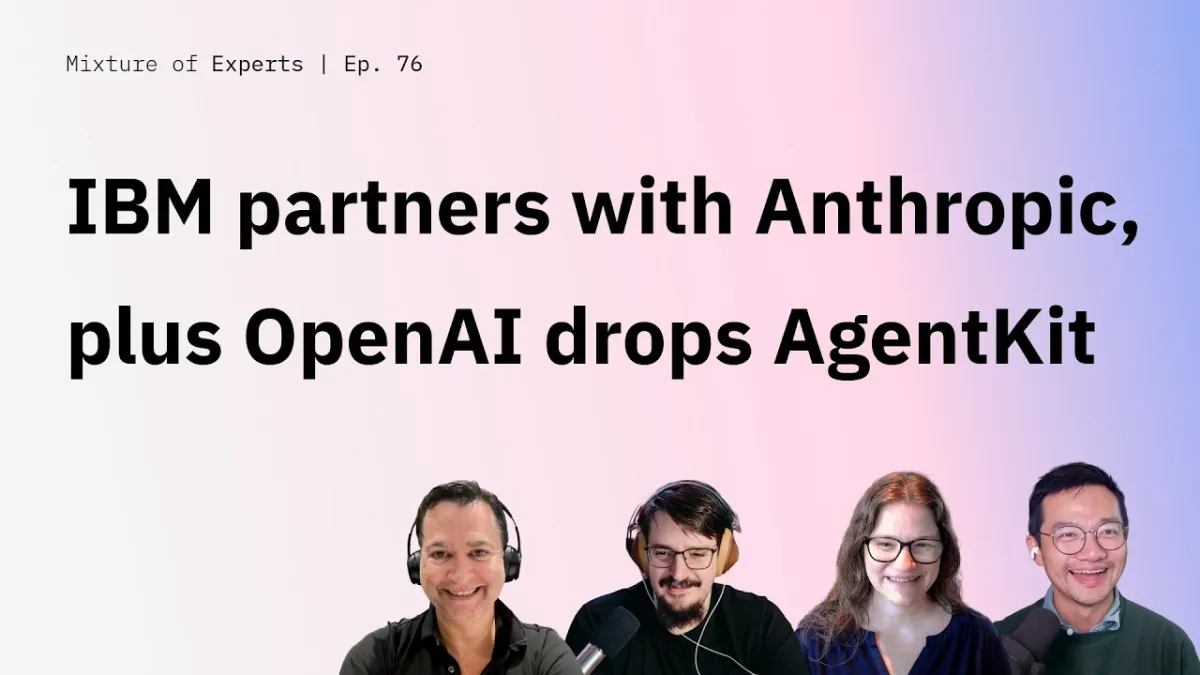
"Machine learning is fundamentally probabilistic and humans are not," stated Olivia Buzek in a recent "Mixture of Experts" podcast. This statement underscores the central theme of the discussion: the inherent limitations of AI and the challenges of completely replacing human expertise.
The latest episode of "Mixture of Experts" featured Tim Hwang, Olivia Buzek, Chris Hay, and Mihai Criveti who analyzed OpenAI's new AgentKit, and IBM's partnership with Anthropic. The analysts also discussed modular manifolds and AI's potential role in healthcare.
The discussion highlighted the advancements in AI agents, including OpenAI's AgentKit. This toolkit aims to simplify the development of AI agents, offering "a clean sort of user experience for designing agents," as Tim Hwang noted. However, the conversation quickly shifted to the inherent limitations of these tools.
The partnership between IBM and Anthropic, focused on securing enterprise AI architectures, further emphasizes the need for AI governance. This partnership acknowledges that AI, while powerful, needs careful oversight to ensure responsible and ethical deployment. "There is always going to be an error rate with machine learning techniques as they have currently been developed," Buzek explained.
Chris Hay then delved into the concept of modular manifolds, a complex topic that underscores the intricate mathematical underpinnings of AI. This discussion served as a reminder of the depth and complexity involved in AI development, highlighting that even with advanced tools, a comprehensive understanding of the underlying principles is essential.
The discussion then turned to the possibility of AI becoming healthcare experts, specifically in radiology. While AI can assist radiologists in identifying anomalies in medical images, the panel emphasized the importance of human oversight. "It's actually a huge engineering challenge to act like a human and have actual like conscious decision-making," Buzek said, highlighting the difficulty in replicating human intuition and experience.
Criveti noted, "What we have seen in the past is that with the big labs is you did a big training run and then about three months in it goes and and it was just and and every you know you you had something it was wrong and the training run blew up." This underscores the challenges with relying on machine learning.
The conversation concluded with a nuanced perspective on AI's role in various industries. While AI offers tremendous potential, it is not a panacea. The panel emphasized that human expertise remains critical, particularly in areas requiring nuanced judgment and ethical considerations. The key takeaway is that AI should be viewed as a tool to augment human capabilities, not replace them entirely.
AI agents AI governance