The staggering statistic of over half a million open cybersecurity jobs in the U.S. alone highlights a critical global deficit. This chronic shortage, coupled with an ever-increasing volume of data and sophisticated cyber threats, presents a formidable challenge that traditional security tools struggle to meet. However, a new paradigm is emerging: AI agents, powered by large language models (LLMs), are augmenting human expertise, offering a dynamic and adaptive approach to cybersecurity.
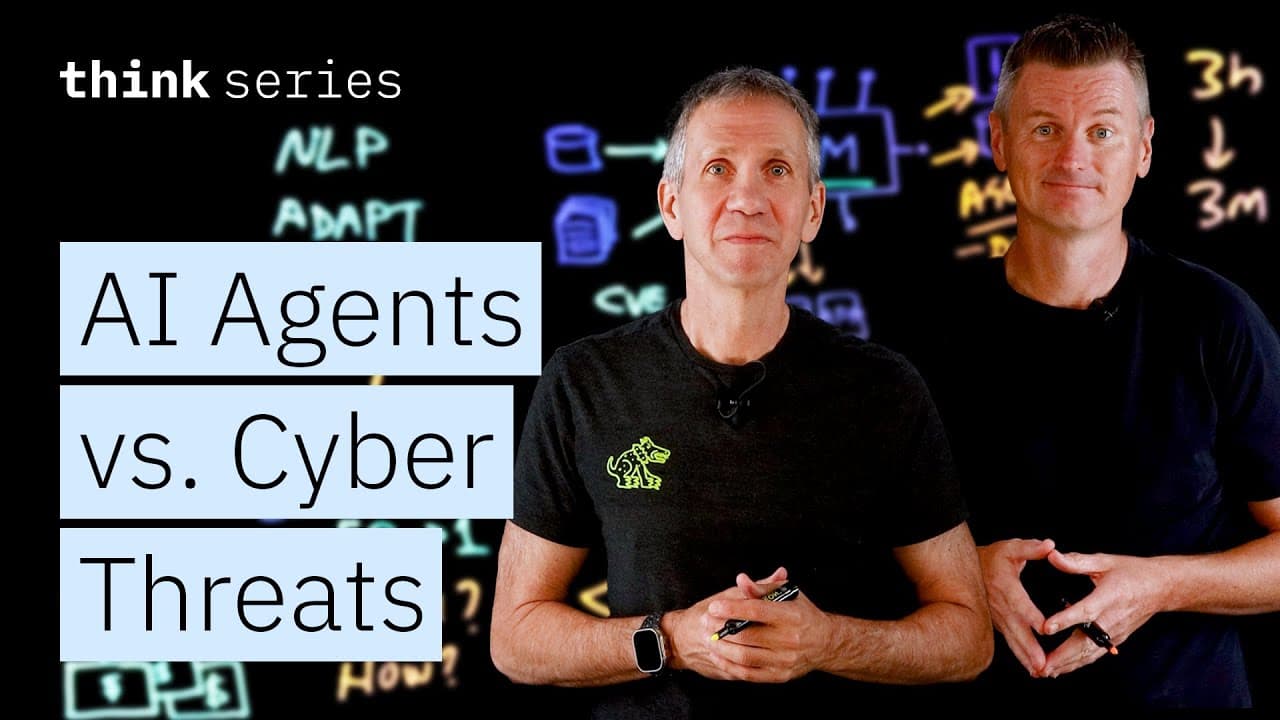
Jeff Crume, Distinguished Engineer at IBM, and Martin Keen, Master Inventor at IBM, recently explored this transformative shift, detailing how AI agents enhance automation and threat detection. Their discussion underscored the fundamental difference between static, rule-based security systems and the intelligent, autonomous capabilities of LLM-driven agents. Traditional systems rely on predefined rules and narrow machine learning models, often falling behind rapidly evolving attack tactics.
In contrast, AI agents are "dynamic and adaptive," capable of thinking, acting, and reasoning within defined boundaries. They can ingest both structured log files and unstructured inputs like written reports and security advisories, interpreting intent and context to autonomously decide which tools to query or actions to execute. This adaptability is crucial in a landscape where attackers constantly change their methods. AI agents can handle unexpected scenarios or cleverly disguised attacks far better than a brittle script, significantly cutting investigation times. "What might have once taken three hours can now be achieved in as little as three minutes, without sacrificing accuracy," Crume noted, emphasizing the dramatic efficiency gains.
For instance, in threat detection, an LLM agent can analyze raw event data or alerts in plain language, determining if they narratively suggest malicious activity. Given a series of logs, an agent might pick up on an unusual sequence not explicitly coded as a rule, detecting malicious intent in text-based data "sometimes actually better than humans or by using traditional methods." This extends to phishing detection, where AI agents analyze factors like writing style, urgency, and consistency with past communications, going beyond static filters. For malware analysis, an LLM can act as a junior reverse engineer, explaining suspicious code in natural language and identifying dubious API calls.
However, the power of AI agents comes with inherent risks, including hallucinations, adversarial manipulation, and overfitting. LLMs can produce incorrect or fabricated information, and attackers might attempt to deceive or exploit these agents. This necessitates "explicit guardrails," as Keen pointed out. The best practice is to confine agent actions to read-only or low-risk situations, requiring human confirmation for high-risk steps like shutting down a server. An overly automated system could be higher risk if it hallucinates, or conversely, human analysts might overfit to AI output if they blindly trust it. The ideal lies in a "human-in-the-loop" approach, fostering a culture of healthy skepticism where AI assists thinking rather than replacing it entirely. Organizations should apply the same caution as deploying any powerful automation or even a new team member: start with limited permissions, test extensively, review outputs, and gradually increase trust as consistency is proven.