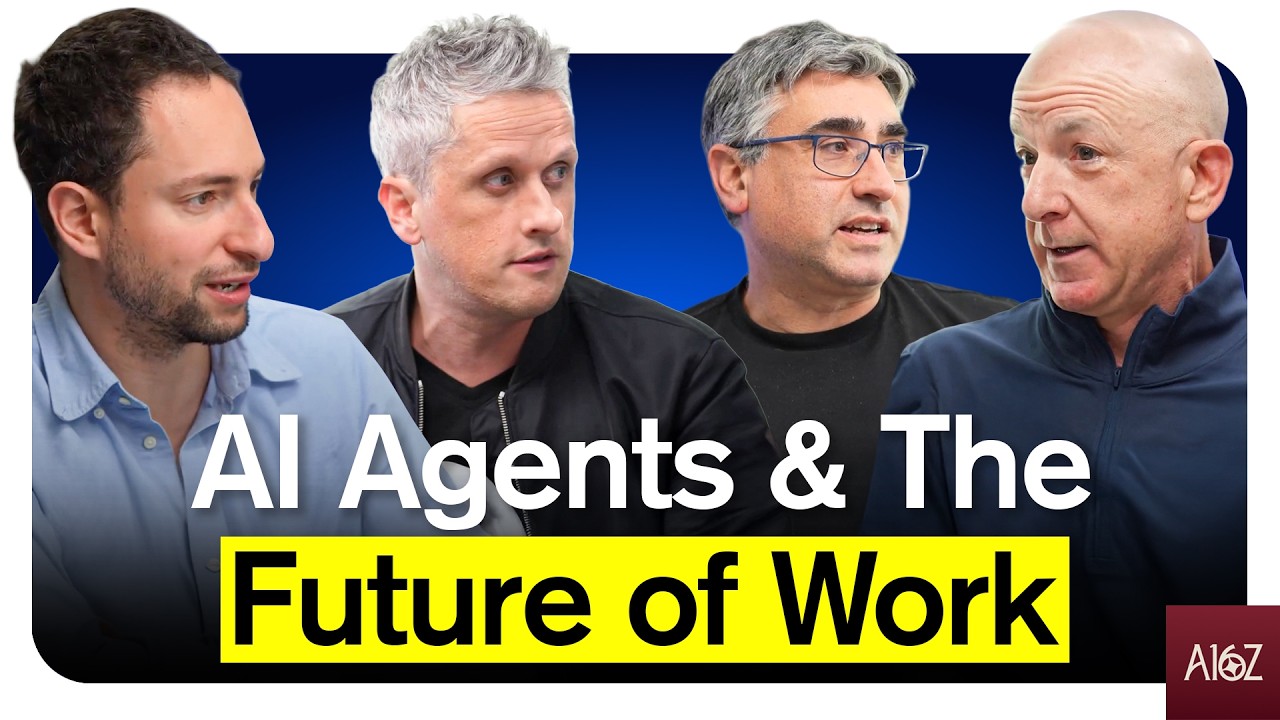
The prevailing vision of AI agents is shifting from a singular, all-encompassing artificial general intelligence to a more practical, distributed network of specialized entities. This was a core insight from the recent a16z podcast featuring Box CEO Aaron Levie and Steven Sinofsky, a prominent a16z board partner and former Microsoft executive, who joined general partners Erik Torenberg and Martin Casado to dissect the evolving landscape of AI agents and their impact on future work.
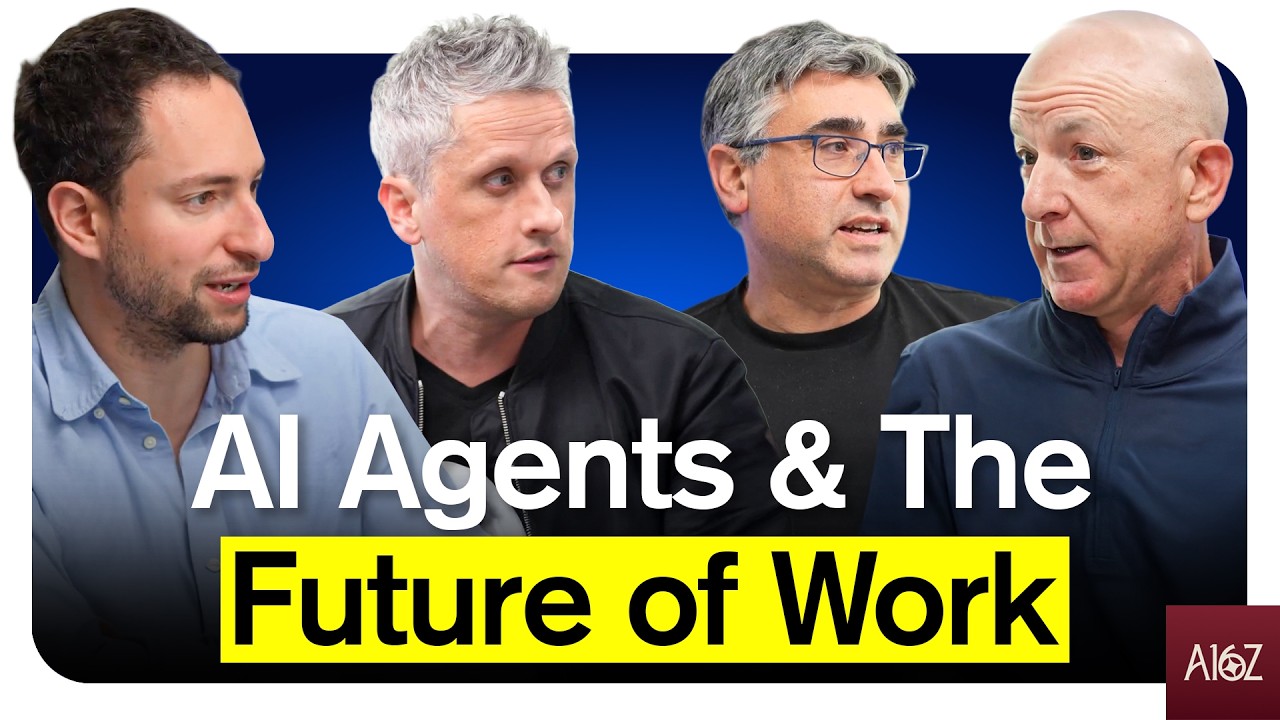
The discussion, "Aaron Levie and Steven Sinofsky on the AI-Worker Future," explored competing definitions of an "agent," from background tasks to autonomous interns, and the technical challenges inherent in developing long-running, self-improving systems. They highlighted how these agent-driven workflows could fundamentally reshape coding, productivity, and enterprise software.
Aaron Levie articulated the ideal agent as an autonomous entity: "The real ultimate end-state of AI and thus AI agents is these are autonomous things that run in the background on your behalf and executing real work for you." However, Steven Sinofsky offered a more grounded, humorous perspective on the current reality, stating, "And agentification is just hiring a lot of these really bad interns." This highlights the critical need for human oversight and verification in today's agent-driven workflows, where outputs still frequently require scrutiny to prevent "hallucinations" or errors.
A crucial theme revolved around the technical limitations and the practical path forward. Martin Casado emphasized the complexity of recursive self-improvement, noting that a truly autonomous agent would produce "output that it feeds back into itself as input." The challenges of containing such feedback loops and ensuring convergence, rather than divergence, are profound. Consequently, the industry is moving away from the idea of a monolithic AGI, recognizing that a single, super-intelligent system doing everything is currently impractical. Instead, the focus is on specialized sub-agents, each adept at a particular task, orchestrated by human experts. This division of labor allows for greater control and reliability, mitigating the risks associated with a single, potentially unreliable, "bad intern."
The conversation also underscored the folly of making rigid predictions about AI's timeline. Steven Sinofsky vehemently argued against setting arbitrary dates for AGI: "AGI is about about robot fantasy land... and that leads to all the nonsense about destroying jobs and blah blah blah. And none of that is helpful." He stressed that AI's exponential progress makes precise forecasts impossible, rendering attempts to do so "folly." Instead, the focus should be on adapting to continuous, rapid change and understanding how the technology is currently reshaping work patterns. AI is transforming how we interact with tools and define tasks, pushing humans into roles of managing and refining agent outputs, rather than simply automating existing processes. This redefinition of workflows is a platform shift, akin to the introduction of personal computers or the internet, where human ingenuity will be key to leveraging these new capabilities.