


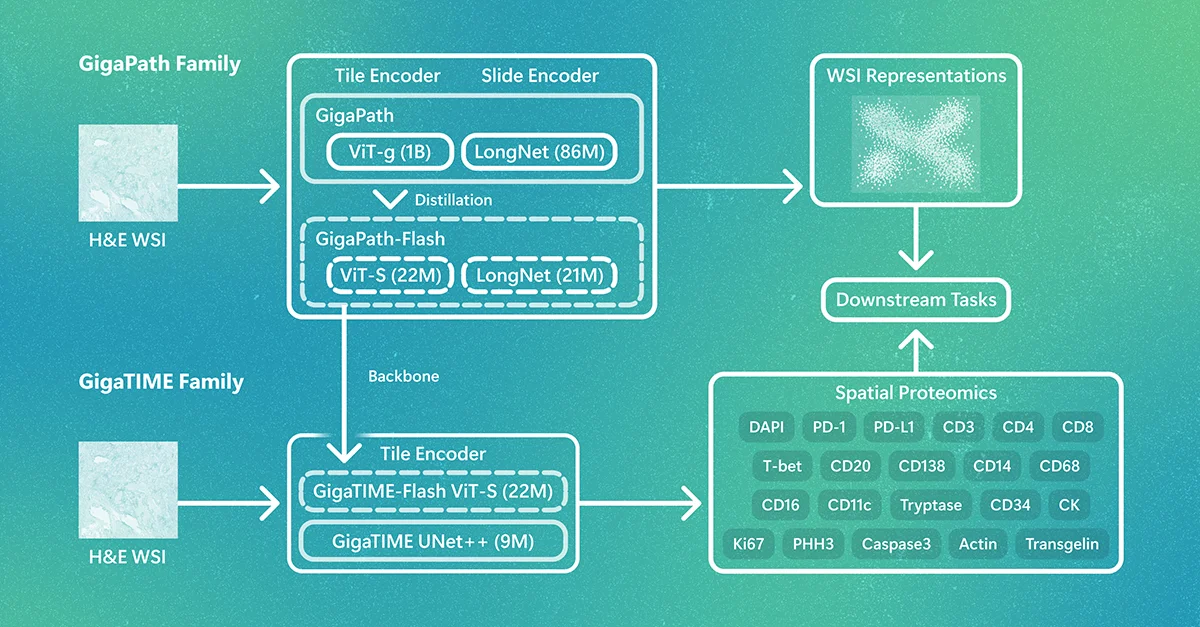
Microsoft Research just made pathology foundation models practical at population scale. GigaPath-Flash squeezes a billion-parameter whole-slide model into a 22M-parameter backbone that keeps 97% of the performance.
The goal isn't a leaderboard bump. It's to run the same model thousands of times across the kind of cohorts that hospitals actually generate.
How GigaPath-Flash stays accurate on a smaller backbone
GigaPath-Flash pairs a distilled ViT-S tile encoder with a 21M-parameter LongNet slide encoder that uses dilated attention, so it scales linearly with tile count. The ViT-S is distilled from the original GigaPath ViT-g teacher, which was pretrained on Providence real-world slides.
On PANDA prostate grading and EBRAINS brain tumor subtyping, the smaller model lands within 3% of GigaPath at roughly 50 times less compute, the lowest inference cost among whole-slide pretrained models in Microsoft Research tests. This is the third efficiency push from Microsoft Research this summer, following Microsoft's Aurora 1.5 Boosts Weather AI, and the playbook is familiar: keep the representations, cut the backbone.
Why GigaTIME-Flash matters for tumor biology
GigaTIME-Flash reuses that ViT-S encoder for a different job, translating routine H&E stains into virtual spatial proteomics across 21 protein channels. The original GigaTIME was trained on 40 million cells with paired H&E and multiplex immunofluorescence, then applied to over 14,000 patients. It surfaced more than 1,200 associations between immune cell states and clinical biomarkers.


