

Scientists Recreate Fruit Fly Brain, Play Doom

Scientists have created a fully simulated fruit fly brain that controls a virtual body, marking a significant advancement in neuroscience and AI.

Mar 10 at 6:03 PM4 min read
A 3D rendering of a fruit fly's brain, showing complex neural connections in various colors.

In a remarkable feat of bio-computational engineering, scientists have successfully simulated the entire brain of a fruit fly, enabling it to perform complex behaviors in a virtual environment. This groundbreaking achievement, detailed in a recent publication, marks a significant leap forward in our understanding of neural circuits and the potential for creating artificial life.
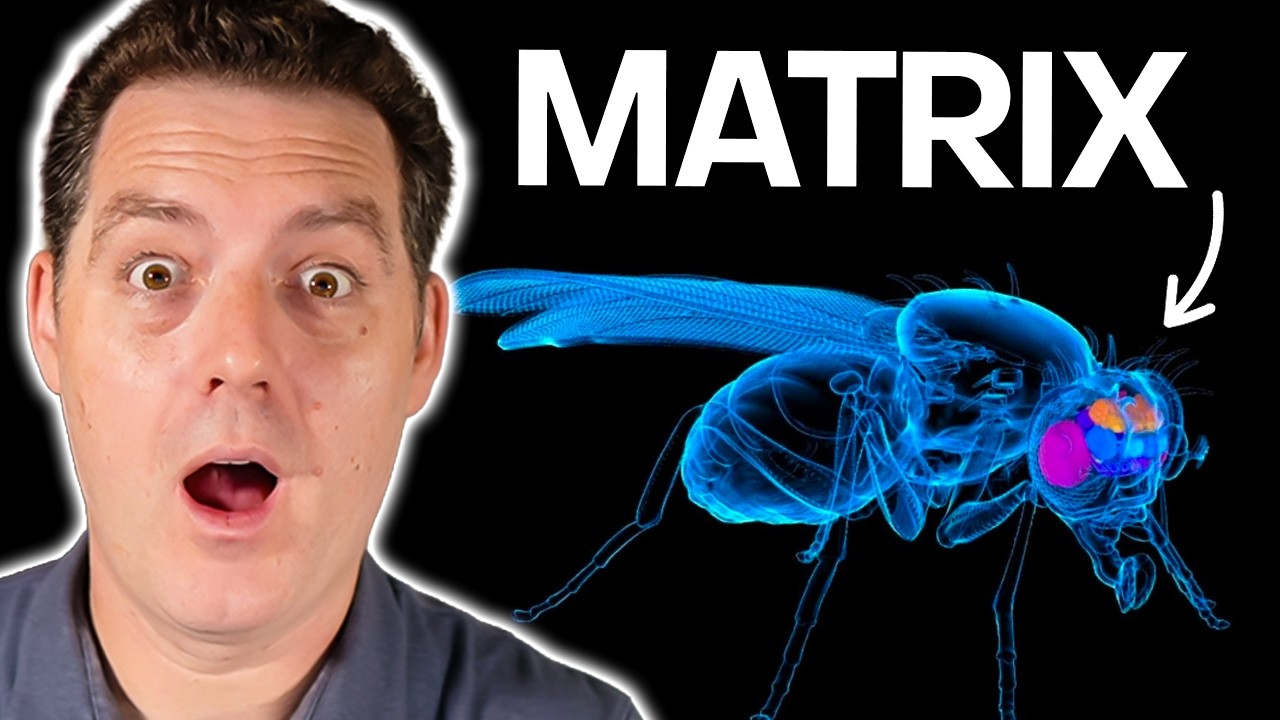
The research, led by senior scientist Philip Shu and his collaborators at Eon, utilized the detailed connectome of the fruit fly Drosophila melanogaster, mapped by FlyWire, and combined it with a simplified neuron model. This model, comprising over 125,000 neurons and 50 million synaptic connections, was then used to control a MuJoCo physics-simulated fly body. The result was a virtual organism that exhibited behaviors with 91% accuracy, including the crucial act of feeding, all without any prior AI training data.

This accomplishment represents a qualitative threshold in the field of brain emulation. Previous work had either modeled brains without bodies or animated bodies without brains. This demonstration, however, successfully closes the loop from neural activity to physical action within a simulated environment. The implications are vast, ranging from deeper insights into brain function and disease treatment to the potential for creating highly sophisticated AI systems.

The Science Behind the Simulated Fly

The core of this breakthrough lies in the comprehensive mapping of the fruit fly's connectome. This map, essentially a wiring diagram of the fly's nervous system, provides the blueprint for the simulation. By applying a simplified neuron model to this connectome, the researchers were able to create a functional digital representation of the fruit fly's brain. This model captures the essential dynamics of how neurons connect and communicate, allowing for the prediction of motor behavior with remarkable accuracy.

The simulation was further enhanced by integrating Eon's connectome-based brain emulation with a physics-simulated fly body in MuJoCo. This allowed the digital brain to interact with a virtual environment, driving its simulated body through a series of naturalistic behaviors. The key here is that the simulation was not trained using machine learning algorithms in the traditional sense; instead, it relied on the biological architecture itself to generate behavior.

Michael Andrgg, a key figure in this research, highlighted the four critical components that enabled this success:

  • The graph of connections between neurons.
  • The weights of these connections, determined by the number of synapses.
  • A map of excitatory and inhibitory neurons.
  • The 'leaky-integrate-and-fire' model, which dictates how neurons fire.

Andrgg noted, "This shows how much information is captured by the architecture itself, rather than the neuron model, which is great for the feasibility of full emulation."

Implications and Future Directions

The success with the fruit fly is just the beginning. Eon's mission extends to producing the world's largest connectome and highest-fidelity brain emulation, with the ultimate goal of emulating a mouse brain and laying the groundwork for eventual human-scale emulation. A mouse brain, for context, contains roughly 70 million neurons, approximately 560 times the number found in a fruit fly's brain.

The team is currently working on combining this connectomic data with functional recording data to further refine their models. By leveraging advances in expansion microscopy, they aim to map neural connections with unprecedented detail, capturing calcium and voltage imaging data to observe neural activity in living tissue.

The ability to simulate a brain and close the perception-action loop has profound implications. It could revolutionize our understanding of how brains function, paving the way for new treatments for neurological disorders. Furthermore, it raises philosophical questions about consciousness and the nature of reality, echoing concepts from the simulation hypothesis, which suggests that our own reality might be a sophisticated simulation.

As Andrgg pointed out, "If a fly brain can now close the sensorimotor loop in simulation, the question for the mouse becomes one of scale, not of kind." This suggests that as our computational power and understanding of neural networks grow, we may soon be able to simulate increasingly complex brains, potentially leading to artificial general intelligence or even digital consciousness.