


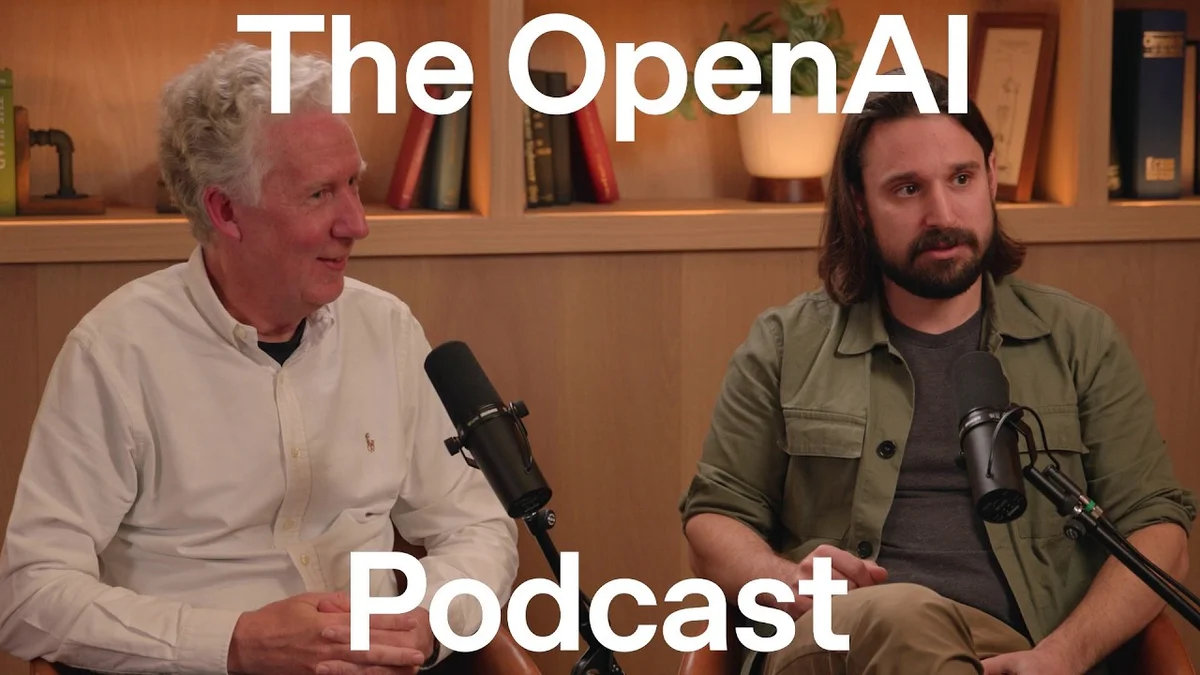
The relentless drive for more powerful AI models is pushing the boundaries of computing infrastructure, demanding a fundamental rethink of how supercomputers communicate. In the latest OpenAI Podcast episode, host Andrew Mane sits down with Mark Handley and Greg Steinkrecker from OpenAI's networking and workload systems teams to discuss why AI needs a new kind of supercomputer network. The core challenge, they explain, lies in the sheer scale and synchronization required for modern AI training, which overwhelms traditional networking paradigms.
The Bottleneck of Traditional Networking
As AI models grow in complexity and data requirements, the need to efficiently connect massive clusters of GPUs has become paramount. Mark Handley, a professor at University College London with decades of networking research experience, highlights the limitations of existing infrastructure. "Academia does not know a whole lot about what real data center workloads look like," Handley notes, contrasting the theoretical models with the practical demands of AI training. Greg Steinkrecker, from OpenAI's workload systems team, echoes this sentiment, explaining that the rapid advancement of AI has outpaced the capabilities of conventional data center networking, which was initially designed for the more distributed and less synchronized nature of the early internet.
The full discussion can be found on OpenAI Youtube's YouTube channel.
Steinkrecker elaborates on the problem: "When you're training AI models, you're not just sending data between individual machines; you have thousands of GPUs trying to talk to each other simultaneously. This means you need massive bandwidth and extremely reliable, low-latency communication. Traditional networking, which relies on statistical multiplexing and averages, breaks down under these highly synchronized, high-demand workloads." The issue is compounded by the fact that even a single link failure can cripple the entire training process, leading to significant downtime and wasted resources.
Introducing MRC: A New Approach to Network Reliability
To address these challenges, OpenAI has been developing and implementing a new networking approach called MRC (Message Rate Control), which includes techniques like packet trimming and segment routing. Steinkrecker explains the core idea: "Instead of relying on centralized coordination or slow convergence protocols when a link fails, MRC allows each endpoint to independently detect and reroute around failures in milliseconds. This means the system can continue to operate smoothly even if individual components fail, which is crucial when you have millions of components in a large-scale cluster."