

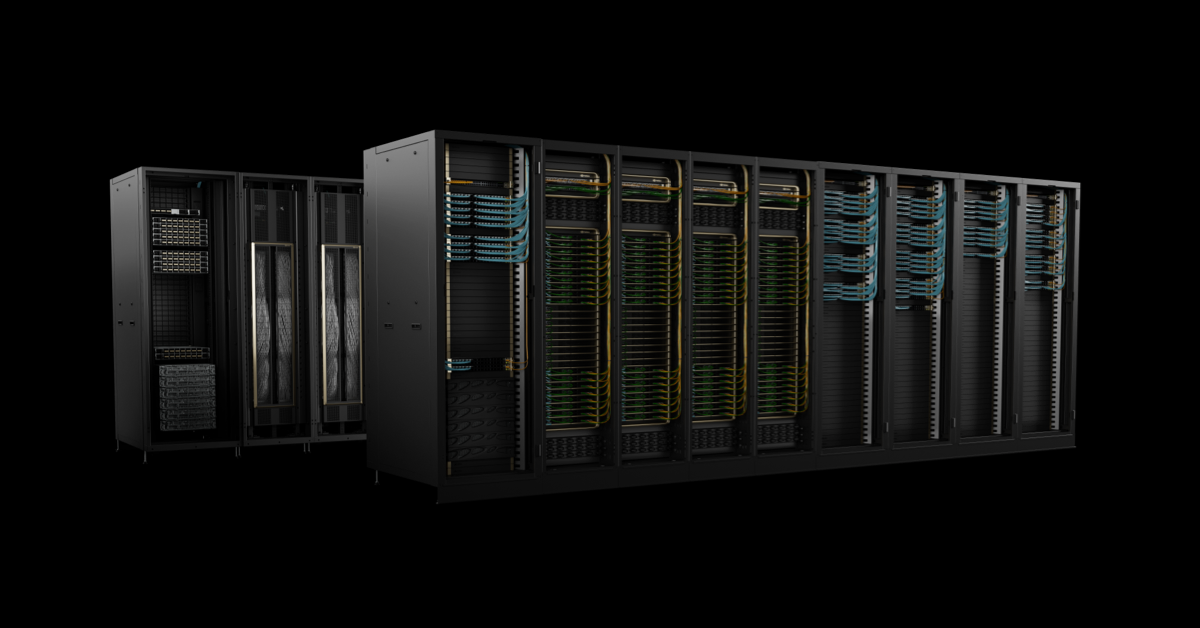
NVIDIA has laid out its comprehensive strategy and technology portfolio for building the next generation of "AI factories", massive, specialized data centers designed not for traditional web services, but for training and deploying artificial intelligence at an unprecedented scale. In an announcement on its blog, the company detailed how these facilities are fundamentally different from existing hyperscale data centers, demanding a complete rethinking of networking and hardware infrastructure to support millions of GPUs.
These emerging AI factories are envisioned as high-performance engines, orchestrating tens to hundreds of thousands of GPUs as a single, cohesive unit. This shift means the entire data center, rather than individual servers, becomes the new unit of computing. The critical challenge lies in how these GPUs are interconnected, requiring a layered network design that incorporates bleeding-edge technologies like co-packaged optics, once considered futuristic. The complexity is not a flaw, but a defining characteristic, as traditional networking approaches simply cannot meet the demands of distributed AI.
The physical infrastructure is also undergoing a radical transformation. A decade ago, chips were designed for lightness; today's cutting edge involves multi-hundred-pound copper spines, liquid-cooled manifolds, and custom busbars. AI now necessitates industrial-scale hardware, with systems like the NVIDIA NVLink spine moving more data per second (130 TB/s GPU-to-GPU bandwidth) than the entire internet, effectively creating an AI super-highway within the server rack itself.
Training modern large language models (LLMs) is a distributed computing challenge, splitting massive calculations across numerous GPUs. These systems rely heavily on collective operations like "all-reduce" and "all-to-all," which are highly sensitive to network latency and bandwidth. For inference, especially in multi-tenant cloud environments, the need for real-time lookups, high throughput, and strict isolation between users further strains traditional network designs.
Redefining the AI Network Fabric
NVIDIA highlights that conventional Ethernet, designed for single-server workloads, struggles with the consistent, predictable performance required by distributed AI. Its legacy architectures often lead to bottlenecks, jitter, and inconsistent delivery. This is where InfiniBand, long the gold standard for high-performance computing, comes into play for AI factories. NVIDIA Quantum InfiniBand, with its SHARPv4 technology, adaptive routing, and telemetry-based congestion control, optimizes collective operations directly within the network, ensuring zero-jitter performance and precise scaling for AI communication. The Quantum-X800 InfiniBand switches, for instance, offer 144 ports of 800 Gbps connectivity and integrate co-packaged silicon photonics for improved power efficiency and reduced latency.