

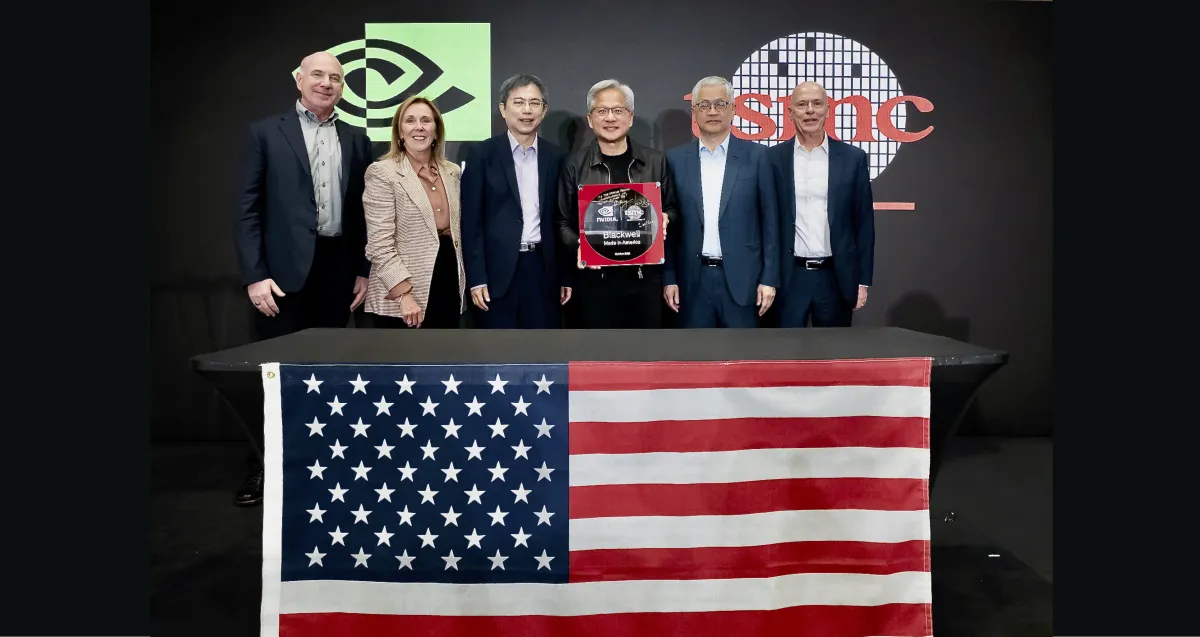
NVIDIA's groundbreaking Blackwell architecture has officially entered US volume production, a pivotal moment for the global technology landscape. The first Blackwell wafer was celebrated at TSMC's state-of-the-art Phoenix facility, marking a significant step towards domestic semiconductor manufacturing. This strategic collaboration between NVIDIA and TSMC fundamentally reshapes the critical AI supply chain, bringing core infrastructure closer to home.
Jensen Huang, NVIDIA's CEO, underscored the historic nature of this achievement, boldly declaring Blackwell the "single most important chip" now being manufactured in America. This initiative directly aligns with broader reindustrialization efforts, aiming to generate high-value jobs and firmly secure the US's competitive edge in the most vital technology sector. It represents a tangible, high-stakes commitment to onshoring the entire AI technology stack, from foundational silicon to advanced intelligence. According to the announcement
Domesticating Advanced Chipmaking
TSMC Arizona's impressive agility, delivering the inaugural US-made NVIDIA Blackwell chip in just a few short years, speaks volumes about its operational prowess and dedicated workforce. This advanced facility is slated to produce cutting-edge 2nm, 3nm, 4nm, and A16 chips, all indispensable for the demands of high-performance computing, telecommunications, and next-generation AI applications. This decades-long partnership with NVIDIA has consistently pushed technological boundaries, now culminating in the domestic production of the world's most sophisticated fabrication.
The localized production of NVIDIA Blackwell GPUs promises not only exceptional performance but also compelling return on investment and superior energy efficiency for critical AI inference workloads. This move significantly fortifies the US supply chain, strategically reducing its vulnerability and reliance on overseas manufacturing for essential AI infrastructure components. Furthermore, NVIDIA's commitment extends beyond current production, with plans to integrate its own advanced AI, robotics, and digital twin technologies into the design and operation of future US manufacturing facilities.
This achievement transcends a mere manufacturing milestone; it is a profound strategic maneuver designed to solidify American leadership in the rapidly accelerating AI era. By bringing the production of the world's most advanced AI chips onto US soil, the nation gains unprecedented control over its technological destiny and economic security. The implications for innovation, national defense, and the broader global tech ecosystem are undeniably transformative, establishing a new benchmark for high-tech domestic manufacturing.