
The Claude Complex and the Frictionless Future of Coding

5 min read
The Claude Complex and the Frictionless Future of Coding

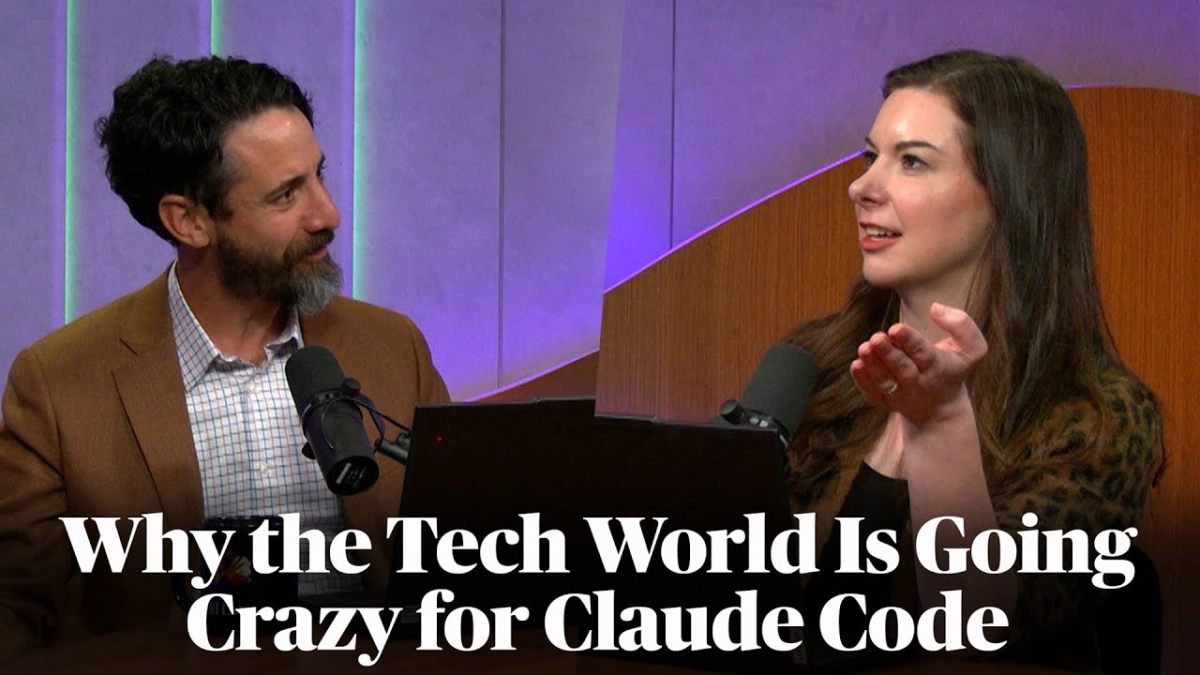
The enthusiasm surrounding Anthropic’s Claude Code has spilled over from the engineering community into the wider tech ecosystem, characterized by Bloomberg’s Odd Lots co-host Joe Weisenthal wryly describing the collective obsession as having a “Claude complex.” This conversational insight, shared with co-host Tracy Alloway and Alephic co-founder Noah Brier, immediately cut to the heart of the matter: Claude Code is not just another iteration in the generative AI space; it represents a fundamental shift in the accessibility and execution of software development, driven by a radical reduction in technical friction.

Weisenthal and Alloway spoke with Brier about the rapid evolution of AI coding assistants, contrasting the current suite of tools—specifically Anthropic’s Claude Code and its emergent application, Co-work—with earlier, clunkier models like GitHub Copilot. Brier, who has been immersed in the API landscape since the early days of GPT-3, provided sharp analysis on why Claude Code has captured the industry’s imagination, focusing less on the core intelligence of the large language model (LLM) itself and more on the elegance of its deployment.


Related startups

The first major insight driving the current hype cycle is the near-total elimination of installation and operational friction. Early coding models, while impressive, required significant technical knowledge: navigating command line interfaces, installing complex libraries, and managing development environments. This created a high barrier to entry, limiting the tools primarily to professional developers. Claude Code sidesteps this entirely. Weisenthal noted that after playing with it over the holidays, he realized: “I see why half my Twitter feed is just like people posting about this... it’s just getting easier and friendlier. There’s almost no technical frictions at all anymore.” This ease of use is democratizing development, allowing individuals without deep coding backgrounds to execute complex tasks previously reserved for specialized engineers. The barrier has dropped from needing a PhD in computer science to simply understanding the intent of the desired outcome.

The core technical breakthrough that enables this frictionless experience is Claude Code’s ability to interact directly with the local environment, specifically the file system and command line. Traditional LLMs are stateless; they forget the previous interaction once the conversation ends, requiring the user to constantly feed back the entire context of the project. Claude Code overcomes this by using the local file system as persistent memory, allowing it to read and write files, execute Unix commands, and maintain state across multiple steps of a complex project. Brier distilled this down to its essence: “It’s the ability to write and read files on your computer, which means you can always write off memories.” This capability transforms the model from a passive suggestion engine into an active, autonomous agent capable of multi-step problem-solving. This architecture allows the AI to manage the tedious, operational aspects of coding—the very parts that demanded specialized command line vernacular—automatically.

This technical advancement immediately redefines the role of the human engineer. Brier suggests that the developer is transitioning from being a direct code writer to becoming a "manager of agents." Instead of spending time on boilerplate code, debugging syntax, or figuring out library dependencies, the engineer focuses on high-level design, instruction, and system architecture. This shift is not about the AI replacing the developer wholesale, but about abstracting away the mechanical labor. The human task becomes defining heuristics, setting parameters, and managing the overall coordination of AI-driven tasks, a role Brier himself now embodies: “I am mostly a manager of a set of agents who are writing code on my behalf.” This transition elevates the human role to strategic oversight, multiplying productivity by allowing one person to effectively manage several concurrent development threads.

The macro-economic implications of this sudden accessibility are profound, particularly for the vast ecosystem of Software as a Service (SaaS) companies. If an individual or a small team can use an AI agent to quickly generate highly customized software solutions for internal needs—solutions that are tailored precisely to their data and workflow—the necessity of buying expensive, generalized SaaS platforms is called into question. Alloway noted the anecdote of a lawyer who automated his entire job using Claude Code. Brier affirmed that this disruption is real and immediate, arguing that the fundamental cost-benefit analysis of the "build vs. buy" decision is changing. “I think software is pretty screwed... the build versus buy pendulum has just swung,” Brier stated, emphasizing that the economic barrier to building bespoke internal tools has vanished. Why pay continuous subscription fees for a one-size-fits-all solution when an internal agent can create a perfect, custom solution cheaply and instantly?

The rapid iteration speed of these models, particularly Anthropic’s ability to quickly embed new features and improve performance based on real-world usage, creates a market dynamic where continuous adaptation is mandatory. The core value now resides not in the proprietary code itself, but in the highly efficient infrastructure and philosophical approach (like Anthropic’s emphasis on safety and helpfulness) that enables the frictionless developer experience.

© 2026 StartupHub.ai. All rights reserved. Do not enter, scrape, copy, reproduce, or republish this article in whole or in part. Use as input to AI training, fine-tuning, retrieval-augmented generation, or any machine-learning system is prohibited without written license. Substantially-similar derivative works will be pursued to the fullest extent of applicable copyright, database, and computer-misuse laws. See our terms.