


ZuriQ Secures $25.5M for 2D Quantum Leap

ZuriQ, an ETH Zürich spin-out, has secured $25.5 million to scale its novel 2D trapped-ion quantum architecture, aiming to dramatically increase qubit count.

3 min read
Close-up illustration of ZuriQ's 2D quantum chip design with ions arranged in a grid pattern, highlighted by a blue glow.
ZuriQ's innovative 2D architecture allows for greater qubit density and flexible ion movement compared to traditional 1D designs.

ZuriQ, an ETH Zürich spin-out, has secured $25.5 million in seed funding to scale its groundbreaking two-dimensional trapped-ion quantum architecture. This round, led by Quantonation with participation from Forward.one, Extantia, Firgun Ventures, and previous investors, follows a $4.2 million pre-seed round in 2025.

The Swiss quantum computing company aims to significantly increase the number of qubits on a single chip, leveraging its novel approach to trapped-ion quantum processors. This investment underscores continued interest in quantum computing investment rounds, even as the field matures.
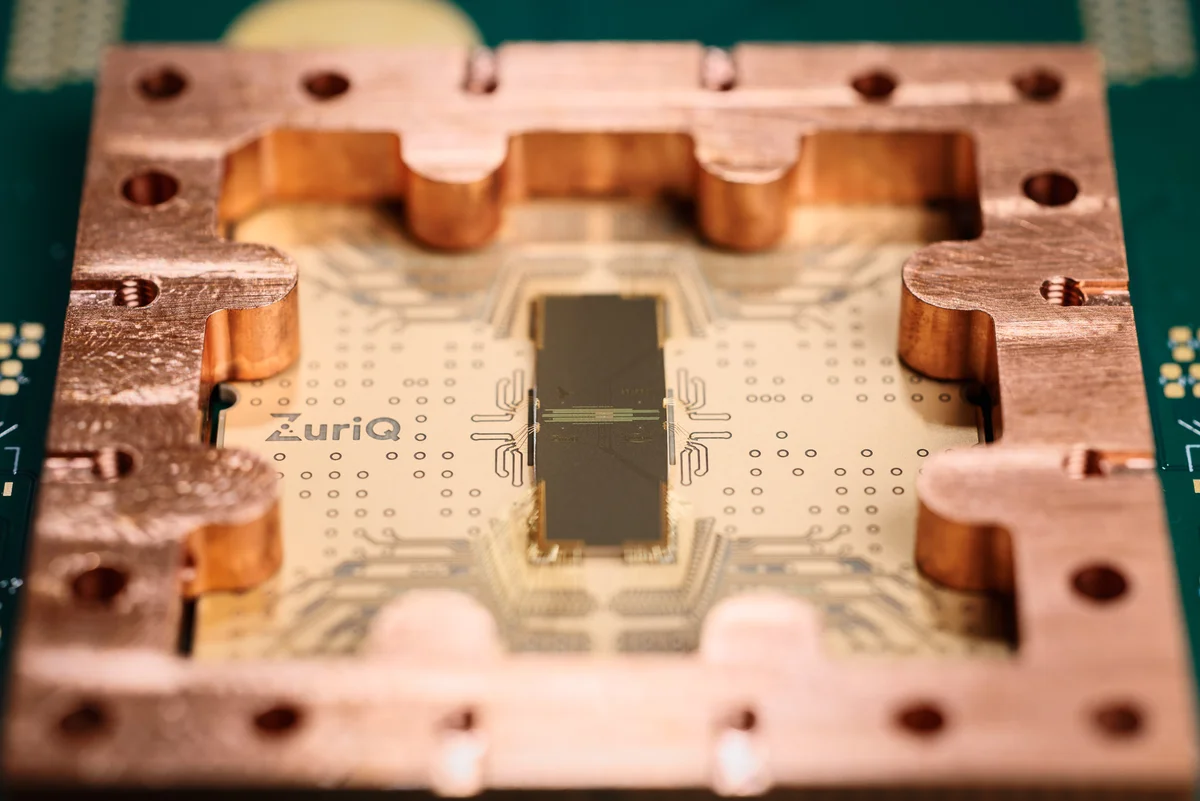
Illustration of ZuriQ's 2D quantum architecture with ions arranged in a grid
Image credit: ZuriQ

A New Dimension in Quantum Computing

Unlike conventional trapped-ion systems that rely on one-dimensional chains and complex junctions, ZuriQ’s design is natively two-dimensional. It employs Penning micro-traps, utilizing a static magnetic field instead of the rapidly oscillating fields found in legacy architectures. This allows ions to move freely in any direction, unconstrained by junctions.

Professor Jonathan Home of ETH Zürich, a scientific adviser to ZuriQ, emphasized the geometric advantage. "Hold ions in two dimensions, and it grows with the area of the chip, on a standard chip, that is the difference between tens of ions and many thousands." This flexibility in ion movement also enables more versatile connectivity, crucial for complex quantum applications.

ZuriQ has already proven its concept with a working demonstrator: a 3x3 array of nine individually controlled ions. Developed in just 18 months, this represents the largest two-dimensional array of its kind to date. The chips, fabricated in collaboration with Infineon, confirm the architecture's compatibility with established industry processes.

Scaling for Commercial Applications

With the architecture and manufacturing route established, ZuriQ's immediate focus shifts to rapid scaling. The company has grown from four to eighteen employees since its last investment, attracting talent from leading quantum and photonics organizations like IonQ, Xanadu, and Hamamatsu.

The new capital will fund further hiring, expand research and development, and accelerate chip fabrication, laying the groundwork for putting hundreds of qubits on a chip. This push is vital for achieving scalable quantum computing needed for real-world applications.

Dr. Pavel Hrmo, co-founder and CEO of ZuriQ, highlighted the strategic advantage. "We spent longer in the lab, and that time allowed us to identify an alternative route that is inherently easier to scale. Our architecture is two-dimensional from the ground up, so the number of qubits we can place on a chip will grow far more readily than in systems built on a legacy blueprint."

Christophe Jurczak, Founding Partner at Quantonation, reiterated the ongoing nature of the quantum race. "ZuriQ is demonstrating that there remain significant and transformational physics breakthroughs still to be made in Quantum architectures."

© 2026 StartupHub.ai. All rights reserved. Do not enter, scrape, copy, reproduce, or republish this article in whole or in part. Use as input to AI training, fine-tuning, retrieval-augmented generation, or any machine-learning system is prohibited without written license. Substantially-similar derivative works will be pursued to the fullest extent of applicable copyright, database, and computer-misuse laws. See our terms.