

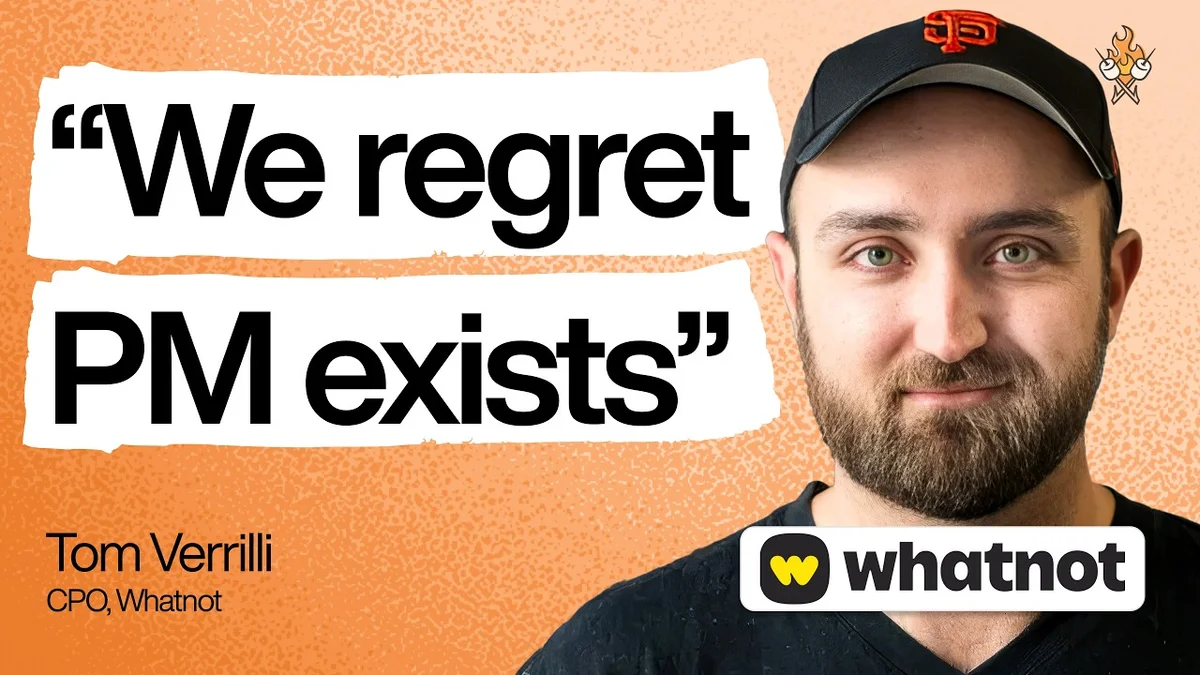
Whatnot CPO: "We regret that product management exists"

Whatnot CPO Tom Verilli questions the necessity of traditional product management, arguing it can hinder engineers and designers, and highlights the growing role of AI in empowering ICs.

9 min read
Tom Verilli, Chief Product Officer at Whatnot, speaking in a podcast interview.
Lenny's Podcast

Visual TL;DR. Whatnot CPO: Regret PMs because PMs 'infantilize' teams. PMs 'infantilize' teams despite Engineers/Designers capable. Whatnot CPO: Regret PMs historical context Founders led product. PMs 'infantilize' teams drives Rise of ICs. Engineers/Designers capable leads to Hiring for Impact. Hiring for Impact supports Rise of ICs. Rise of ICs enhanced by AI empowers ICs. AI empowers ICs results in Better product outcomes.

  1. Whatnot CPO: Regret PMs: Tom Verilli questions traditional product management's necessity, arguing it can hinder teams
  2. PMs 'infantilize' teams: traditional PM structure prevents engineers and designers from making sound decisions
  3. Engineers/Designers capable: these professionals are perfectly capable of making sound decisions without constant PM presence
  4. Founders led product: PM role originated when founders or CEOs directly communicated with engineering and design
  5. Hiring for Impact: Verilli focuses on hiring individuals who can directly contribute and make decisions
  6. Rise of ICs: growing importance of individual contributors making direct impact on product development
  7. AI empowers ICs: AI's role in empowering individual contributors to make more autonomous decisions
  8. Better product outcomes: empowering ICs and leveraging AI leads to more efficient and innovative product development
Visual TL;DR
Visual TL;DR, startuphub.ai Whatnot CPO: Regret PMs because PMs 'infantilize' teams. PMs 'infantilize' teams drives Rise of ICs. Rise of ICs enhanced by AI empowers ICs. AI empowers ICs results in Better product outcomes because drives enhanced by results in Whatnot CPO: Regret PMs PMs 'infantilize' teams Rise of ICs AI empowers ICs Better product outcomes From startuphub.ai · The publishers behind this format
Visual TL;DR, startuphub.ai Whatnot CPO: Regret PMs because PMs 'infantilize' teams. PMs 'infantilize' teams drives Rise of ICs. Rise of ICs enhanced by AI empowers ICs. AI empowers ICs results in Better product outcomes because drives enhanced by results in Whatnot CPO:Regret PMs PMs 'infantilize'teams Rise of ICs AI empowers ICs Better productoutcomes From startuphub.ai · The publishers behind this format
Visual TL;DR, startuphub.ai Whatnot CPO: Regret PMs because PMs 'infantilize' teams. PMs 'infantilize' teams drives Rise of ICs. Rise of ICs enhanced by AI empowers ICs. AI empowers ICs results in Better product outcomes because drives enhanced by results in Whatnot CPO: Regret PMs Tom Verilli questions traditional productmanagement's necessity, arguing it canhinder teams PMs 'infantilize' teams traditional PM structure preventsengineers and designers from making sounddecisions Rise of ICs growing importance of individualcontributors making direct impact onproduct development AI empowers ICs AI's role in empowering individualcontributors to make more autonomousdecisions Better product outcomes empowering ICs and leveraging AI leads tomore efficient and innovative productdevelopment From startuphub.ai · The publishers behind this format
Visual TL;DR, startuphub.ai Whatnot CPO: Regret PMs because PMs 'infantilize' teams. PMs 'infantilize' teams drives Rise of ICs. Rise of ICs enhanced by AI empowers ICs. AI empowers ICs results in Better product outcomes because drives enhanced by results in Whatnot CPO:Regret PMs Tom Verilliquestionstraditional product… PMs 'infantilize'teams traditional PMstructure preventsengineers and… Rise of ICs growing importanceof individualcontributors making… AI empowers ICs AI's role inempoweringindividual… Better productoutcomes empowering ICs andleveraging AI leadsto more efficient… From startuphub.ai · The publishers behind this format
Visual TL;DR, startuphub.ai Whatnot CPO: Regret PMs because PMs 'infantilize' teams. PMs 'infantilize' teams despite Engineers/Designers capable. Whatnot CPO: Regret PMs historical context Founders led product. PMs 'infantilize' teams drives Rise of ICs. Engineers/Designers capable leads to Hiring for Impact. Hiring for Impact supports Rise of ICs. Rise of ICs enhanced by AI empowers ICs. AI empowers ICs results in Better product outcomes because despite historical context drives leads to supports enhanced by results in Whatnot CPO: Regret PMs Tom Verilli questions traditional productmanagement's necessity, arguing it canhinder teams PMs 'infantilize' teams traditional PM structure preventsengineers and designers from making sounddecisions Engineers/Designers capable these professionals are perfectly capableof making sound decisions without constantPM presence Founders led product PM role originated when founders or CEOsdirectly communicated with engineering anddesign Hiring for Impact Verilli focuses on hiring individuals whocan directly contribute and make decisions Rise of ICs growing importance of individualcontributors making direct impact onproduct development AI empowers ICs AI's role in empowering individualcontributors to make more autonomousdecisions Better product outcomes empowering ICs and leveraging AI leads tomore efficient and innovative productdevelopment From startuphub.ai · The publishers behind this format
Visual TL;DR, startuphub.ai Whatnot CPO: Regret PMs because PMs 'infantilize' teams. PMs 'infantilize' teams despite Engineers/Designers capable. Whatnot CPO: Regret PMs historical context Founders led product. PMs 'infantilize' teams drives Rise of ICs. Engineers/Designers capable leads to Hiring for Impact. Hiring for Impact supports Rise of ICs. Rise of ICs enhanced by AI empowers ICs. AI empowers ICs results in Better product outcomes because despite historical context drives leads to supports enhanced by results in Whatnot CPO:Regret PMs Tom Verilliquestionstraditional product… PMs 'infantilize'teams traditional PMstructure preventsengineers and… Engineers/Designerscapable these professionalsare perfectlycapable of making… Founders ledproduct PM role originatedwhen founders orCEOs directly… Hiring for Impact Verilli focuses onhiring individualswho can directly… Rise of ICs growing importanceof individualcontributors making… AI empowers ICs AI's role inempoweringindividual… Better productoutcomes empowering ICs andleveraging AI leadsto more efficient… From startuphub.ai · The publishers behind this format

In a candid discussion about the evolution of product roles, Tom Verilli, Chief Product Officer at Whatnot, shared a provocative take that might surprise many in the tech industry: "Since its earliest inception, the Whatnot product team has built was built on the somewhat simple premise: We regret that product management exists."

Whatnot CPO: "We regret that product management exists" - Lenny's Podcast
Whatnot CPO: "We regret that product management exists" — from Lenny's Podcast

Speaking on the Lenny's Podcast, Verilli elaborated on this contrarian view, explaining that the traditional product management structure, which often involves a specific ratio of PMs to engineers within development pods, can inadvertently "infantilize the engineers and the designers." He argues that these professionals are perfectly capable of making sound decisions but are often prevented from doing so by the constant presence of a PM acting as a "babysitter."

The Case Against Over-Indexing on PMs

Verilli traced the origins of the product manager role back to a time before it existed, when founders or CEOs directly communicated with engineering and design teams. As internet businesses scaled rapidly, the need to delegate and trust others arose, but this rarely manifested as a specialized role. Instead, engineers and designers often possessed the necessary context to make informed decisions.

The core argument for Whatnot's philosophy is that it would be optimal if engineers and designers already had the context needed to make great decisions, being sufficiently in touch with users and their needs. Verilli stated, "The only argument as far as I'm aware for why you would want product management to be a specialist function is really it's a trade, not a qualification. It's something you get good at by doing. It's a muscle." However, he cautioned that by abstracting engineers and designers from these decision-making processes, their own "muscle gets underdeveloped."

Verilli acknowledged that product management plays a crucial role and can provide significant leverage for critical initiatives, enabling design and engineering to excel in their crafts. However, he stressed that "wherever possible it's kind of optimal to not have a product manager."

Hiring for Impact: What Verilli Looks For

The conversation also touched on Whatnot's highly selective hiring process for PMs. Verilli revealed that in the past two years, 31,832 people applied for a product manager role, and only one was hired. This selectivity highlights the company's focus on specific qualities.

What's trending down in Verilli's hiring criteria? "Folks who spend a lot of their time in their interviews talking about driving alignment and stakeholder management," he said. Verilli believes that a segment of PMs have specialized in "politics" rather than technical or customer-centric skills. Candidates who naturally lean into relationship building and alignment without demonstrating deeper product thinking are less appealing.

Conversely, what truly impresses Verilli is the ability of candidates to demonstrate both "macro thinking and micro thinking." He wants to see individuals who can articulate an end state and then exhibit an almost impatient drive to validate and execute. He values specificity in describing past accomplishments, particularly for those who have driven novel solutions or navigated complex changes, rather than simply "babysitting things that existed."

The Rise of the Individual Contributor and AI's Role

Verilli expressed excitement about the trend of PMs moving away from large-scale organizational management and towards more individual contributor (IC) work. He noted that historically, successful PMs were promoted into director roles, effectively removing them from the hands-on building process. This, he argued, led to a "yo-yo development process" where great ideas were reviewed and rejected through multiple layers.

At Whatnot, managers and directors are expected to spend 90%+ of their time in IC work, with Verilli himself still dedicating about 50% of his time to it. This approach, he believes, allows for quicker decision-making, greater impact, and keeps leadership connected to the "ground floor."

The conversation also touched on the role of AI. While not the sole driver, Verilli acknowledged that AI tools significantly enhance productivity for individuals. He highlighted AI's impact on data science, enabling quick cohort analysis and sensitivity modeling, and its ability to help engineers and PMs understand codebases more readily. "There's no excuse not to understand that or a nuance layer now," he stated, referring to the accessibility of information through AI tools.

Ultimately, Verilli's perspective challenges conventional wisdom, pushing for a more empowered, hands-on approach to product development where core teams are trusted to make decisions, with product management serving as a supportive function rather than a gatekeeper.

© 2026 StartupHub.ai. All rights reserved. Do not enter, scrape, copy, reproduce, or republish this article in whole or in part. Use as input to AI training, fine-tuning, retrieval-augmented generation, or any machine-learning system is prohibited without written license. Substantially-similar derivative works will be pursued to the fullest extent of applicable copyright, database, and computer-misuse laws. See our terms.