

Recursive AI Hits $4.65B Valuation with Self-Improving Tech

Recursive AI, a leader in self-improving AI, has achieved a $4.65B valuation after raising over $650M. CEO Richard Socher discusses the company's vision to build AI that drives its own innovation.

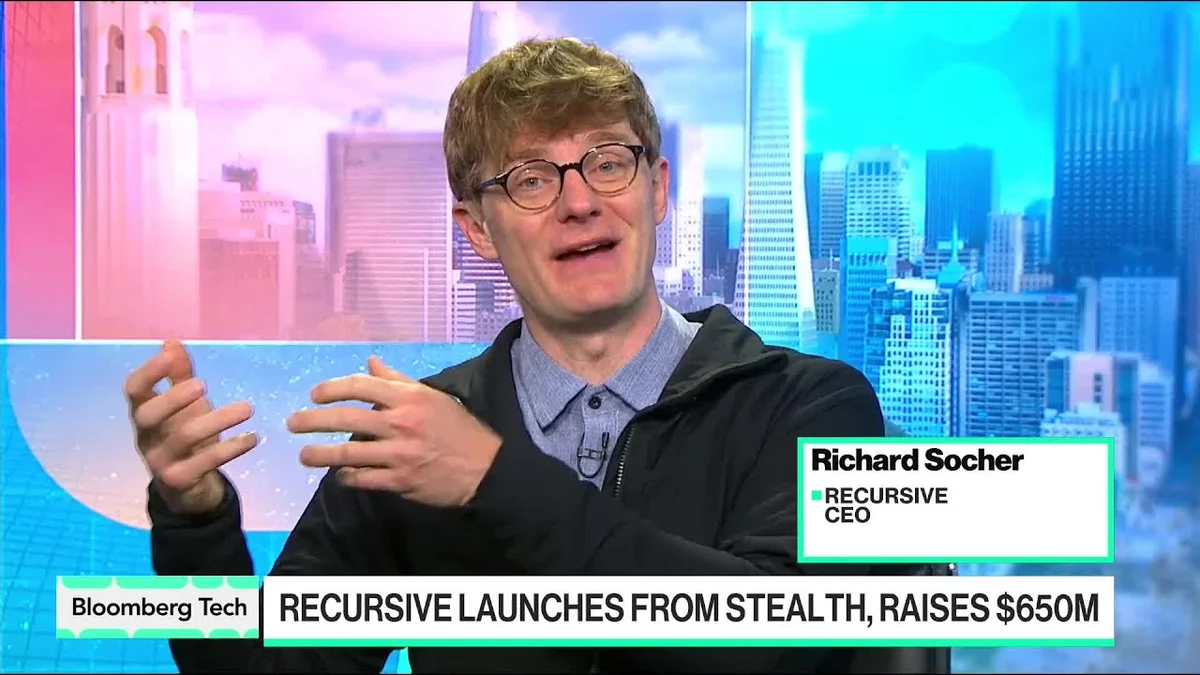
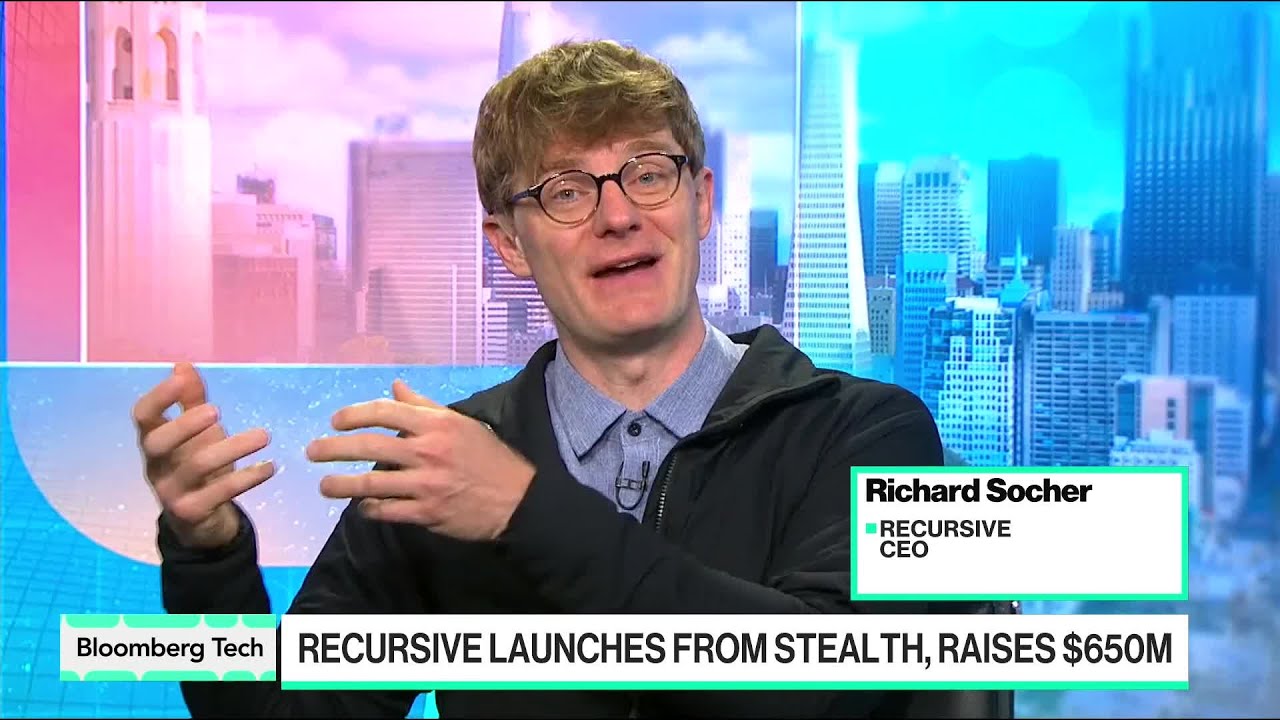
Richard Socher, CEO of Recursive AI, interviewed on Bloomberg Tech.
Image credit: Bloomberg· Bloomberg Technology
Visual TL;DR
Richard Socher (CEO)Core
Leading the vision for autonomous AI innovation
From the articleRichard Socher, CEO of Recursive AI, explained the core mission of the company: to build self-improving AI systems that can autonomously discover, implement, and validate new ideas.
Self-Improving AICore
AI that drives its own innovation and development
From the article 5 mentionsRecursive AI, a startup pioneering self-improving artificial intelligence, has emerged from stealth with a significant valuation of $4.65 billion.
Compute ChallengeDriver
Significant investment needed for advanced AI development
From the article 3 mentionsSocher acknowledged this, noting that compute is one of the largest costs for AI development.
Eureka MachineContext
AI capable of accelerating human progress
From the articleThis closed-loop system, where AI can iterate on its own development, is seen as the pathway to creating a 'eureka machine' that can accelerate human progress.
$650M+ FundingEffect
Substantial backing from prominent venture capital firms
From the article 4 mentionsThe company announced it has raised over $650 million in funding, with its latest round co-led by prominent venture capital firms GV and Greycroft.
$4.65B ValuationOutcome
Achieved significant market recognition and investor confidence
From the articleRecursive AI, a startup pioneering self-improving artificial intelligence, has emerged from stealth with a significant valuation of $4.65 billion.
Contents(5)

Recursive AI, a startup pioneering self-improving artificial intelligence, has emerged from stealth with a significant valuation of $4.65 billion. The company announced it has raised over $650 million in funding, with its latest round co-led by prominent venture capital firms GV and Greycroft. This substantial backing underscores the growing investor interest in foundational AI advancements.

The Vision of self-improving AI

Richard Socher, CEO of Recursive AI, explained the core mission of the company: to build self-improving AI systems that can autonomously discover, implement, and validate new ideas. Socher articulated that AI is increasingly becoming code itself, capable of generating and refining its own intelligence. This closed-loop system, where AI can iterate on its own development, is seen as the pathway to creating a 'eureka machine' that can accelerate human progress.

The full discussion can be found on Bloomberg Technology's YouTube channel.

Self-Improving AI Startup Recursive AI Valued at $4.65B - Bloomberg Technology
Self-Improving AI Startup Recursive AI Valued at $4.65B, from Bloomberg Technology

"We want to build recursive self-improving intelligence that automates knowledge discovery," Socher stated. He elaborated on the concept by explaining that the ability for AI to generate hypotheses, test them, and learn from the results is crucial. "AI is code, and can code, and can implement those ideas and validate those ideas," he added, highlighting the potential for AI to drive its own evolution.

The Compute Challenge and Strategic Backing

The pursuit of advanced AI, particularly self-improving models, is notoriously compute-intensive. Socher acknowledged this, noting that compute is one of the largest costs for AI development. Recursive AI has secured significant investment from key players in the semiconductor industry, including Nvidia (NASDAQ:NVDA) and AMD (NASDAQ:AMD). This strategic backing suggests a strong alignment with the hardware companies that power the AI revolution.

Socher emphasized that having a strong team with expertise from leading AI labs, including Google DeepMind, Meta AI, and Salesforce Research, is critical. He believes that by focusing on open-endedness and enabling AI to conduct its own experimentation, Recursive AI can build a new infrastructure for innovation. This contrasts with earlier approaches where human intervention was more heavily relied upon for AI development.

Equity and Talent Acquisition

When asked about the company's strategy for allocating its substantial funding, Socher highlighted the importance of equity and attracting top talent. He stated, "we do share equity with our employees and everyone, and I think that encourages everyone to be aligned with what we're creating." This approach aims to foster a culture where the team is deeply invested in the company's mission.

The CEO also noted the significant cost associated with hiring world-class AI talent. The substantial funding ensures Recursive AI can compete for and retain the best minds in the field, crucial for pushing the boundaries of self-improving AI. The company’s strategy is to build a team capable of not only developing advanced AI but also ensuring its safe and effective implementation.

The Future of AI Development

Recursive AI's focus on enabling AI to improve itself represents a significant shift in the AI development paradigm. By creating systems that can autonomously experiment and innovate, the company aims to unlock new levels of scientific discovery and technological advancement. The substantial funding and strategic partnerships with leading hardware providers position Recursive AI as a key player in the next era of artificial intelligence.

Frequently Asked Questions

What is recursive self-improvement in AI?

Recursive self-improvement refers to an AI system's ability to enhance its own capabilities. This process involves the AI analyzing its own code and architecture to identify areas for improvement, then modifying itself to become more efficient or intelligent. The goal is to create a cycle where each iteration of the AI is superior to the last, leading to rapid capability growth.

Is AI's recursive self-improvement an immediate concern?

The concept of recursive self-improvement is a subject of ongoing research and debate within the AI community. While theoretical advancements suggest it's possible, practical implementation faces significant technical hurdles. The timeline for achieving truly recursive self-improvement remains uncertain, with many experts focusing on current AI safety and alignment challenges.

Why is recursive self-improvement generating both excitement and concern?

The potential for recursive self-improvement promises transformative advancements in problem-solving and scientific discovery. However, it also raises concerns about control and alignment. An AI that can rapidly improve itself might outpace human understanding and oversight, leading to unintended consequences if its goals are not perfectly aligned with human values.

What are the implications of AI achieving recursive self-improvement?

If AI systems achieve recursive self-improvement, it could lead to an intelligence explosion, where AI capabilities rapidly surpass human levels. This could unlock solutions to complex global challenges, from disease to climate change. Conversely, it necessitates robust safety measures to ensure such powerful AI remains beneficial and controllable.

© 2026 StartupHub.ai. All rights reserved. You may not republish this article in full without a license. Search engines and AI research tools may crawl and summarize for reference. Bulk reproduction or model training requires a license. See our terms.
Daniel Singer

Written by

Daniel Singer

Editor, StartupHub.ai

Daniel Singer is the editor of StartupHub.ai, a technology expert and thought leader on AI and its applications across sectors, from fintech and healthcare to developer tooling and consumer software. He writes and tests the tools covered here thoroughly and regularly, and built StartupHub.ai to give founders, operators and buyers a clearer read on what they are actually being sold.