

Perplexity just kicked down one of the biggest doors in artificial intelligence. The AI search company announced today that it has developed and open-sourced a method for running massive, trillion-parameter models on standard Amazon Web Services (AWS) cloud infrastructure, a feat that was previously considered impractical.
This breakthrough effectively dismantles a critical barrier that has kept the most powerful AI models locked away inside elite research labs with bespoke, high-end hardware.
For years, a frustrating paradox has governed the cutting edge of AI. The most capable models, like Mixture-of-Experts (MoE) architectures with a trillion or more parameters, are so enormous they require the coordinated power of multiple computers to even exist. While solutions emerged for this multi-node problem, they were almost exclusively tailored for specialized, expensive networking hardware like NVIDIA’s ConnectX-7 with InfiniBand.
This created a two-tiered AI world. If you had access to a custom-built supercomputer, you could run the giants. If you were like most researchers, startups, or even large companies relying on the more generalized infrastructure of a cloud provider like AWS and its Elastic Fabric Adapter (EFA), you were out of luck. The techniques simply didn't translate, making deployments on the cloud prohibitively slow and costly. As Perplexity noted in its announcement, this lack of cloud portability has been a major bottleneck for the entire industry.
Bridging the Cloud Divide
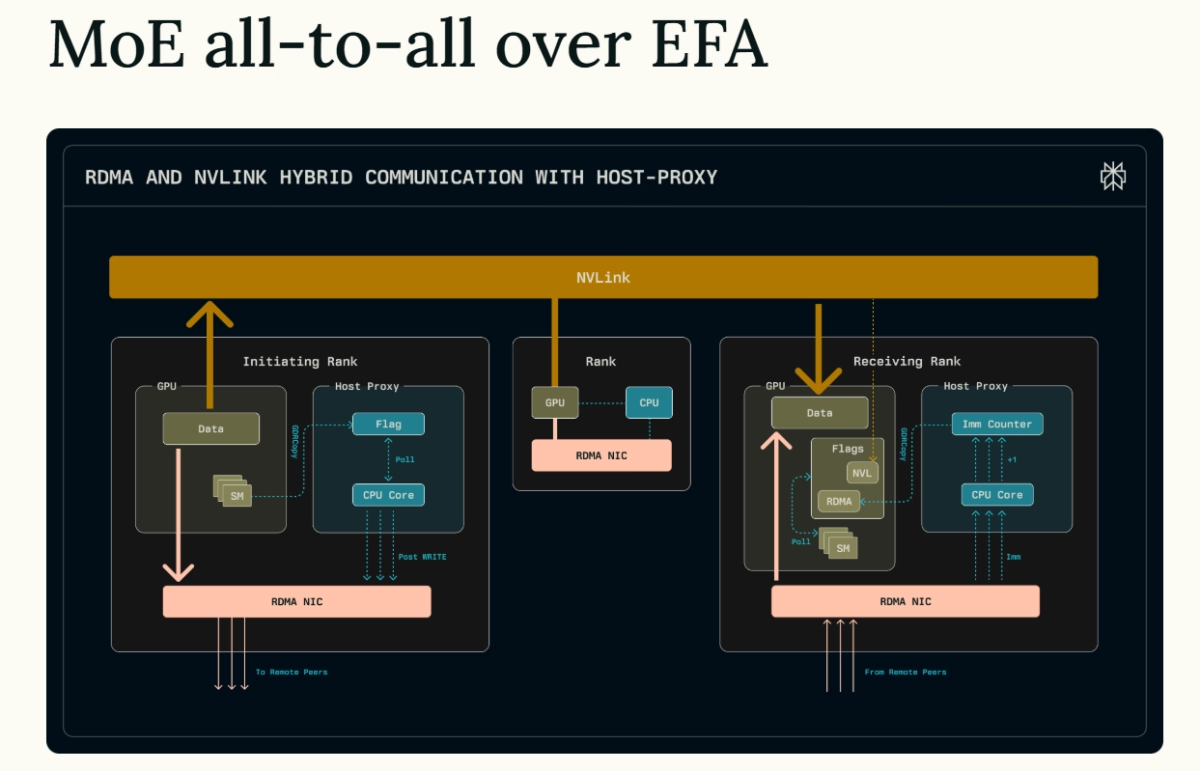
Perplexity’s solution, detailed in a new research paper, is a set of highly optimized software components called kernels. These kernels manage the incredibly complex task of routing data between different GPUs across multiple machines, a process central to making MoE models work. According to the company, their kernels are the first to achieve “viable performance” for this task on AWS EFA.