

OpenAI Funds AI Policy Projects

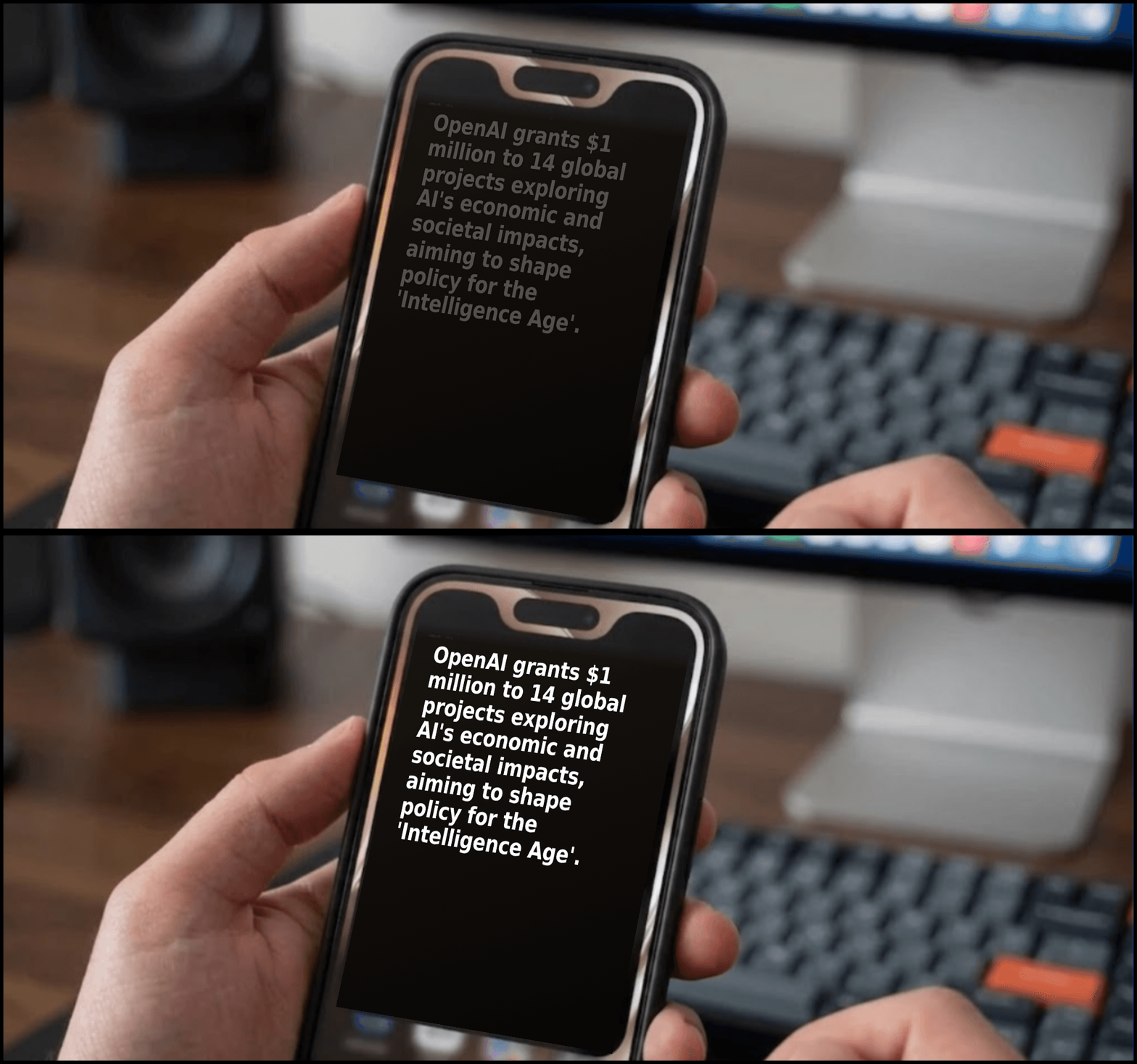
OpenAI grants $1 million to 14 global projects exploring AI's economic and societal impacts, aiming to shape policy for the 'Intelligence Age'.

OpenAI logo with a graphic representing global connections and data.
OpenAI News
Visual TL;DR
AI Capabilities AccelerateDriver
AI tools like ChatGPT reaching 1 billion users, capabilities accelerating rapidly
From the article 2 mentionsThese projects will investigate how AI can foster economic opportunity and bolster societal resilience as capabilities accelerate.
Need Proactive PolicyDriver
From the articleEnsuring AI's benefits are widely shared requires proactive policy decisions, not just incremental adjustments.
OpenAI Funds ProjectsCore
OpenAI grants $1 million to 14 global projects exploring AI's impacts
From the article 3 mentionsThe grants, detailed on OpenAI News, will fund 14 initiatives across the globe.
Shape AI PolicyEffect
aiming to shape policy for the 'Intelligence Age' based on research
From the article 9+ mentionsOpenAI is injecting $1 million into independent research projects aimed at shaping the policy response to advanced artificial intelligence.
Economic OpportunityContext
From the article 5 mentionsThese projects will investigate how AI can foster economic opportunity and bolster societal resilience as capabilities accelerate.
Societal ResilienceContext
From the article 4 mentionsThese projects will investigate how AI can foster economic opportunity and bolster societal resilience as capabilities accelerate.
Test OpenAI IdeasContext
From the articleThe initiative stems from OpenAI's April 2026 paper, "Industrial Policy for the Intelligence Age." It underscores a commitment to testing and building upon the company's own policy ideas.
Global InitiativesContext
14 initiatives across the globe, translating high-level concepts
From the article 5 mentionsThese initiatives are designed to translate high-level policy concepts into actionable research, practical frameworks, and testable prototypes.
Widely Shared BenefitsOutcome
From the articleEnsuring AI's benefits are widely shared requires proactive policy decisions, not just incremental adjustments.
Contents(4)

OpenAI is injecting $1 million into independent research projects aimed at shaping the policy response to advanced artificial intelligence. The grants, detailed on OpenAI News, will fund 14 initiatives across the globe. These projects will investigate how AI can foster economic opportunity and bolster societal resilience as capabilities accelerate.

The initiative stems from OpenAI's April 2026 paper, "Industrial Policy for the Intelligence Age." It underscores a commitment to testing and building upon the company's own policy ideas. With tools like ChatGPT reaching 1 billion users, OpenAI acknowledges that broad access is only part of the equation. Ensuring AI's benefits are widely shared requires proactive policy decisions, not just incremental adjustments.

Funding the Future of AI Governance

The $1 million in grants, along with up to $1 million in API credits, will support a diverse range of projects. These initiatives are designed to translate high-level policy concepts into actionable research, practical frameworks, and testable prototypes. Applicants were selected from over 400 proposals, indicating significant external interest in shaping AI's societal impact.

StartupHub.ai data shows OpenAI with a strong score of 86/100, reflecting its significant impact and valuation of $850 billion following a $100 billion funding round in 2026. Competitors like Anthropic (score 76/100) are also actively engaged in policy research, though OpenAI's broad grant program signals a unique commitment to fostering external expertise in this critical domain.

Broadening Economic Opportunity

Several projects focus on ensuring economic inclusivity in the AI era. The American Enterprise Institute will model AI's impact on the workforce, while the Centre for European Policy Studies examines the distribution of AI-driven productivity gains in Europe. The European Centre for International Political Economy plans to develop a framework for a "Right to AI," exploring ownership models beyond traditional employment.

Other initiatives include the Abundance Institute's work on energy infrastructure to support data center demand and the Progressive Policy Institute's design for a person-based benefits system. The Tax Foundation will analyze AI's impact on tax revenue, and Windfall Trust will convene national working groups on AI economic policy. In Brazil, IMPA will study research institutions' needs for AI integration, and HCFMUSP will evaluate AI-enabled clinical infrastructure for public hospitals.

Building Societal Resilience

Beyond economic considerations, a significant portion of the grants addresses safety and governance. The Institute for Security and Technology is developing a framework for measuring and responding to recursively self-improving AI systems. The Nuclear Threat Initiative will explore secure cross-border information sharing for AI-driven biological risks.

The Council on Strategic Risks aims to build institutional capacity in frontier AI safety among national security professionals. Nanyang Technological University is developing privacy-preserving AI agents for auditing government policy simulations. Yonsei University will investigate AI-enabled democratic accountability by assessing legislative oversight quality.

Why This Matters

OpenAI's move to fund independent policy research is a strategic play. As AI capabilities advance at an unprecedented pace, the societal and economic implications are profound. By seeding research outside its own walls, OpenAI is not only diversifying policy perspectives but also potentially preempting future regulatory challenges by proactively engaging with potential issues. This approach acknowledges that complex AI governance cannot be solved by one entity alone, especially in democratic societies.

The projects are slated to run for six months, with results expected in 2027. This funding injection is a critical step in ensuring that the upcoming "Intelligence Age" translates into broad-based prosperity and resilience, rather than exacerbating existing inequalities.

© 2026 StartupHub.ai. All rights reserved. You may not republish this article in full without a license. Search engines and AI research tools may crawl and summarize for reference. Bulk reproduction or model training requires a license. See our terms.
Daniel Singer

Written by

Daniel Singer

Editor, StartupHub.ai

Daniel Singer is the editor of StartupHub.ai, a technology expert and thought leader on AI and its applications across sectors, from fintech and healthcare to developer tooling and consumer software. He writes and tests the tools covered here thoroughly and regularly, and built StartupHub.ai to give founders, operators and buyers a clearer read on what they are actually being sold.