

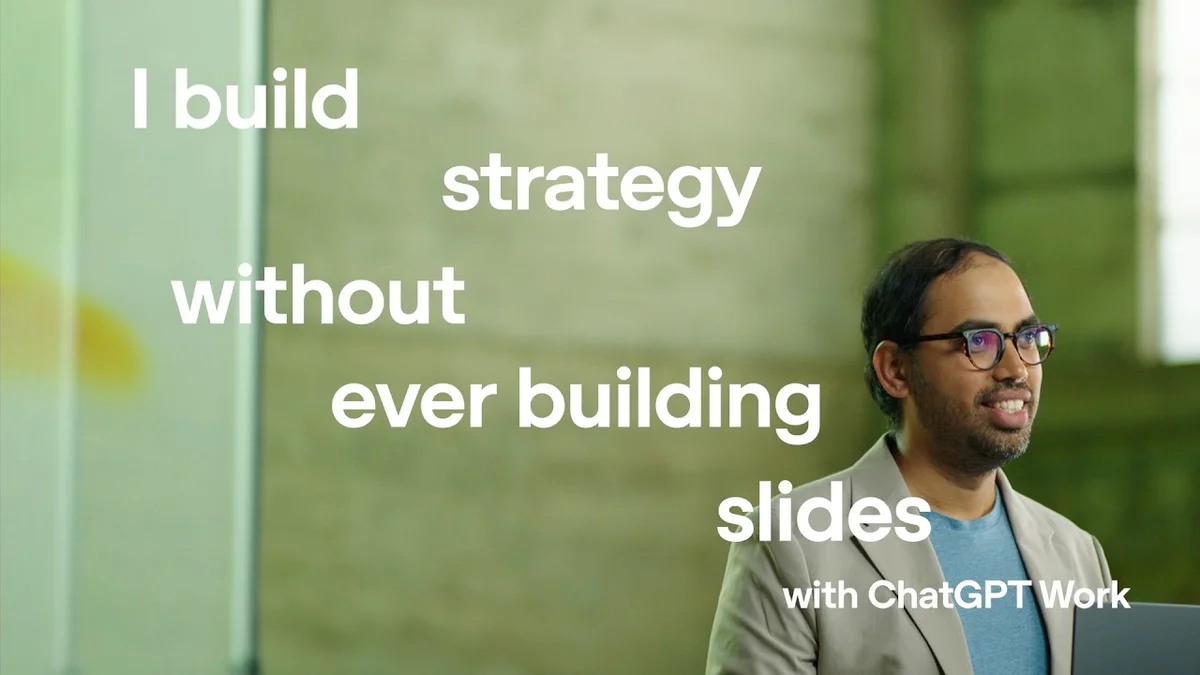
OpenAI Exec Shows ChatGPT Work for Strategy Decks

OpenAI's Arvind Vaitheeswaran demonstrates how to use ChatGPT Work to create business strategy decks, streamlining market prioritization and data analysis.

Arvind Vaitheeswaran from OpenAI presents a tutorial on using ChatGPT Work for strategy deck creation.
OpenAI Youtube
Visual TL;DR
Complex Business QuestionDriver
determining which Latin American markets to prioritize next for business expansion
From the article 3 mentionsArvind, who works in business strategy at OpenAI, has shared a tutorial demonstrating how to transform a complex business question into a fully formed strategy deck using ChatGPT Work.
Manual Data AnalysisDriver
previously took days to compile market research and customer trends manually
From the article 3 mentionsThis method significantly reduces the time previously spent on manual data compilation and analysis, a task that for Arvind used to take "days to pull together." The video highlights a streamlined workflow that guides users from initial inquiry to a polished recommendation readout.
ChatGPT Work ToolCore
OpenAI's Arvind Vaitheeswaran demonstrates its use for strategy deck creation
From the article 5 mentionsThe core of the demonstration revolves around a single, pivotal business question: "Which markets in Latin America should we prioritize next?" Arvind explains that the ChatGPT Work tool was instrumental in gathering and synthesizing market research, account data, customer trends, and previous strategy documents to construct a compelling recommendation deck.
Synthesizes Diverse DataContext
gathers market research, account data, customer trends, and past strategies
Streamlined WorkflowEffect
From the articleThis method significantly reduces the time previously spent on manual data compilation and analysis, a task that for Arvind used to take "days to pull together." The video highlights a streamlined workflow that guides users from initial inquiry to a polished recommendation readout.
Automated Strategy DecksOutcome
From the article 2 mentionsArvind, who works in business strategy at OpenAI, has shared a tutorial demonstrating how to transform a complex business question into a fully formed strategy deck using ChatGPT Work.
Significant Time SavingsEffect
reduces days of manual work to a much shorter, more efficient process
Contents(3)

Arvind, who works in business strategy at OpenAI, has shared a tutorial demonstrating how to transform a complex business question into a fully formed strategy deck using ChatGPT Work. This method significantly reduces the time previously spent on manual data compilation and analysis, a task that for Arvind used to take "days to pull together." The video highlights a streamlined workflow that guides users from initial inquiry to a polished recommendation readout.

From Business Question to Strategy Deck

The core of the demonstration revolves around a single, pivotal business question: "Which markets in Latin America should we prioritize next?" Arvind explains that the ChatGPT Work tool was instrumental in gathering and synthesizing market research, account data, customer trends, and previous strategy documents to construct a compelling recommendation deck. This end-to-end process underscores the AI's capability to handle complex analytical tasks.

The full discussion can be found on OpenAI Youtube's YouTube channel.

How to Turn a Business Question Into a Strategy Deck With ChatGPT Work | Tutorial - OpenAI Youtube
How to Turn a Business Question Into a Strategy Deck With ChatGPT Work | Tutorial, from OpenAI Youtube

The Workflow Explained

Arvind outlines a five-step process for utilizing ChatGPT Work:

  • 1. Open ChatGPT Work: The process begins by accessing the ChatGPT desktop app or web interface and switching to the "Work" mode.
  • 2. Define the Business Question: A clear, focused business question is the starting point. In this case, it was about prioritizing Latin American markets.
  • 3. Connect Your Data: This crucial step involves connecting various data sources through plugins. These can include tools like Google Drive, Slack, Salesforce, and internal data repositories. This allows ChatGPT to pull in relevant research, customer data, and past reports. Arvind also incorporates the company's slide template at this stage.
  • 4. Align on the Story: Before the final deck is built, Arvind asks ChatGPT to propose a storyline and a plan for the presentation. This ensures a coherent narrative structure.
  • 5. Refine and Approve: The final phase involves reviewing the AI-generated storyline, verifying the numbers and sources, refining the recommendations, and ultimately approving the final readout.

Arvind emphasizes that he uses ChatGPT Work because it can handle the task "end to end from analyzing data to producing reports." The output includes market context, customer analysis, supporting tables, and recommended next steps, presenting a complete business expansion readout.

Efficiency Gains and Future Implications

The tutorial showcases a significant acceleration in strategic planning. What previously took days of manual effort can now be accomplished much more efficiently, freeing up strategists to focus on higher-level analysis and decision-making. The integration of various data sources and the AI's ability to structure information into a presentable format are key takeaways. This approach suggests a future where AI assistants are integral to business strategy development, enabling faster and more data-driven decisions.

© 2026 StartupHub.ai. All rights reserved. You may not republish this article in full without a license. Search engines and AI research tools may crawl and summarize for reference. Bulk reproduction or model training requires a license. See our terms.
Daniel Singer

Written by

Daniel Singer

Editor, StartupHub.ai

Daniel Singer is the editor of StartupHub.ai, a technology expert and thought leader on AI and its applications across sectors, from fintech and healthcare to developer tooling and consumer software. He writes and tests the tools covered here thoroughly and regularly, and built StartupHub.ai to give founders, operators and buyers a clearer read on what they are actually being sold.