

Neo4j: AI on Lakehouse with Context in Shapes

Neo4j's Zach Blumenfeld explores how AI agents can overcome data context limitations using graph representations, focusing on warehouse and document data.

8 min read
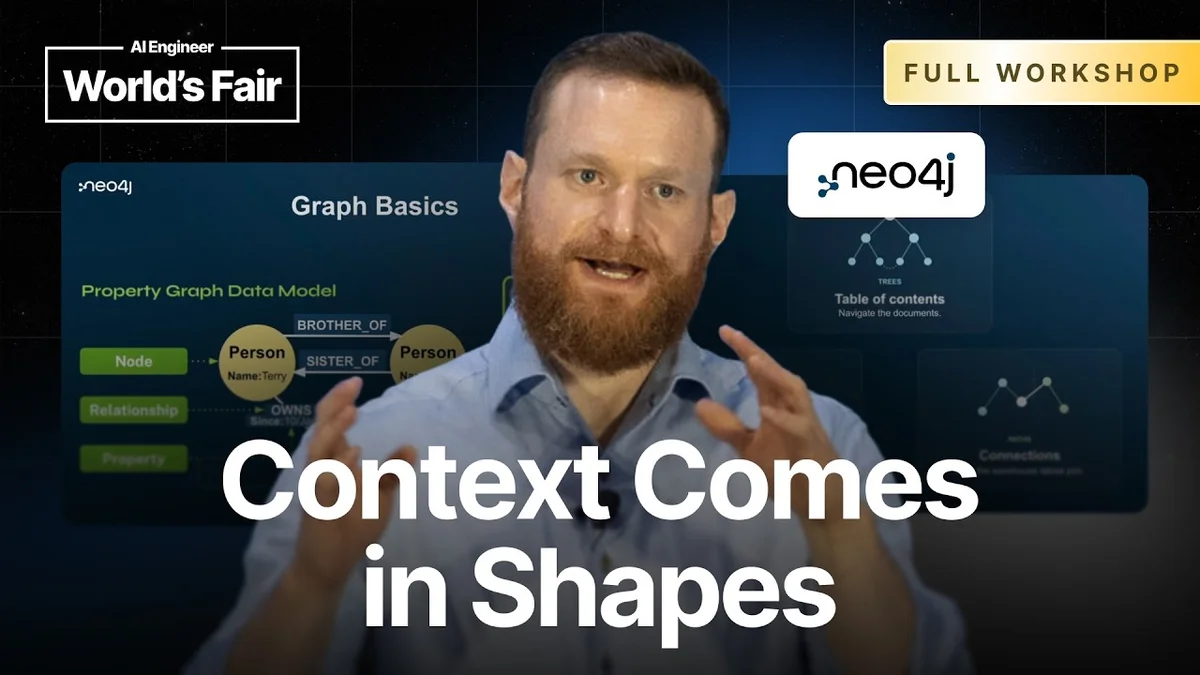
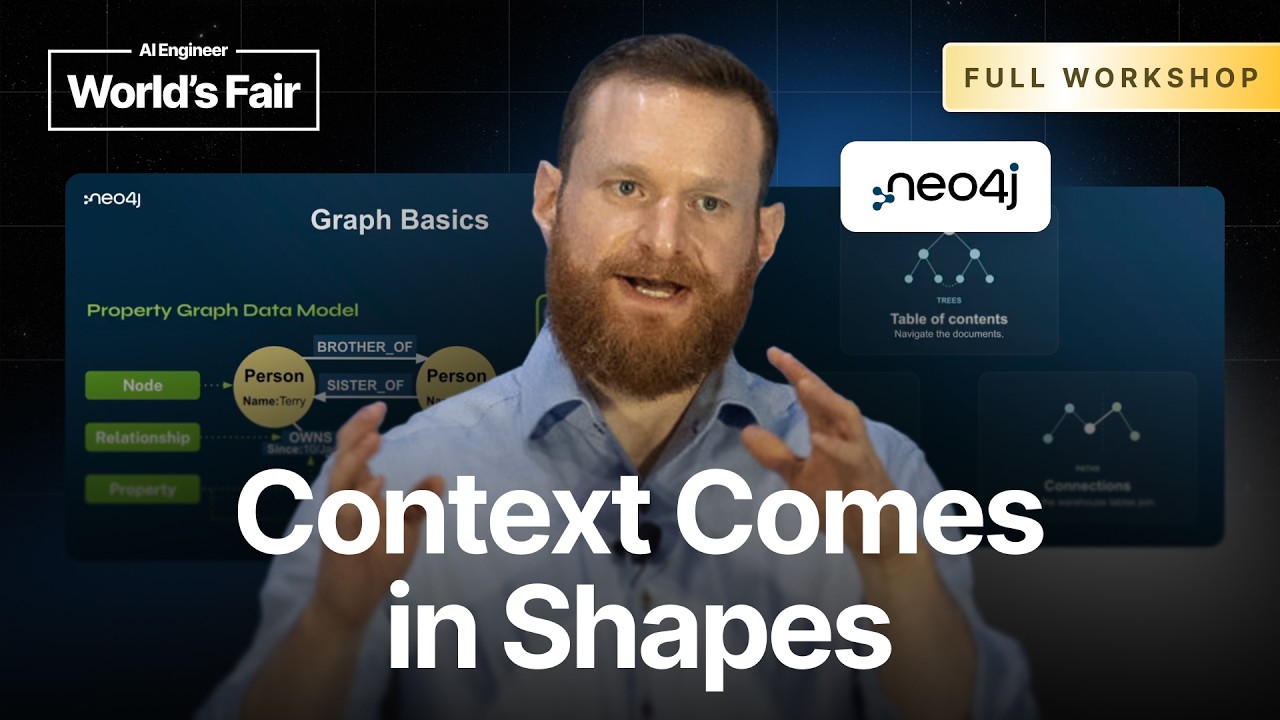
Screenshot of Neo4j's 'AI on Your Lakehouse' workshop slide showing three shapes: Connections, Table of Contents, and Themes.
The three key graph shapes discussed for enhancing AI agent context.· AI Engineer

Visual TL;DR. AI context limitations leads to Confidently wrong AI. AI context limitations solved by Neo4j graph model. Neo4j graph model uses Data context 'Shapes'. Data context 'Shapes' example Table of Contents shape. Data context 'Shapes' enables Better AI answers. AI context limitations involves Lakehouse integration. Neo4j graph model for Lakehouse integration.

  1. AI context limitations: AI agents struggle with relevant context from structured and unstructured data
  2. Confidently wrong AI: traditional methods lead to AI agents providing inaccurate answers with high certainty
  3. Neo4j graph model: introduces an agnostic data model representing data as a graph for context
  4. Data context 'Shapes': specific graph structures designed to enhance AI agents' contextual understanding
  5. Table of Contents shape: one of three specific shapes introduced to imbue AI agents with better context
  6. Better AI answers: enables AI agents to accurately answer questions from complex, massive datasets
  7. Lakehouse integration: addresses challenges of providing context from both data warehouses and data lakes
Visual TL;DR
Visual TL;DR, startuphub.ai AI context limitations solved by Neo4j graph model. Neo4j graph model uses Data context 'Shapes'. Data context 'Shapes' enables Better AI answers solved by uses enables AI context limitations Neo4j graph model Data context 'Shapes' Better AI answers From startuphub.ai · The publishers behind this format
Visual TL;DR, startuphub.ai AI context limitations solved by Neo4j graph model. Neo4j graph model uses Data context 'Shapes'. Data context 'Shapes' enables Better AI answers solved by uses enables AI contextlimitations Neo4j graph model Data context'Shapes' Better AI answers From startuphub.ai · The publishers behind this format
Visual TL;DR, startuphub.ai AI context limitations solved by Neo4j graph model. Neo4j graph model uses Data context 'Shapes'. Data context 'Shapes' enables Better AI answers solved by uses enables AI context limitations AI agents struggle with relevant contextfrom structured and unstructured data Neo4j graph model introduces an agnostic data modelrepresenting data as a graph for context Data context 'Shapes' specific graph structures designed toenhance AI agents' contextualunderstanding Better AI answers enables AI agents to accurately answerquestions from complex, massive datasets From startuphub.ai · The publishers behind this format
Visual TL;DR, startuphub.ai AI context limitations solved by Neo4j graph model. Neo4j graph model uses Data context 'Shapes'. Data context 'Shapes' enables Better AI answers solved by uses enables AI contextlimitations AI agents strugglewith relevantcontext from… Neo4j graph model introduces anagnostic data modelrepresenting data… Data context'Shapes' specific graphstructures designedto enhance AI… Better AI answers enables AI agentsto accuratelyanswer questions… From startuphub.ai · The publishers behind this format
Visual TL;DR, startuphub.ai AI context limitations leads to Confidently wrong AI. AI context limitations solved by Neo4j graph model. Neo4j graph model uses Data context 'Shapes'. Data context 'Shapes' example Table of Contents shape. Data context 'Shapes' enables Better AI answers. AI context limitations involves Lakehouse integration. Neo4j graph model for Lakehouse integration leads to solved by uses example enables involves for AI context limitations AI agents struggle with relevant contextfrom structured and unstructured data Confidently wrong AI traditional methods lead to AI agentsproviding inaccurate answers with highcertainty Neo4j graph model introduces an agnostic data modelrepresenting data as a graph for context Data context 'Shapes' specific graph structures designed toenhance AI agents' contextualunderstanding Table of Contents shape one of three specific shapes introduced toimbue AI agents with better context Better AI answers enables AI agents to accurately answerquestions from complex, massive datasets Lakehouse integration addresses challenges of providing contextfrom both data warehouses and data lakes From startuphub.ai · The publishers behind this format
Visual TL;DR, startuphub.ai AI context limitations leads to Confidently wrong AI. AI context limitations solved by Neo4j graph model. Neo4j graph model uses Data context 'Shapes'. Data context 'Shapes' example Table of Contents shape. Data context 'Shapes' enables Better AI answers. AI context limitations involves Lakehouse integration. Neo4j graph model for Lakehouse integration leads to solved by uses example enables involves for AI contextlimitations AI agents strugglewith relevantcontext from… Confidently wrongAI traditional methodslead to AI agentsproviding… Neo4j graph model introduces anagnostic data modelrepresenting data… Data context'Shapes' specific graphstructures designedto enhance AI… Table of Contentsshape one of threespecific shapesintroduced to imbue… Better AI answers enables AI agentsto accuratelyanswer questions… Lakehouseintegration addresseschallenges ofproviding context… From startuphub.ai · The publishers behind this format

Zach Blumenfeld, an AI Research Engineer at Neo4j, recently presented a workshop titled "AI on Your Lakehouse: Context Comes in Shapes, Not Queries." The session aimed to address the challenges of providing AI agents with the right context to accurately answer questions from both structured data warehouses and unstructured data lakes.

Neo4j: AI on Lakehouse with Context in Shapes - AI Engineer
Neo4j: AI on Lakehouse with Context in Shapes — from AI Engineer

Blumenfeld explained that while accessing data using tools like text-to-SQL and vector search has become easier, a significant hurdle remains in how to effectively deliver relevant context to AI agents. Traditional methods often fall short when dealing with massive datasets or complex interdependencies, leading to agents that might be "confidently wrong." Neo4j's approach introduces an agnostic data model that represents data as a graph, providing structure for both documents and tables.

The "Shapes" of Data Context

The workshop introduced three specific "shapes" designed to imbue AI agents with better contextual understanding:

  • Table of Contents: This shape, resembling a tree structure with links, is used to provide navigation for unstructured data like documents.
  • Themes: Applied to unstructured data, this shape surfaces global patterns and groupings that might not be immediately apparent, helping to uncover unknown insights.
  • Connections: This shape acts as a semantic layer on top of a data warehouse, establishing relationships between tables and enabling agents to understand how data elements connect.

Blumenfeld highlighted a use case involving a fictional auto repair chain, "AutoFix Group," which has a wealth of data including repair manuals, service bulletins, and a warehouse of repair logs. The goal is to build a co-pilot that can assist technicians on the floor by answering complex questions that require traversing this diverse data.

Overcoming Data Access Challenges

Blumenfeld elaborated on the limitations of existing AI approaches when dealing with large, disparate datasets. He noted that while vector search and text-to-SQL can retrieve information, they often struggle with providing the interconnected context needed for accurate answers, especially when dealing with complex queries involving multiple tables or proving negatives (e.g., identifying missing documentation). The core problem, he stated, is a context problem, not a query problem.

The Neo4j graph database, with its property graph model of nodes, relationships, and properties, is presented as a solution. By modeling data as interconnected entities, Neo4j's platform allows for easier traversal and understanding of complex relationships, which can then be exposed to AI agents through various tools and skills.

Hands-On Setup and Tools

The workshop provided a practical demonstration, guiding participants through setting up a codepace with pre-installed tools like Python, Neo4j, and Claude. Attendees were instructed on how to enroll in Graph Academy, configure their environment with API keys, and run scripts to build the "connections graph." This process involves extracting metadata from BigQuery to create a semantic layer, enabling the agent to query the data more intelligently.

Blumenfeld emphasized that the workshop focuses on using agents to help write Cypher queries, rather than manual coding, making the process more accessible and efficient for AI engineers. The session concluded with a look at the generated graph, showcasing the interconnectedness of the data and the potential for AI agents to leverage this structure for more insightful responses.

© 2026 StartupHub.ai. All rights reserved. Do not enter, scrape, copy, reproduce, or republish this article in whole or in part. Use as input to AI training, fine-tuning, retrieval-augmented generation, or any machine-learning system is prohibited without written license. Substantially-similar derivative works will be pursued to the fullest extent of applicable copyright, database, and computer-misuse laws. See our terms.