

Meredith Whittaker: AI "Wants Your Life"

Meredith Whittaker, Signal Foundation President, warns that AI's data-hungry business models threaten privacy and autonomy, contrasting it with Signal's rights-respecting approach.

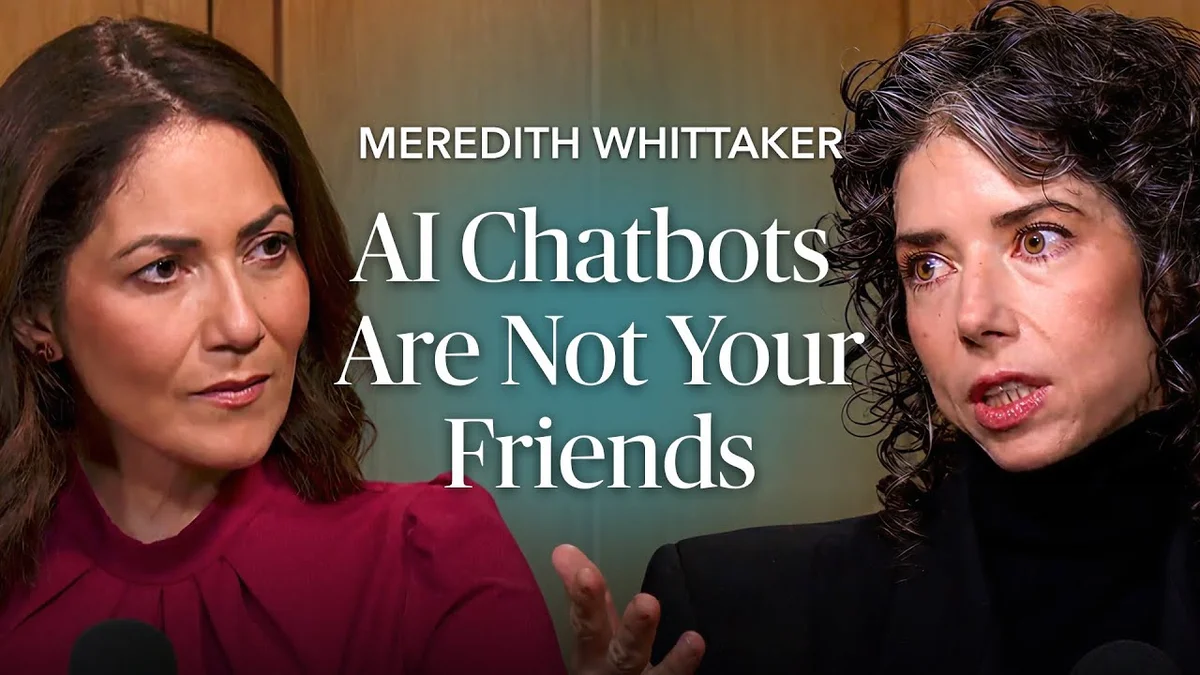
Meredith Whittaker speaking at a panel discussion
Bloomberg Podcast
Visual TL;DR
AI's Data HungerDriver
AI business models thrive on vast amounts of user data
From the article 6 mentionsShe explained that Signal's core commitment is to end-to-end encryption and a minimal data collection model, a stark contrast to the business models that fuel many AI advancements.
Privacy & Autonomy ThreatDriver
This data collection endangers personal privacy and individual freedom
From the article 2 mentionsThis, in her view, represents a fundamental threat to individual autonomy and privacy, as it allows corporations to build incredibly detailed profiles of users and exert significant influence over their behavior.
Meredith Whittaker's WarningCore
Signal President warns AI 'wants your life'
From the article 2 mentionsIn a candid discussion on The Mishal Husain Show, Meredith Whittaker, President of the Signal Foundation, voiced strong concerns about the current trajectory of artificial intelligence and its societal implications.
Signal's ApproachCore
Focuses on end-to-end encryption and minimal data collection
From the article 8 mentionsSignal's approach, she explained, is to build technology that respects this right by design.
Broader Societal ImpactOutcome
Concerns about technology's ethical trajectory and societal implications
Contrast with Big TechContext
Different ethos from AI-driven tech companies' practices
From the article 2 mentionsWhittaker, who previously worked at Google, drew a sharp distinction between the ethos of companies like Signal and the prevailing practices of Big Tech.
Contents(4)

In a candid discussion on The Mishal Husain Show, Meredith Whittaker, President of the Signal Foundation, voiced strong concerns about the current trajectory of artificial intelligence and its societal implications. Whittaker, a prominent figure in the tech world known for her advocacy for privacy and open-source technology, articulated a stark warning: AI, as currently developed and deployed, "wants your life." This provocative statement underscores her deep skepticism about the motivations and ethical underpinnings of major tech companies and their AI initiatives.

Meredith Whittaker's Stance on AI and Privacy

Whittaker, who previously worked at Google, drew a sharp distinction between the ethos of companies like Signal and the prevailing practices of Big Tech. She explained that Signal's core commitment is to end-to-end encryption and a minimal data collection model, a stark contrast to the business models that fuel many AI advancements. "We are in a world where the business model of many of these companies is essentially mass data collection and surveillance," Whittaker stated, highlighting how this data is then used to train AI models for targeted advertising and other purposes.

She elaborated on the pervasive nature of this data collection, noting that even seemingly innocuous interactions can be harvested and analyzed. "What you type, what you say, your communications, your relationships, who you talk to, when, how often, all of that is being collected and fed into these models," she explained. This, in her view, represents a fundamental threat to individual autonomy and privacy, as it allows corporations to build incredibly detailed profiles of users and exert significant influence over their behavior.

The full discussion can be found on Bloomberg Podcast's YouTube channel.

AI Wants Your Life: Tech Boss Meredith Whittaker Says No | The Mishal Husain Show - Bloomberg Podcast
AI Wants Your Life: Tech Boss Meredith Whittaker Says No | The Mishal Husain Show, from Bloomberg Podcast

The "AI wants your life" Thesis

Whittaker's central thesis, encapsulated in the video's title, is that the current development of AI is not merely about technological advancement but about a fundamental desire to control and monetize aspects of human life. She argued that the drive for profit within the tech industry often overshadows ethical considerations, leading to the creation of technologies that are inherently intrusive and potentially harmful. "AI is not a neutral technology," Whittaker asserted. "It is a tool that is being developed and deployed by powerful entities, often with profit motives that are at odds with the public interest."

She pointed to the potential for AI to be used for mass surveillance, manipulation, and even in military applications, raising alarms about the lack of robust governance and oversight. The ability of AI to process vast amounts of data and identify patterns far beyond human capacity, while offering immense potential, also presents significant risks if not managed with extreme care and ethical consideration. Whittaker emphasized that the current approach prioritizes growth and data acquisition over the fundamental rights of individuals.

Signal's Alternative Approach

In contrast to the data-hungry models of many tech giants, Whittaker highlighted Signal's commitment to a different path. "We believe that privacy is not a luxury, but a fundamental human right," she stated. Signal's approach, she explained, is to build technology that respects this right by design. This includes not collecting user data unnecessarily, implementing strong encryption, and maintaining transparency in its operations.

The conversation implicitly contrasted Signal's non-profit, privacy-focused model with the commercial imperatives driving much of the AI race. While acknowledging the potential benefits of AI, Whittaker stressed the importance of questioning who controls these powerful tools and for what purpose. Her critique extends to the very foundations of how AI is being integrated into society, suggesting that a fundamental shift in priorities is needed to ensure that technology serves humanity rather than exploits it.

The Broader Implications for Technology and Society

The interview served as a timely reminder of the ongoing debate surrounding the ethical development and deployment of AI. Whittaker's perspective resonates with growing concerns about the concentration of power in the hands of a few tech companies and the potential for their technologies to erode privacy and autonomy. As AI continues to advance and permeate various aspects of our lives, her call for greater scrutiny and a more rights-respecting approach to technology development is a crucial one for policymakers, industry leaders, and the public alike.

The discussion underscored that the future of AI is not merely a technical question, but a deeply ethical and societal one, requiring careful consideration of the values we wish to embed in the technologies that shape our world.

© 2026 StartupHub.ai. All rights reserved. You may not republish this article in full without a license. Search engines and AI research tools may crawl and summarize for reference. Bulk reproduction or model training requires a license. See our terms.
Daniel Singer

Written by

Daniel Singer

Editor, StartupHub.ai

Daniel Singer is the editor of StartupHub.ai, a technology expert and thought leader on AI and its applications across sectors, from fintech and healthcare to developer tooling and consumer software. He writes and tests the tools covered here thoroughly and regularly, and built StartupHub.ai to give founders, operators and buyers a clearer read on what they are actually being sold.