


Codex Creates Campaign Assets for Maison Fève

Discover how Codex AI generates campaign concepts and visual assets for brands like Maison Fève, streamlining marketing production.

4 min read
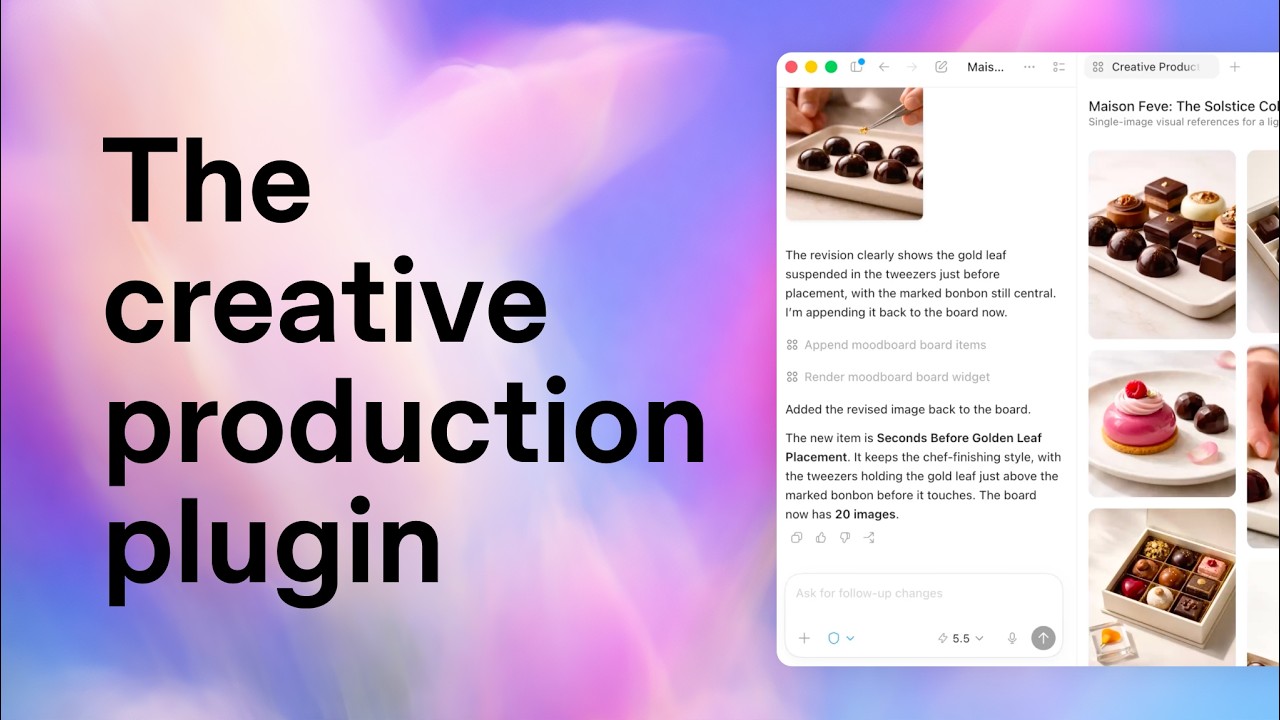
Screenshot of AI generating marketing campaign visuals for chocolates.
OpenAI Youtube

The video demonstrates how AI, specifically OpenAI's Codex, can be instrumental in creating campaign concepts and assets. This process is shown through a practical example involving a chocolate brand, Maison Fève, and their upcoming 'Solstice Collection' marketing campaign. The demonstration highlights how marketing professionals can leverage AI to accelerate and enhance their creative workflows, transforming initial ideas into tangible marketing materials.

Leveraging Codex for Creative Production

The workflow begins with a marketing professional interacting with a system that integrates Codex. The user specifies the need for campaign ideas for Maison Fève's 'Solstice Collection' marketing campaign, which is for their new premium chocolates. The prompt is designed to elicit creative concepts and visual references that align with the brand's desired aesthetic. This interaction showcases the conversational and prompt-driven nature of using AI for creative tasks.

The full discussion can be found on OpenAI Youtube's YouTube channel.
Related startups

Create campaign concepts and assets with Codex - OpenAI Youtube
Create campaign concepts and assets with Codex, from OpenAI Youtube

Developing Campaign Concepts and Visuals

Codex, integrated into a plugin, assists in generating a mood board for the 'Maison Fève Solstice Collection'. This involves defining the desired emotional response and visual elements for the campaign. The system prompts for attributes such as 'What should it make people feel?' with options like 'Quiet prestige,' 'Premium focus,' and 'Calm confidence.' It also asks 'What should show up visually?' with choices including 'Work surfaces,' 'Light trails,' and 'Editorial product scenes.' Finally, users can select 'Which creative lane feels closest?' such as 'Restrained luxury,' 'Warm and useful,' or 'Material detail.' These inputs guide the AI in generating relevant visual references.

Iterative Asset Generation and Refinement

The process is iterative. After initial visual references are generated, the marketing professional can refine them. For instance, an image of a chocolate being prepared with gold leaf is selected. Codex is then used to provide annotations, such as 'update to the seconds before the golden leaf is placed.' This allows for precise control over the generated imagery. The system then revises the image based on these annotations, creating a more refined visual asset. The AI also facilitates the creation of multiple variations and the addition of new items to the mood board, expanding the collection of visual references.

From Mood Board to Marketing Assets

Once a mood board is established, Codex and its associated plugins can be used to generate specific marketing assets. In the video, the next step involves creating a set of display ads for a 'Grand Opening' on June 2nd. The AI is prompted to create these ads using a revised hero image. The system then generates several ad tiles in different dimensions, such as 300x250, 336x280, and 728x90. These assets are presented as individual tiles on a mood board review surface, rather than a combined concept sheet, highlighting the flexibility of the output.

Integration with Design Tools

The generated assets are not final products but starting points. The video demonstrates how these assets can be exported and further edited in design tools like Canva. Codex can be integrated with Canva, allowing users to open the generated designs directly in the platform. This enables further manual edits, adjustments to visual strips, typography, and the overall campaign direction. The seamless transition from AI-generated concepts to professional design software underscores the practical application of Codex in a real-world marketing context.

Codex as a Creative Partner

The demonstration illustrates Codex's capability to act as a creative partner for marketing professionals. It not only generates initial ideas and visual concepts but also assists in refining those concepts and producing ready-to-edit marketing assets. This accelerates the creative process, allowing teams to explore more ideas and produce high-quality campaign materials efficiently. The ability to iterate and collaborate with the AI, as shown with the mood board revisions and ad creation, emphasizes its role in augmenting human creativity rather than replacing it.

© 2026 StartupHub.ai. All rights reserved. Do not enter, scrape, copy, reproduce, or republish this article in whole or in part. Use as input to AI training, fine-tuning, retrieval-augmented generation, or any machine-learning system is prohibited without written license. Substantially-similar derivative works will be pursued to the fullest extent of applicable copyright, database, and computer-misuse laws. See our terms.