

Codex Aids Black Hole Simulation Breakthrough

This video explores how the AI model Codex is revolutionizing the creation of black hole simulations, making previously intractable problems computationally feasible and accelerating astrophysical research.

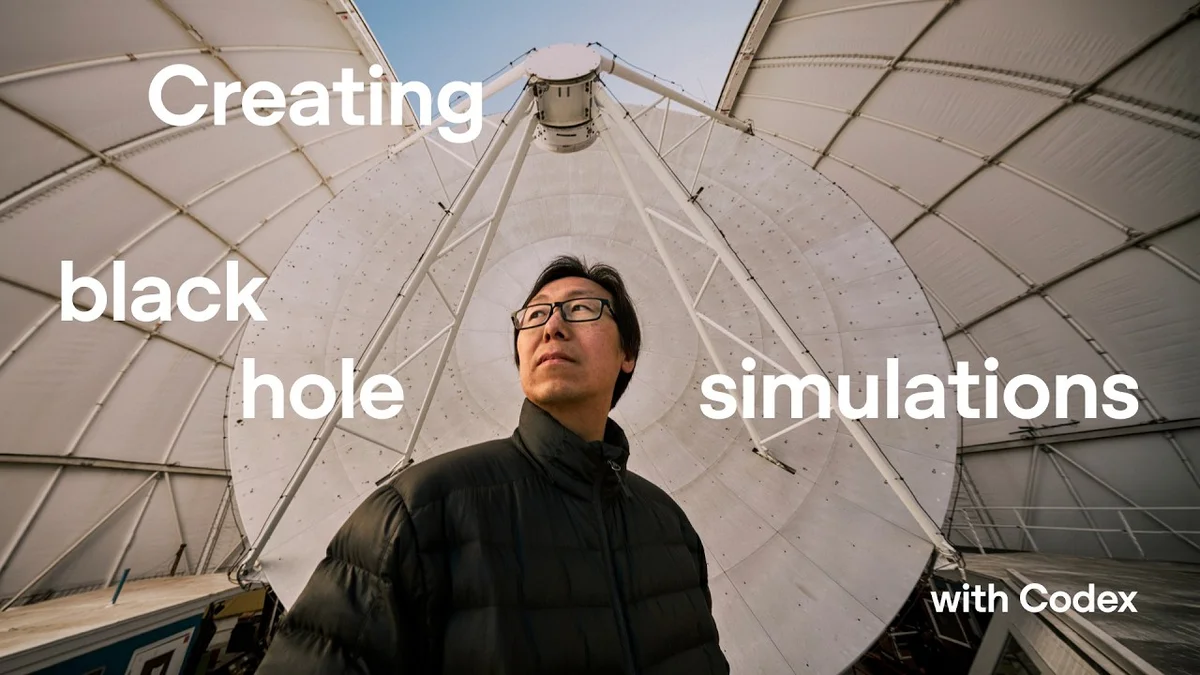
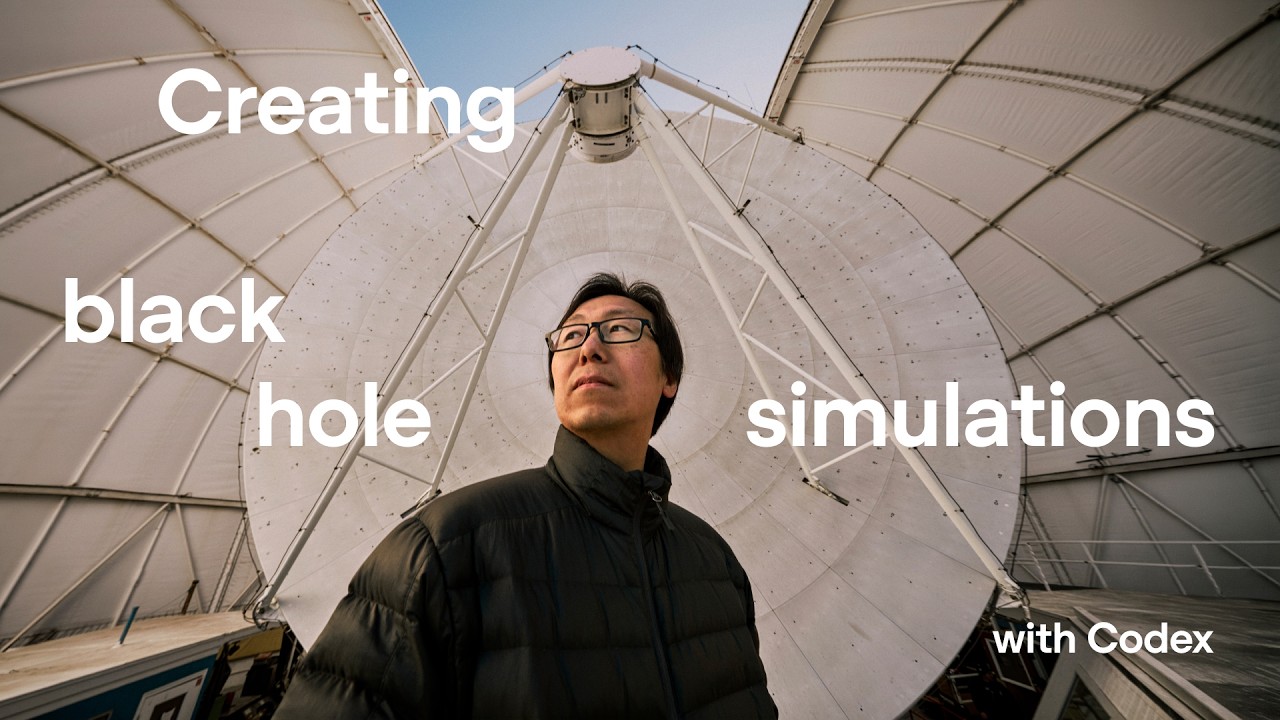
A person stands before a large radio telescope dome, with the text 'Creating black hole simulations with Codex' overlaid.
OpenAI Youtube
Visual TL;DR
Black Hole Simulation ChallengeDriver
modeling extreme physical conditions, plasma, magnetic fields, intense gravity
From the article 7 mentionsA new video titled Creating black hole simulations with Codex showcases how artificial intelligence is pushing the boundaries of astrophysical research.
Traditional Methods StruggleDriver
From the article 2 mentionsTraditional numerical methods often struggle with the stability and accuracy required for these simulations, making them time-consuming and computationally prohibitive.
Codex AI ModelCore
artificial intelligence model revolutionizing black hole simulation creation
From the article 8 mentionsThe presentation details the use of Codex, an AI model, to tackle complex computational problems in simulating black hole phenomena, a feat that has historically been limited by the immense computational resources required.
Tackles Complex ProblemsEffect
making previously intractable problems computationally feasible
From the articleThe presentation details the use of Codex, an AI model, to tackle complex computational problems in simulating black hole phenomena, a feat that has historically been limited by the immense computational resources required.
Accelerates ResearchOutcome
pushing boundaries of astrophysical research
From the article 2 mentionsThe research team involved in this work was part of the Event Horizon Telescope team, which captured the first image of a black hole, indicating a continued push in observational and computational astrophysics.
Advances UnderstandingOutcome
deeper insights into astrophysical phenomena
From the article 2 mentionsThese simulations provide crucial insights into the physics of black holes, phenomena that are difficult to observe directly but are fundamental to understanding the universe.
Contents(3)

A new video titled Creating black hole simulations with Codex showcases how artificial intelligence is pushing the boundaries of astrophysical research. The presentation details the use of Codex, an AI model, to tackle complex computational problems in simulating black hole phenomena, a feat that has historically been limited by the immense computational resources required.

Understanding the Challenge of Black Hole Simulation

Simulating black holes and their surrounding environments involves modeling extreme physical conditions, including the behavior of plasma and magnetic fields under intense gravitational forces. Traditional numerical methods often struggle with the stability and accuracy required for these simulations, making them time-consuming and computationally prohibitive. The video highlights that standard numerical schemes can be unstable, and finding the right algorithms to accurately model these extreme environments has been a significant challenge.

The full discussion can be found on OpenAI Youtube's YouTube channel.

Creating black hole simulations with Codex - OpenAI Youtube
Creating black hole simulations with Codex, from OpenAI Youtube

Codex as a Catalyst for Discovery

The video demonstrates how Codex is being utilized to overcome these limitations. By leveraging Codex, researchers can explore previously intractable problems. The AI assists in identifying and implementing new algorithms that are significantly faster and more stable than conventional approaches. For instance, the video mentions that Codex can achieve results in minutes that would have previously taken days or even weeks using traditional methods.

The process involves using Codex to understand the problem, plan the evaluation, and then select or generate appropriate algorithms. This AI-driven approach allows for the simulation of phenomena such as plasma falling into black holes and the behavior of magnetic fields near the event horizon. These simulations provide crucial insights into the physics of black holes, phenomena that are difficult to observe directly but are fundamental to understanding the universe.

Advancing Astrophysical Understanding

The ability to simulate these complex astrophysical events more efficiently is a significant step forward. The video suggests that by using Codex, researchers can now explore scenarios that were once considered computationally impossible. This acceleration in simulation capabilities is expected to lead to a deeper understanding of the universe, including the nature of black holes and their role in cosmic evolution. The research team involved in this work was part of the Event Horizon Telescope team, which captured the first image of a black hole, indicating a continued push in observational and computational astrophysics.

© 2026 StartupHub.ai. All rights reserved. You may not republish this article in full without a license. Search engines and AI research tools may crawl and summarize for reference. Bulk reproduction or model training requires a license. See our terms.
Daniel Singer

Written by

Daniel Singer

Editor, StartupHub.ai

Daniel Singer is the editor of StartupHub.ai, a technology expert and thought leader on AI and its applications across sectors, from fintech and healthcare to developer tooling and consumer software. He writes and tests the tools covered here thoroughly and regularly, and built StartupHub.ai to give founders, operators and buyers a clearer read on what they are actually being sold.