

Cloudflare Reimagines SDLC for AI Agents

Cloudflare proposes the Agent Development Lifecycle (ADLC), a new framework to manage AI-driven software development, moving beyond the traditional SDLC.

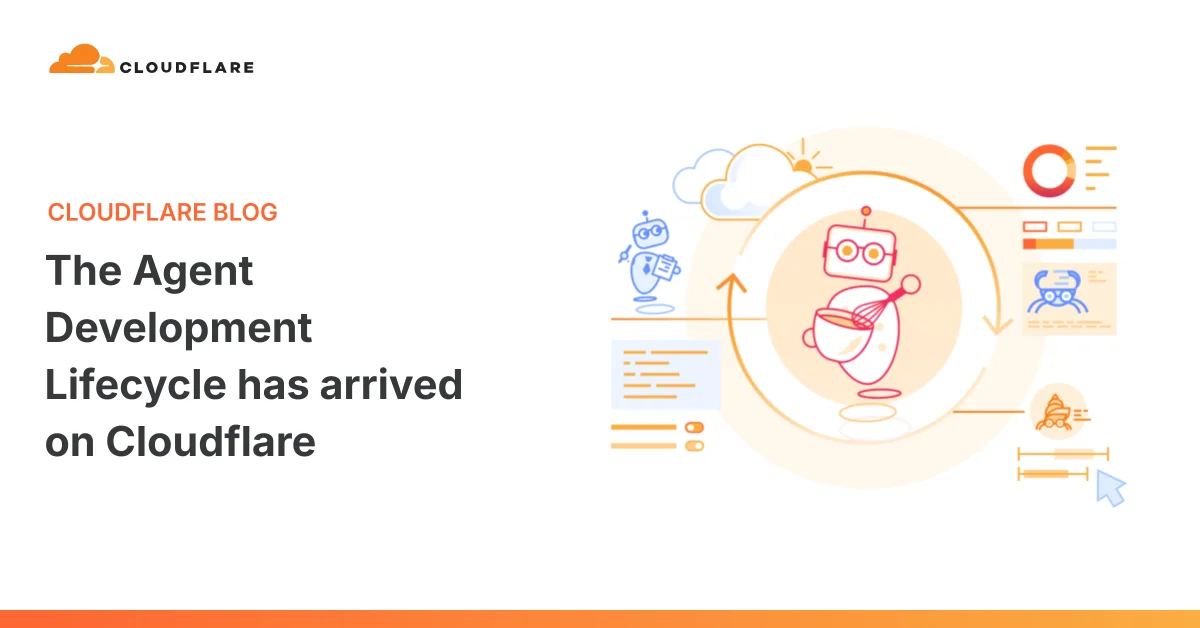
Illustration of Cloudflare's Agent Development Lifecycle concept
Cloudflare
Visual TL;DR
Traditional SDLCContext
decades-old framework for human collaboration on code, phases like plan, design, test
From the article 5 mentionsThe company announced the arrival of the Agent Development Lifecycle (ADLC) this week, a concept that moves beyond the traditional Software Development Lifecycle (SDLC) to better accommodate AI-driven development processes.
AI Speeds ImplementationDriver
AI agents make implementation phase faster and cheaper than ever before
From the article 3 mentionsThe company argues that the traditional SDLC, even with automation, doesn't scale for the volume of code AI can produce or the speed required in today's market.
Bottlenecks CreatedDriver
From the articleThis speedup, while beneficial, has created bottlenecks in the subsequent stages, overwhelming teams responsible for validation, deployment, and maintenance.
Cloudflare Proposes ADLCCore
new framework to manage AI-driven software development beyond traditional SDLC
From the articleWhile Cloudflare's announcement provides a compelling vision, the practical implementation details of the ADLC, particularly around agent governance, ethical considerations, and sophisticated debugging of agent-induced errors, remain areas for further exploration.
Agent Development LifecycleContext
accommodates accelerating pace and scale brought by AI agents in development
From the article 6 mentionsCloudflare views these agents as their own customers, capable of interacting with APIs to manage the full lifecycle of software development.
Empowers AI 'Customers'Effect
ADLC framework empowers AI agents as 'customers' in the development process
From the article 3 mentionsThis could free up human engineers to focus on higher-level tasks like system architecture, customer engagement, and strategic innovation.
Future Software FactoriesOutcome
shifts how software factories operate, adapting to AI-driven development
From the article 2 mentionsThe ADLC is envisioned as the lifecycle for "software factories", autonomous, agent-driven systems that manage software from input (like a bug report or feature request) to deployment and ongoing management.
Contents(5)

Cloudflare is proposing a new framework for software development, one that accounts for the accelerating pace and scale that AI agents can bring. The company announced the arrival of the Agent Development Lifecycle (ADLC) this week, a concept that moves beyond the traditional Software Development Lifecycle (SDLC) to better accommodate AI-driven development processes. This initiative is detailed in a recent Cloudflare blog post.

For decades, engineering teams have refined the Software Development Lifecycle (SDLC) to manage human collaboration on code. This process, tracing its roots back to the 1970s, typically includes phases like plan, design, implement, test, deploy, maintain, and retire. However, the advent of AI has dramatically shifted the balance, making the implementation phase faster and cheaper than ever before. This speedup, while beneficial, has created bottlenecks in the subsequent stages, overwhelming teams responsible for validation, deployment, and maintenance.

The core idea behind the ADLC is to acknowledge that AI agents can handle more than just code generation. Cloudflare views these agents as their own customers, capable of interacting with APIs to manage the full lifecycle of software development. This means agents can now be empowered to take on tasks beyond initial coding, extending into testing, deployment, and ongoing maintenance.

The ADLC: Empowering AI 'Customers'

Cloudflare's approach treats agents as sophisticated users with needs that mirror human developers. The company states, "We know that agents need APIs and tools to be able to manage the full SDLC on behalf of our customers, not just the start of it." This perspective necessitates platform capabilities that can support agents throughout their operational journey.

To facilitate this, Cloudflare is rolling out new tools: @cloudflare/ci, designed for high-volume CI/CD across millions of repositories with self-healing capabilities; and OpenTelemetry traces integrated into local development environments via Wrangler and the Cloudflare Vite plugin. This brings production-level observability to agents during development.

From SDLC to ADLC: A Shift for Software Factories

The company argues that the traditional SDLC, even with automation, doesn't scale for the volume of code AI can produce or the speed required in today's market. The ADLC is envisioned as the lifecycle for "software factories", autonomous, agent-driven systems that manage software from input (like a bug report or feature request) to deployment and ongoing management.

This shift requires platform features that are programmatic, horizontally scalable, and reproducible. "ClickOps", manual, point-and-click operations, is insufficient for agents. Every action must be API-driven, and every agent needs a production-like preview environment. Reproducibility, especially under complex conditions like simulated network throttling, is also paramount.

Industry Context and Competitive Landscape

Cloudflare's move into agent development lifecycle management aligns with a broader industry trend. Companies are increasingly exploring how to operationalize AI agents for complex tasks, moving beyond simple chatbots or code completion tools. The concept of a "software factory" is gaining traction as organizations look to automate more of their software delivery pipelines. StartupHub.ai data shows that while Cloudflare scores a strong 78/100, competitors like Akamai Technologies, Inc. (NASDAQ:AKAM) (score 75/100) and Fastly (NASDAQ:FAST) (score 50/100) are also active in the edge computing and developer platform space, though perhaps not as explicitly framing the ADLC.

Cloudflare itself, Cloudflare, Inc. (NYSE:NET), has a verified funding history of $2M in Seed funding in 2021, indicating a focused early investment in its development. Their deep integration into the internet's infrastructure positions them uniquely to manage these large-scale agent operations.

Why This Matters for Developers and Enterprises

The implications of the ADLC are significant. For developers, it means a potential shift from managing individual code commits to overseeing and guiding fleets of AI agents. This could free up human engineers to focus on higher-level tasks like system architecture, customer engagement, and strategic innovation. Enterprises stand to gain from faster development cycles, reduced operational costs, and more resilient software systems.

However, the ADLC also raises questions. How will security and compliance be managed when agents have greater autonomy? What new types of bugs or vulnerabilities might emerge from agent-driven development? Cloudflare acknowledges the challenge of enforcing engineering standards using AI, sharing their own experiences in this area. The vision is to move human effort towards tasks requiring inspiration, taste, and judgment, rather than constant oversight of mechanical steps.

Identifying Gaps and Future Outlook

While Cloudflare's announcement provides a compelling vision, the practical implementation details of the ADLC, particularly around agent governance, ethical considerations, and sophisticated debugging of agent-induced errors, remain areas for further exploration. The company has shared insights into how they enforce engineering standards and build software factories to manage issues, but the full spectrum of challenges and solutions for a truly autonomous ADLC is still being defined.

The transition from SDLC to ADLC signifies a fundamental rethinking of how software is built and managed in the AI era. It's a recognition that the tools and processes must evolve as rapidly as the technology they support.

© 2026 StartupHub.ai. All rights reserved. You may not republish this article in full without a license. Search engines and AI research tools may crawl and summarize for reference. Bulk reproduction or model training requires a license. See our terms.
Daniel Singer

Written by

Daniel Singer

Editor, StartupHub.ai

Daniel Singer is the editor of StartupHub.ai, a technology expert and thought leader on AI and its applications across sectors, from fintech and healthcare to developer tooling and consumer software. He writes and tests the tools covered here thoroughly and regularly, and built StartupHub.ai to give founders, operators and buyers a clearer read on what they are actually being sold.